Henry's Crime (2011)
Director: Malcolm Venville
Writer: Sacha Gervasi, David White, Stephen Hamel
Cast: Keanu Reeves, James Caan, Vera Farmiga, Judy Greer, Fisher Stevens, Danny Hoch, Bill Duke, Peter Stormare
Time: 108 min.
Rating: R
Here's a novel idea: have Keanu Reeves play a man who has a great natural talent in acting. What were they thinking? Now that his boyish good looks and physique are behind him, is there still an audience who forgives him his thespian shortcomings? Add to that, for a bank heist film, the necessary convoluted and exacting plot not only isn't there, but in its simplicity is obviously doomed to failure. We forensics-and-investigatory-techniques-savvy viewers, release little moans of disappointment throughout the course of this crime.
Henry (Reeves) has spent the last few years in prison for a crime he didn't commit because he wouldn't rat on his friends who actually did attempt the bank heist. He figures out during his sentence that he should commit the crime since he already did the time -- not for the money, but for the sense of |

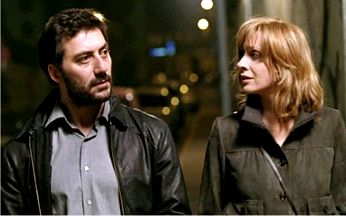
Farmiga, Reeves and Caan plotting.
|
completion. The history and even floor plan to a tunnel that runs between the bank and an adjacent theater fall into view a bit too conveniently. Let's call it providence. Henry's half way there. He wants to recruit his prison cell mate, Max (James Caan) to help. Max can be paroled at his next hearing, as in many of the previous ones, but he always choose to remain in the ordered, safe life behind bars. But Henry convinces him to join the caper. To gain access to the theater where the tunnel starts, Henry must win a part in the play in rehearsal, 'The Cherry Orchard,' by Chechov. I gasp in the scene where he gets it. He also falls for the lead, Julie (Vera Farmiga). So, everyone knows his name, and once the deed is done he would obviously be on the 10 Most Wanted list and on and on. Very little entry plan and no exit strategy. That's not why we go to a heist movie. This is no 'Oceans 2.'
And still, the film was entertaining due to Vera Farmiga's energy as the cold hearted, ambitious actress and James Caan as the confidence man who'd rather live out his days in the basic comforts of prison rather than brave freedom. Then, there's also beautiful Buffalo as the backdrop.
Your Highness (2011)
Director: David Gordon Green
Writer: Danny McBride, Ben Best
Cast: Danny McBride, James Franco, Natalie Portman, Zooey Deschanel, Justin Theroux, Toby Jones, Charles Dance, Rasmus Hardiker
Time: 102 min.
Rating: R
Bawdy, foul mouthed and tremendous fun, this fairy tale is definitely not for children. Yes, the king has two sons: one a hero, the other a jealous, lazy, cowardly loser. The good son has already killed the evil cyclops and rescued the damsel he is about to marry, but an evil wizard recaptures her. The quest is on, but the king orders his lout of a son to go with the noble son on his quest to re-save the damsel. Nice basic structure on which to hang the tale. But there are constant sexual references, endless cursing, naked women and men, sexual situations. And it's all absolutely necessary to the plot which raises the standard fantasy to a new level of raucous hysteria. Even the sailors in the audience will say, 'Did he really say that?' 'Did that actually happen?' 'Did I just see what I saw when they undressed that funny looking man?' 'Is that really hanging around the Prince's neck?'
|
|
The words flow effortlessly from the actors' mouths as if they were all native New Yorkers. Curses are an integral part of the vocabulary in the Big Apple and mostly used to accentuate mood; it's a natural part of conversation. Contrarily, in my previous review of 'Paul,' I stated the use of foul language was a joke that was repeated ad infinitum to express a woman's liberation from organized religion. But that rather unimaginative joke caused an R rating which eliminated a large potential audience, and it just wasn't worth it. But in 'Your Highness,' imbuing the otherwise Medieval dialogue with modern epithets was daring, shocking and humorous. The R rating is firmly embedded in plot in any case.
Aside from dialogue and bawdy behavior, the Scottish hillsides where the film was shot is as beautiful and magical as Middle Earth or New Zealand. The detailed sets keep the eye involved. The story takes us to unexpected places filled with unforeseen dangers and laughs. The characters, based on fairytale icons, break out of the mold to be fresh, interesting and engaging. Okay, I want a copy of this film for my personal library.
Poetry
Director/Writer: Lee Chang-dong
Cast: Jeong-hie Yun, Lee David, Ahn Nae-sang, Kim Hi-ra,
Time: 139 min.
This is a story about a 66 year old woman, a rarity in cinema and almost always a foreign film, in this instance, Korean. Mija is poised, elegant, quiet, even serene. She hints her life was full of many varied experiences she need not repeat. She goes about her present daily life -- taking care of her slug of a grandson, housecleaning and tending to a man disabled by a stroke -- with a conscious appreciation and awareness of her surroundings. It is no surprise that she decides to enroll in a cultural center poetry class. She would like to put into words her appreciation for the beauty around her. Therefore, she begins to take even closer scrutiny of her surroundings and takes notes, hoping to construct the words to how she feels. |
|
Even her pensive observations of trees and apples fill the dark void of a movie theater; we allow her silent wanderings through nature to overtake us. Unfortunately, her equanimity is thrown off kilter by events in her life and that of her (did I say?) slug of a grandson. It would be unfair to say what these two events are, but they are devastating to her. How she deals with them is the crux of the film. While solving one problem and ignoring the other, she continues to strive to fulfill herself by simply writing a poem.
As lovely a film and as mesmerizing its star (recently voted the greatest actress in Korean cinema in a public poll), the film drags. Easily, a half hour could be shaved, and all of it poetry readings. I truly don't believe I reach this conclusion because I am a Luddite who doesn't appreciate poetry, which I admit, but because it's not poetry at all, but anecdotal stories from insignificant characters, and there's just to much of it. I can say the final poem written my our lead character is worth the wait. If I may borrow from the Japanese, this film can be compared to Haiku -- in its simplicity of spirit and depth of human experience.
In A Better World (Hæven)
Director: Susanne Bier
Story: Susanne Bier, Anders Thomas Jensen
Writer: Anders Thomas Jensen
Cast: William Jøhnk Nielsen, Markus Rygaard, Mikael Persbrandt, Trine Dyrholm, Martin Buch, Wil Johnson
Time: 113 min.
Rated: R
Anton (Mikael Persbrandt) is a doctor who works in an African refugee camp, where he encounters heart wrenching senseless violence. He commutes to Denmark on a regular basis to be with his family -- a wife (Trine Dyrholm) who is contemplating divorce and his two sons. The contrast between the two cultures is extreme: a harsh desert inhabited by homeless tribes people seeking medical treatment, the necessities of life, and protection from marauders who mercilessly slaughter innocent people for the fun of it; compared to verdant, moist Denmark. There, his heart is breaking because his wife is not able to forgive him his transgression. It |
|
seems his only other problem is his older son, Elias, who is trying to deal with a school bully. Otherwise, Anton can relax by the lake at his country home, enjoy spending time with his sons and generally regroup for his next intense stay in Africa.
Yet, we learn these two cultures have the same undercurrents motivating their citizens. There is unprovoked evil around us all; there is the deep-seated need for retribution; there is always and everywhere these darker examples of the human condition. And Anton desperately desires to rise above these baser human instincts.
Through the interactions of his son, and his new school friend, Christian (William Johnk Nielsen), we find a microcosm of these instincts. Christian's mother has recently died and he becomes angry and remote. His father, Claus (Ulrich Thomsen) can't reach him. Actually, it seems both fathers' attempts at reaching their sons, putting them on the 'right' path and regaining parental authority and intimacy are thwarted. One example. Christian pummels the school bully after he is once hit by him. His father tries to explain this is no solution. Fighting just leads to more fighting. Christian responds that Claus doesn't know *^$#. In every new school he has attended, he had to fight the biggest bully. Then he is never bothered again. And that's how it really is.
Perhaps he's right. Perhaps both dads are idealists who have somehow survived in the more advanced societies of Western Europe, but again, they also may have to confront their own ideals, bite the bullet and just do what has to be done.
This is a subtle and fascinating study in the roots of culture and how far modern society has taken us. The young boys are both brilliant in their roles. Christian was particularly powerful as a boy on the cusp of becoming a bad seed and reminded me of his namesake Christian Bale as a child of the same age in 'Empire of the Sun' (1987). And that's saying a lot, especially this being his first film!. Markus Rugaard as Elias perfectly captured the vulnerable boy in flux -- witnessing his family breaking up, dealing with the violence of a relentless bully, deciding to hold onto his best ever friendship or not based on his morals and fears. 'In A Better World' truly deserves its Best Foreign Film Academy Award. It should not be missed by anyone living among others (not necessary for hermits) and has a lot to say directly to fathers.
Hop
Director: Tim Hill
Writer: Cinco Paul, Ken Daurio, Brian Lynch
Cast: James Marsden, Russell Brand, Hank Azaria, Gary Cole, Elizabeth Perkins, Hugh Laurie, David Hasselhoff
Rating: PG
'Hop' is a film that children will surely enjoy. The candy factory is more cheerful and in some aspects even more spectacular than Willy Wonka's, which was ominous. The Easter Bunny (Hugh Laurie) is a kindly gentleman rabbit who is eager to pass on his duties to his son (no child abuse in this candy factory), E B (Russell Brand). But there's a problem in this holiday workshop -- E B would rather be a rock drummer than the bringer of joy in the form of sweets to children 'round much of the world. |
|
This film is even more bereft of any religious connotation to the Easter holiday than Santa Claus movies are to the original meaning of Christmas -- something to do with the life and death of Jesus. No matter. Here, we're going back to the original pagan pleasure principle of fertility and partying -- eggs and sweets. Seems E B has a better understanding of the holiday than his father. He leaves the underground sweets factory in Easter Island and goes to Hollywood to gratify his desires -- rock 'n roll. And to help him in his quest, he recruits Fred O'Hare (get the pun?) (James Marsden) who is the perfect sidekick to talking, computer-generated creatures, much as Dave (Jason Lee) is to the Chipmunks (Alvin and the Chipmunks - 2007), which coincidentally was directed by 'Hop' director Tim Hill. Both Dave, companion to chipmunks, and Fred, bunny pal, learn many life lessons along the way, most a little too subtle for children to pick up on. In 'Hop,' fatherly love and acceptance is one for the parents in the audience to heed.
Along the way, the pink beret ninja bunnies try to apprehend the errant rabbit, there's an audition for David Hasselhoff, a coup d'etat takes place back on Easter Island, and eventually aimless, jobless Fred finds his true calling. The details of each of these adventures and the interplay of all the characters bring these computer generated souls, plus Fred, to life with exuberance and joy.
Rubber
Filmmaker: Quentin Dupieux
Cast: Stephen Spinella, Jack Plotnick, Wings Hauser, Roxane Mesquida, Ethan Cohn, Charley Koontz, Daniel Quinn
Time: 85 min.
Early on in 'Rubber,' the Sheriff offers a lengthy monologue directly to the camera about how so many movies include issues that just have no reason to them. 'Why was ET brown?' 'Why did the two leads in 'Love Story' love each other?' 'Why did some stranger shoot Kennedy in 'JFK'?' Okay, the Sheriff's logic is faulty in the third instance, but his point is that the audience should not expect any reason for what is to follow -- being a tire lying in a heap of garbage in the desert waking up and starting to roll. Add to this unreasonable situation a group of about dozen people standing a safe distance away from the exploring tire watching him with binoculars like a modern day Greek chorus. There is also no reason for this or, actually, for the tire's actions that follow or the fate of the observers -- who in many respects seem to be waiting for Godot. |
|
Being told up front that the film is an absurdist exercise frees us to watch and enjoy without belaboring WHY. There is no why. We simply watch, like our binoculared brethren, as Robert the tire, responds to spider, scorpion, plastic bottle, glass bottle, rabbit, black bird and eventually humans. His consciousness may be expanding as his experience does, but we are offered little as to his motivations or feelings -- except of course, anger. Don't get Robert mad!
Shot on a Canon 5D digital camera, the film, amazingly, has a very finished, professional and beautiful look to it. Also, It's hard to believe Robert was not actually alive, but with remote control mechanisms and a little magic, it didn't look at all corny and one could suspend one's disbelief -- a bit.
We've all heard about the mysterious disappearance of honey bees throughout the world in news reports and specials on the subject. Yes, mysterious because there seems to be no reason for it. Is it alien abduction or have the bees abandoned the earth much as the dolphins did in Douglas Adams' 'Hitchhikers Guide to the Galaxy," predicting the end of the planet? It all seems so romantic and foreboding. What will the world do without cross-pollination? The bees' flower dance is responsible for 40% of the food we eat. What will we do without honey -- the most healthful of all sweeteners?
Multi-award-winning Taggert Siegel, director of 'The Real Dirt on Farmer John' (2005), takes on what seems to be a daunting task of finding out what has actually happened to the bees. As it turns out, many people, experts in their various scientific and agricultural fields, are willing to tell him exactly the causes of their disappearance. It is a multi-pronged problem, and the reason it has probably remained untold to this point is that humans are 100% responsible for it. The explanations are clear and precise, and it's fascinating. But not only does this documentary explain how the problems arose, causing colony collapse disorder (5 million empty hives thus far at 50,000 to 60,000 bees per hive never to be re-inhabited), but offers solutions.
This beautifully shot film is also a loving, poetic and historic tribute. Siegel travels to locations throughout the world where agronomists, beekeepers and gardeners express their respect and admiration for bees from their lifestyle of total cooperation for the good of the hive to the benefits humans have reaped from their vital place in the ecosystem.
Winter in Wartime (2011)
Director: Martin Koolhoven
Writer: Martin Koolhoven, Paul Jan Nelissen., Mieke de Jong, from the novel by Jan Terlouw
Cast: Martijn Lakemeier, Yorick van Wageningen, Jamie Campbell Bower, Raymond Thiry, Melody Klaver
Time: 103 min
Rated: R
There are still stories to be told about World War II that are unique and powerful, that reflect the human condition through an individual's experiences and actions. In 'Winter in Wartime,' we hone in on one 13 year old boy living in occupied Holland. It is the last winter of World War II, and clandestine radio reports are predicting an end to the war soon. At first, Michiel is making the best of the Nazi presence in his town. He and his friend still have the freedom to ride their bikes through the countryside and even mischievously explore a downed fighter plane. Not totally oblivious to the political situation, he resents that his father, the mayor of the town, who seems to cooperate and even outwardly enjoy the company of the Nazis. |

Michiel (Martijn Lakemeier) learns the brutality
of the Nazis the hard way. |
Michiel becomes entangled in a dangerous situation in trying to help the British pilot of that very downed plane. Once the decision is made to help, the boy quickly become a man. He must decide who to trust, what to do, and how to accept the sacrifices he must make, as well as the losses he much accept.
The story is told from the young boy's perspective -- naively, simply, as pure as the snow that constantly cleanses the town and nearby forests. But as the film progresses, situations become more complex. Even the over-ridingly simple concepts, such as all Germans are the evil enemy, are confounded when one German soldier puts his own life at risk to save Michiel. The choices he has to make become more difficult as he becomes wiser and stronger.
'Winter in Wartime' is a unique perspective on wartime occupation and the pressures that change people, and children, into heroes, traitors, victims, and cowards. The acting is direct and deeply moving. No histrionics, just simple portrayals of common people in a small town trying to survive, principals in tact, under extreme conditions. The cinematography juxtaposes the beauty of the gently falling snow with the immovable force of the enemy occupiers.
29th San Francisco International Asian American Film Festival (2011)
The Center for Asian America Media presents the San Francisco International Asian American Film Festival (SFIAAFF) every March. The SFIAAFF is the largest and most prestigious showcase for new Asian American and Asian films in North America, annually presenting approximately 120 works in San Francisco, Berkeley and San Jose. Since 1982, the SFIAAFF has been an important launching point for Asian American independent filmmakers as well as a vital source for new Asian cinema. Some of the films I've seen:
Surrogate Valentine (USA)
Goh Nakamura (in real life and in this film) is a guitarist/singer/music teacher who travels up and down the West Coast from his home base in San Francisco , south to L.A. and north to Seattle, playing his guitar and singing his self-composed compositions in small, smoke-filled clubs. A friend of his is making a feature film and has hired Goh to teach the film's lead, a mid-range TV drama star, Danny, to sing and play guitar. Danny turns out to be a self-absorbed manic with no talent, either for music or acting. In sharp contrast to Goh's quiet, reserved, serious stance on life, Danny is loud, egotistical and a pain in Goh's ass. As Danny accompanies Goh on his latest tour, this road trip becomes one of discovery for both. Goh is a completely acculturated American; the only Asian thing about him is his ancestry. This is true for most first and second generation transplants from any country to any other country. This festival is not just about Asian traditions and cultures, but Asians today everywhere.
Almost Perfect (USA)
Again, Asian family members so removed from traditional Asian culture, that it's a more modern take on family life anywhere. Yes, the mother is Chinese; the father is English; the family lives in the United States. There could have been issues for the adult children of cultural or national identity, but there isn't. In fact, there were no cross-cultural issues probed, even among the parents whose strained marriage seems to have nothing to do with their different races, nationalities or residence in a country foreign to both of them. This is simply a story of each of the members of a very dysfunctional family. The worst insult the mother can say to her one son or two daughters is, 'You're just like your father.' Likewise, when the father wants to show disappointment with any of his kids, he says, 'You're just like your mother.' The three siblings don't get along much better among themselves. As a matter of fact, there are no references to any racial or cultural tensions between family members or among their business associates or romantic partners. So much discord all due to conflicting personalities -- perhaps a more significant and probing cause has been overlooked to the detriment of the story.
Dog Sweat (Iran)
Sex in the city -- Tehran. Seems things are not as fundamentalist as they once were. There is just enough personal freedom to cause chafing at the bit for the youth of the big city. Though everyone has a cell phone and girls don't need to be escorted, even at night, there is the Moral Police that keeps things in check, including punishments like televised execution for a man who sells liquor to imprisonment for aiding and abetting a woman in developing a music career. Though 'Dog Sweat' explores modern relationships -- like adultery, homosexuality, promiscuity,. un-arranged marriages -- no two partners are shown kissing or even holding hands. After all, this film was shot in Iran and the actors and filmmakers could face criminal charges for these very acts. In this current climate of civil protest for democracy, it will be interesting to see next year's filmic reflection of cultural mores from Iran and neighboring Muslim nations.
One Kine Day (Hawaii)
As soon as the cock fight started I stopped watching. Perhaps everyone associated with this film should be arrested for encouraging and participating in cock fights. Before the cock fight scene, we watch aimless, lazy, irresponsible teens hanging out in skate parks and hitching rides around the island. Many of their high school girl girlfriends are pregnant or already raising their children at their parents' homes. And the sound of traffic is the constant music score, with moments of reggae or Hawaiian pop music. Paradise is lost.
It's a Wonderful Afterlife (England)
Mrs. Sothi, like all good Indian mothers, even those living in London, only wants her daughter to get married. She wants it so badly that even though she would prefer dying to be with her departed husband, she will continue living and working at marrying her daughter off. And if anyone should reject or mock her overweight and rather plain looking 30 year old child, her wrath will fall upon him or her in the form of over spiced and lethal Indian cooking. We have here all the elements of a charming, yet macabre, Indian comedy romance. Oh, can't forget her victims' ghosts who can't get reincarnated until Mrs. Sothi dies in divine retribution. Ergo, the Greek chorus of spirits not only commenting on and interfering in various comic situations, but developing in character and improving their chances in a better reincarnation in the process. There is also the de rigueur dance sequence and the extraneous and hysterical funny 'Carrie' tribute. A thoroughly enjoyable interpretation of immigrant Indian life with all its traditional values strained through first generational sensibilities.
M/F Redux (USA / France)
It is writ large across the screen very early on, 'A story of youth with no story at all.' And so it is. We watch a couple of Asian American roommates who like to say the word RE VO LU TION a lot. They party, they play, they watch television, they clean the apartment, they never express their true feelings for each other. And there are a couple of couples in Paris who talk about nothing at all, too. The Americans play with cigarettes; the French take them more seriously. There a several scenes that take place in a factory; obviously, there is a dim view taken of work. War is referred to several times. Overall, 'M/F Redux' is a pastiche of images and sounds that seem to be relevant to young people. Films just like this were also just as relevant 40 years ago, also. Something in the chemistry of youth demands to express these tableaus. Eventually, filmmakers grow out of it. But youth this week might just find the film very new and exhilarating.
The Lincoln Lawyer (2011)
Director: Brad Furman
Writers: John Romano from the novel by Michael Connelly
Cast: Matthew McConaughey, Marisa Tomei, Ryan Phillippe, William H. Macy, Josh Lucas, John Leguizamo, Francis Fisher, Michael Pena, Margarita Levieva, Lawrence Mason
Time: 119 min.
Rated: R
Mick Haller (Matthew McConaughey) seems like a very good lawyer: he knows the law, he knows how to work the system, and he stays pretty much within legal bounds to get his clients acquited, often knowing or believing they are guilty. Naturally, prosecutors hate and disdain him, as, it seems, all prosecutors do in all courtroom themed films. They conveniently forget that without defense lawyers there would be no justice system which they hold so dear. I'm really tired of this constantly used confrontational tool in legal films. Even Mick's ex-wife, Maggie (Marisa Tomei) probably divorced him because of his defense skills, her being a prosecutor, though in all other respects they seem to get along very, very nicely. |
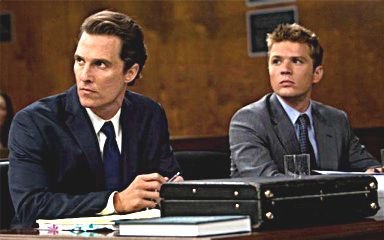
McConaughy and Phillippe watch justice meted out. |
He's called the Lincoln Lawyer since his office is in the backseat of his Lincoln Continental car, not only denoting his geographic flexibility, but his rather mediocre financial status. Along comes an offer of a very lucrative case, the defense of a young, wealthy man , Louis Roulet (Ryan Phillippe), on charges of battery and attempted murder. It's an offer Mick has no intention of refusing. Surprisingly, the taught plot takes us from the linear to some very intriguing curves and branchings out along the way. There's more than just defending Roulet in the face of imposing evidence against him. There's more than even doubts about his innocence. There's more than just legal-moral dilemmas. And it's intelligently done except for a few plot potholes near the end of the films. Possibly, the writers (though I haven't read the novel) painted themselves into a corner they couldn't get out of without some very faulty and exigent devices. No, I can't overlook them. It's a mystery thriller and it all should fit together like a Japanese puzzle box. It ends up like a jigsaw puzzle with damaged pieces, hammered into place to finish off a messed up picture. See if you can spot the inaccuracies and flaws. That should make the end as interesting as the rest of the film.
And let us pay tribute to the first legal client in film who surprised and shocked his lawyer and the audience with a performance yet to be touched: Edward Norton in 'Primal Fear' (1996). His final short scene rightfully launched Norton's career which still thrives (ignore 'The Incredible Hulk' [2008]).
The First Grader (2011)
Director: Justin Chadwick
Writer: Ann Peacock
Cast: Oliver Litondo, Naomie Harris, Vusumuzi Michael Kunene
Time: 103 min.
Rated: PG-13
As Kimani N'gan'ga Maruge (Oliver Litondo) says in 'The First Grader,' a man who cannot read is no better than a goat. So, in this true story, as soon as Kenya offers free education to the children of the country, Kimani stands outside the remote one-room schoolhouse gate and waits to be allowed in. Kimani is 84 years old and seems to be literally on his last leg. Still, he is a stubborn man who has made up his mind -- education is so close he can hear it emanating from the nearby classroom, and he wants in. The school is already overcrowded and it's only for children who are considered the future of Kenya. But Kimani insists he must learn how to read. He has a letter he must read for himself. The sympathetic school teacher, Jane (Naomi Harris) allows him to sit among the children and learn. Trouble ensues and things even get violent, but Kimani holds fast. |
|
We discover that Kimani has hard-earned experience in being stalwart in his convictions. Sixty years earlier, he was a Mau Mau warrior fighting for the independence of Kenya from the British -- a bloody insurrection that lasted eight years until the final withdrawal of the British from this former colony. The price Kimani and the other Mau Maus paid, as shown in graphic flashbacks, was unbearably horrible and high. He would not back down, relent or break his vow to liberate his country. And now it would seem the Kenyans of the 21st century would like to forget this heroic period of their history. It is also made clear that the British were as barbaric, cruel and inhuman as any other imperialistic rule or dictatorship. Now, in the progressive and independent Kenya of today, Kimani is only a bothersome old man who should quietly 'go home and rest in peace,' to which he angrily responds, 'I'm not dead!'
Two messages are relayed in this relevant, cinematically beautiful, and sensitively portrayed film: education, especially free education, is a vital gift to be treasured and a country's history and heroes should not be dismissed.
Paul (2011)
Director: Greg Mottola
Writers: Nick Frost, Simon Pegg
Cast: Simon Pegg, Nick Frost, Kristen Wiig, voice of Seth Rogan, Jason Bateman, Jane Lynch, Bill Hader, Joe Lo Truglio, John Carroll Lynch, Blythe Danner, Sigourney Weaver
Rated: R
There is so much right about this film. These Simon Pegg / Nick Frost films are almost always bright, fast paced, hysterically funny and have a lot of social subtext that enriches the whole experience. Just look at 'Shaun of the Dead' (2004) (masterful revitalization of the zombie genre) and 'Hot Fuzz' (2007) (send up of buddy cop movies). 'Paul' is a very sweet film depicting the friendship of two English, not so young, nerds. They fulfill their dream of going to San Diego for Comicon, surrounded by sci fi fans and meeting their favorite sci fi author. They have even rented an RV with the plan of visiting famous 'alien' locations like Area 51. They are blissfully happy and in the process. Meeting an actual alien who is escaping from Area 51 after 60 years of hospitality (or was in captivity?) throws the men in surprising directors. One would rather continue going to |
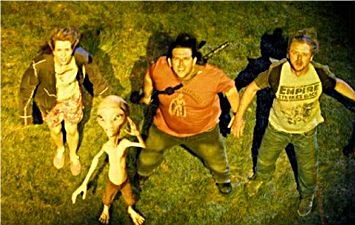
Wiig, Paul, Frost and Pegg watching the landing... |
historic alien sites than veer from the original plan. The other more fully appreciates the significance of the situation and commits himself to doing anything, anything, to help this little green. huge eyed, smart-ass alien to go home.
But there were a few misfires in 'Paul' I found disconcerting. The original Paul and namesake of the alien, a pet dog, is squashed beneath the UFO that brings our ET to Earth in a crash. A dog is killed in the first scene! This certainly confused and shocked the audience. Worse yet, it brought a tone to the film that would resurface from time to time. Death is part of the comedy of the film, and it throws us off. In the other two films I refer to above, murder and mayhem is the basis of the humor and works. In 'Paul,' it seems superfluous and mean spirited.
One other problem is the profanity. It's a one trick pony that is beaten to death and quickly loses its luster. Seems one of the character's being liberated from suffocating, over-zealous Christianity means the unfettered right to curse -- as if fundamentalist Christians envy atheistic foul mouths. one wonders where this character's extensive knowledge of curses came from. A couple of lines of dialogue to make the point would have been sufficient. That one unending theme changed the rating from what could have easily been a G to R. Really not worth the joke to deny so many potential audience members from an otherwise very sweet, funny movie.
Paul's presence also means the debate between knowledgeable people who understand Darwinian evolution and science above grade 3 versus creationists is ended. That argument was also over-labored though it's good to make the distinction clear to those who might still cling to biblical literalism. It would have been preferable to argue the undeniable science of evolution without the necessity of an alien's mere existence to blast this medieval holdout.. Then again, one could argue, who desperately wants to hold onto archaic myths, God the creator could have made aliens on distant planets as well as humans on Earth. But let's forget I said that.
Overall, 'Paul is still a charming and funny movie, finally clarifying where the myths about aliens originated. It was tough without my feeling manipulated.
The Adjustment Bureau (2011)
Director: George Nolfi
Writer: George Nolfi from the short story 'Adjustment Team' by Philip K. Dick
Cast: Matt Damon. Emily Blunt, Terence Stamp, Anthony Macki, John Slattery, Michael Kelly
Rated: PG-13
There has always been a conflict between beliefs in free will and God's plan or fate. Finally, we can now put this debate to rest. People have a little wiggle room regarding choice, but not the big or life determining things. David Norris (Matt Damon) not only believes in free will (as all politicians must or what's the point?), he fights the forces that control his own fate so he can be with the woman he loves. These guys in silly hats (favored by Bing Crosby and Frank Sinatra in the 1960's), members of the Adjustment Bureau, infiltrate people's lives whenever they veer from their predestined path according to notebooks that track lives much like Harry Potter's map that tracks people's movements in Hogwarts. The Adjustment Team members have supernatural powers (being agents of He who |
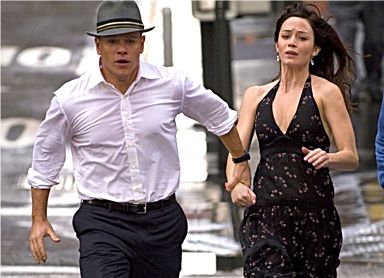
Matt Damon and Emily Blunt fleeing their destiny |
remains unnamed), but it seems love is even more powerful. David finds out about the Bureau, his destiny and that of the woman he loves, Elise (Emily Blunt), and bucks the system big time (it's assumed this fast rising politician is a Democrat) to write his own fate and be with his beloved.
I often have a problem with romance in movies. Why do any two people fall in love in a movie. Usually, it's just because they're in the same place. I call it 'love by propinquity.' I don't see any real spark or simpatico; the screenwriters throw the characters together and nobody else is around. The best intentional film in this vein is 'Swept Away' (1974), in which two people who hate each other are marooned on a Mediterranean island. Take 2010's 'Knight and Day,' in which a relationship eventually forms between the protagonists because they're forced to stay together and have an adventure. Usually, they're just in the same office and the script proceeds. But in 'The Adjustment Bureau,' a man and a woman accidentally meet in a men's room, talk for a few minutes and fall in love. And I buy it! This is brilliant writing and great acting. They're lives will never be the same because of this brief social interaction . There is chemistry between them at a deep level, far beyond sexual attraction, but a true meeting of the minds and hearts. This rarely happens in film and I appreciate it when it's done convincingly.
Also, the film relies more heavily on story than special effects even though the theme is science fiction. We still feel the other-worldliness (even with all the lame hats), though it's sad to think angels are all men only, and more yes-men and executive assistants than empathetic celestial immortals. The special effects are simple (doors leading to unexpected locales) and sparse. We aren't wowed by eye candy so much as thrilled by the lovers' struggle to be able to live their lives together. Reminds me of 'Stairway to Heaven' (1946) in which another couple fight heaven itself to stay together. 'Stairway' is a lot more amusing and fantastical if not as tense and fast paced as 'The Adjustment Bureau.' Both are reflections of their times. Post World War II was a time of great excitement and joy, filled with hope for the future. Now is the time of distrust of suits (and it seems hats) while most of us contend with an economic hole the Western World has yet to climb out of. Both times, maybe all times, appreciate a man's fight against immense odds. Ah, the power of love. Too bad it didn't open in time for Valentine's Day.
When We Leave (2011)
Director: / Writer: Feo Aladag
Cast: Sibel Kekilli, Florian Lukas, Alwara Hofels, Nursel Kose, Derya Alabora, Settar Tanriogen
Time: 119 min.
Turkey
Umay feels she must take her son and leave the brutal and unloving home of her husband and his family in Istanbul, and go back to Germany where her Turkish family lives. Unfortunately, even though her family loves her, they have not given up their traditional Muslim culture, nor can they withstand the pressures of the transplanted Turkish community in which they thrive. She left her husband and took his child. And in the Muslim culture, this brings shame to the family. Umay tries desperately to maintain her independence even though she is being pressured to return to her |
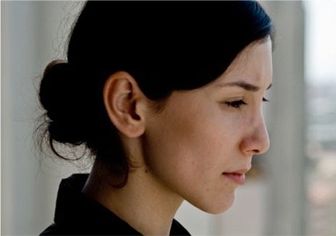
Sibel Kekille as Umay - brave and troubled. |
husband. She must separate herself from her family if she is to keep her child from being taken by her husband. She has to be able to sever all ties with her family to be able to live an independent life with her son. Being brought up in a traditional Muslim family makes this a very painful and possibly dangerous endeavor.
It is expected now that almost all films coming out of Muslim countries, such as Turkey, Iran, Iraq, Egypt, etc., are about the hardships women face, the oppression, abuse and lack of all human rights. There seem to be only two themes coming out of these countries: subjugation of women and war. Are these films shown within their countries of origin? Does anybody there realize that cultural bias against women is a situation that is unacceptable in the rest of the world? Have these many, many films made any impact at all in Muslim countries? 'When We Leave,' taking place in both Turkey and Germany, seems to be a blueprint for the Turkish women who have immigrated with their families to Germany to join its work force. The one remaining hurdle for Muslim women who are able to leave their country's stranglehold on their personal freedoms is to be able to leave their families' emotional hold on them. It seems obvious to me that pointing the way in this regard is the goal of director/writer Feo Aladag. Or maybe I'm reading too much into it...
In any case, with the freedom fights going on in Egypt, Libya, Yemen, Syria and more to follow, it will be interesting to see how women fare once the dust has settled.
This is the true story of eight monks living near the small village of Tibhirine, Algeria, serving God and the local Muslim population in the 1990's. We get to watch them in their daily chores of tending to the health needs of the people in their clinic, plowing and sowing the fields, watering their garden, canning honey for sale in the marketplace, praying and regularly singing hymns in praise of God. Seems 7 out of 8 of them have beautiful, rich, melodic voices. The eighth, the asthmatic doctor/monk does not appear in the chapel with the rest of them during their regular intervals of musical praise to the Lord. They quietly accept their commitment to service and modest living.
This idyllic life changes when Islamic extremists act to overthrow a corrupt government and replace it with a fundamentalist extremist regime. They commit several acts of terrorism against their own people and eventually pose a threat to the existence of the monastery and the very lives of the monks. The film then veers from the day-to-day chores of monks to a philosophical discourse among them on the pros and cons of martyrdom -- if it comes to that.
'Of Gods and Men' does not probe the roots of terrorism in Algeria or among Muslims in general. Terrorism is a threat that tests Christian men's souls, attacking non-revolutionary Muslims and infidels alike. Violence is suggested rather than witnessed . It is a tribute to the monks who have to make the decision to either flee Algeria to go back to France and continue their work at another mission or stay come what may. This real life story can be taken as a metaphor for all missionaries caught in the cross-fire of political upheaval in a foreign land. Only one brief comment is made by a local government official to one of the monks regarding French imperialism in Algeria as being a cause of the resulting revolutionary action. It is a tribute to monks in foreign lands, not in converting heathens, but in serving God through serving them.
Nora's Will (2011)
Director/Writer: Mariana Chenillo
Cast: Fernando Lujan, Cecilia Suarez, Ari Brickman, Veronica Langer, Enrique Arreola, Angelina Pelaez, Silvia Mariscal, Marina de Tavina, Juan Pablo Medina, Juan Carlos Colombo, Martin LaSalle, Max Kerlow
Mexico
Time: 92 min.
Nora (Silvia Mariscal) has attempted suicide a dozen times before unsuccessfully, but this time, she's going to do it right. Not only will she die, but she has planned out the next five days following her death. Passover, the holiday celebrating the exodus of Jews from slavery in Egypt to the Promised Land is about to start. Nora has invited family and friends to attend the Seder |
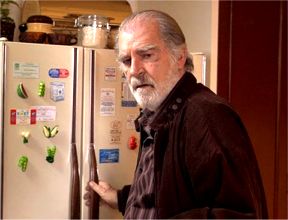
Fernando Lujan checking the fridge
for the Seder repast. |
in her huge, elegant apartment. Food is semi-prepared in the fridge, with detailed notes to her maid/cook/friend, Fabiana (Angelina Pelaez), for final touches. Frozen meat has been delivered to her ex-husband, Jose (Fernando Lujan) who lives across the street. Even the coffee maker has been set by timer to make coffee at a time appropriate for the discovery of her body. We learn this is not consideration for others or an arranged farewell celebration, but manipulation of those who love her for her own agenda .
This is a very subtle study of a strained, yet undying, love between Nora and Jose who were married for 30 years and divorced 20 years ago. I think the math is off, even though these statistics are repeated several times, because it is said she died at age 62, and as her ex says, 'she looks older.' Throughout, he makes snide remarks about her and everyone else within earshot. He is a bitter man who has lost God, but has a good grip on his sense of humor -- completely at other people's expense. As cold and insulting as Jose is, there are several hints that although the marriage couldn't weather their problems, they loved and cared about each other.
There is much to learn about love, Jewish tradition and ritual, human idiosyncrasies and real estate in Mexico City. Though a film about suicide and loss, it's funny and witty. Perhaps more useful than a session with a marriage counselor.
Even The Rain (2011)
Director: Iciar Bollain
Writer: Paul Laverty
Cast: Gael Garcia Bernal, Luis Tosar, Raul Arevalo, Karra Elejalde, Juan Carlos Aduviri
Time: 103 min.
In 'Even the Rain,' a Spanish film production company shoots a movie about Christopher Columbus establishing Spanish rule in the Caribbean shortly after his discovery of the New World. We find out that the company decides to shoot in Cochabamaba, Bolivia, rather than the Caribbean, a continent away, because they can exploit the indigenous people as extras and laborers for $2 a day, a real production cost savings. Soon the parallels in exploitation between the present day Spanish filmmakers and the 16th Century Conquistadors become evident, even to the director Sebastian (Gael Garcia Bernal) and producer Costa (Luis Tosar) of the movie, and they become more and more uncomfortable in their own skins. They wanted to make a film showing the horrors of Spanish imperialism, including slavery, forced |
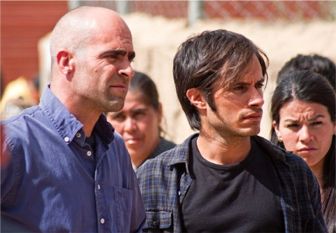
Luis Tosar and Gael Garcia Bernal as Spanish filmmakers
among their Bolivian Indian extras. |
conversion, and brutality, only to find little has changed in the intervening 500 years. They have ties with the Bolivian and local governments which welcome their money. This government is exploiting the natives, not for gold as in the past, but for water. A multinational corporation has bought the rights to water, all water; from pipelines to community dug and managed wells to the very rain that falls from heaven. The native villagers are told it is illegal to collect rain water, ergo the title of this film, 'Even the Rain.' Gold may be valuable to those who like to own shiny yellow things, but water is life. So, this same population who has suffered foreign supremacy since Columbus must fight for survival again.
A revolt, led by one of the film's (or film within the film's) featured extras, Daniel (Juan Carlos Aduviri), ensues. The film production company now better understands and empathizes with these people's situation and has developed respect and affection for them. Choices are forced upon them though their overriding impulse is to finish the film no matter the cost to others.
This is a powerful film. Scenes from the past being shot by the present day crew and situations they face during production are flawlessly intertwined. The comparisons are clear, but not rammed down the audience's throats. Cooperation by the authorities had to have been extensive for much of the film -- with the use of hundreds of extras (I wonder what they were paid) and traffic control. The end result is a beautiful rendering of the bustling city of Cochabamaba and the nearby forests in the depiction of a social problem that repeat throughout the world in a mature, dramatic and empathetic way.
The lead character of this inner film is Father Bartolome de las Casa, the first imperialist representative to stand for equality of all people, civil rights and the abolishment of exploitation. The production staff and cast find themselves put to the test of this hero's principles during the making of his biopic. They even question whether they have the right to speak for him in film.
Bring a bottle of water to drink instead of soda; the impact noticeably increases.
San Francisco Independent Film Festival (2011)
The Aristocrat
This film starts out as a story about a retiring microchip outside salesman training his new replacement. Marc Ward, the man on the way out, is obviously weary and just needs a change. Eddie Kent is the brash, eager tyro who eventually takes heed of the many lessons he learns from the humanistic, thoughtful, and insightful mentor. But along the way, one starts to pick up little hints that there is more going on between them than meets the eye. Eventually, we get to see both sides of their interactions. It's surprising, not only for what lies beneath the surface, but for the change in tone from a salesman story to an action thriller. The look is gritty -- industrial parks, motels, Midwestern monotonous vistas, featureless freeways, a roadside strip joint and a diner. You wonder why anyone would chose this life and sense the emotional oppression of the job. Well, one does want out and the other has his own agenda. Slow start, but interesting crescendo.
The Drummond Will
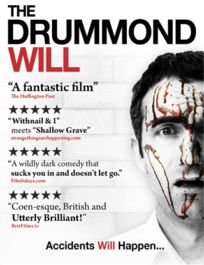
In the vein of classic British inheritance comedies (such as 'The Wrong Box' 1966), though not as charming or chaotically complex in plot, this is a fun adventure that takes place in the English countryside. Two brothers have been avoiding each other in their adult lives because they are so different in temperament. Marcus is the older brother who is straight laced, conservative, hard working and has no time for his brother Danny who never held a job, is flighty and free spirited. They reluctantly reunite to bid adieu to their recently passed father. While staying in dad's dilapidated house which they are told they have inherited, they find a fortune and spend the rest of the film trying to hold onto it to the chagrin of many of the locals who have the same idea. Havoc ensues and bodies drop like flies in the first frost. Not brilliant, but lots of fun.
The Evangelist
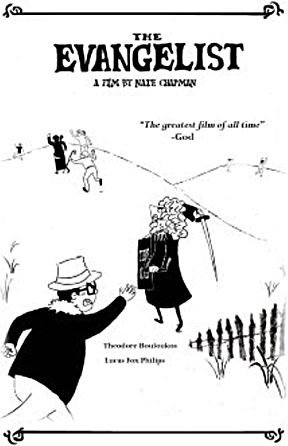
Danny Ziegfeld is an atheist theater director who stumbles upon a charismatic orphan, Gideon, on the beach in Provincetown, Mass., where he runs a theater academy in a building which was once a church. He adopts the young Gideon only to find he is an ardent Christian evangelist whose mission is to save everyone on earth! Danny is horrified, but decides to play along, helping Gideon in his calling in the hope it will just be a passing phase and believing that if he protested, that would just cement Gideon's resolve. To Danny's chagrin, not only does Gideon's fervor increase with his new father's support, but Danny is constantly embarrassed and humiliated by Gideon's attempts to save any stranger he meets. This film is not for the feint of religion. Religious extremism is pushed beyond logic's limits and some may find it offensive; though the San Francisco audience will most likely appreciate 'The Evangelist''s absurdist humor. And Provincetown off-season is lovely its frosty, isolation.
Fuerteventura
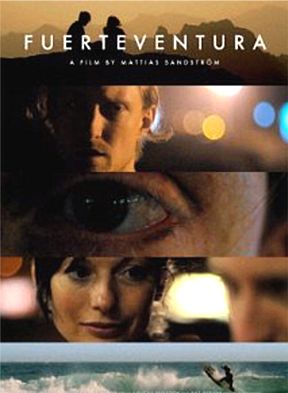
How do you know if you're dreaming? You can't count your fingers! This is a vital piece of information for Jesper, a Swedish tourist visiting Fuerteventura in the Canary Islands. Jesper has suffered a terrible loss, and accompanying extreme guilt, back in Sweden, but instead of healing on this tropical Spanish island, he starts hallucinating or dreaming about his lost love. He can no longer tell the difference between imaginary or real life, even more confused by finding a hotel maid who is the spitting image of her. I lived in the Canary Islands and it felt the same way, and I wasn't grieving or suffering in any way. This archipelago is intoxicating and it was pleasant to revisit it. Jesper may not be the best vacation companion; he lives pretty much in slo-mo and. not to cast aspersions on Scandinavians, he has that stereotypical dour Nordic personality. But that is more than made up for with his sweet illusions and various other locals.
Gabi on the Roof
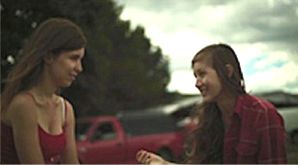
Gabi is the most annoying of the group of 20 and 30 somethings she is hanging with during her summer in New York City. That is not to say the rest of the clique isn't also annoying. Almost the whole of the film explores inane prattle posing as insightful exposition. It's obviously improvisation since characters are constantly repeating what they have already said and repeating others -- a common crutch for actors who want screen time, but don't have screen writing talent. The plot is as insubstantial as the dialogue: virgin kid sister moves in with brother so she can parade around the apartment naked among strangers; brother wants to change girlfriends. And neither Gabi nor anyone else was on the roof.
The Happy Poet
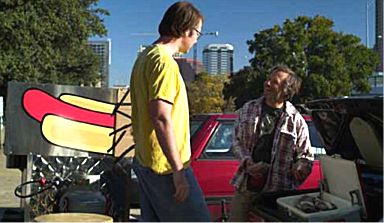
The joke of the film is the irony of its title. This poet (who admits he doesn't write) only recites one poem in the film, and it's shockingly bad. At his happiest, he still can't contort his rubbery, eternally downcast face into the slightest grin. Bill is following his bliss: buying a hot dog stand and filling it with healthy, organic food to sell in the park. And the thrust of the film is he's doomed because that's just stupid; people want hot dogs. Or it might just be a matter of location, location, location. Bill's food stand is settled in an almost untraversed part of a very large park, far away from the bustling business lunch crowd. Either way, things are not going well for Bill -- with his business, friends or potential girlfriend. He doesn't have a clue how to make his situation better and there seems to be some gaps in the story to get him to his ultimate conclusion. Still, this is an American dream fulfillment story and we root for this uncharismatic, Buster Keaton-like character. I would also love to try one of his eggless egg sandwich.
A Little Help

Poor Laura. This suburban Long Island housewife and mother feels she's loosing her husband. As it turns out, she does lose him, but not to his secretary; to arrhythmia. Now she has to deal with widowhood. Her son is telling a whopper of a lie to make his dad a hero. Her mother offers no solace or compassion, but continues to order her around and pressure her as if she were still a teenager. Her sister admits she always hated her for being the pretty one. Her brother-in-law reveals an old secret reminiscence of 'Like Water for Chocolate.' Her lawyer insists she sue because she is now penniless. But nobody is giving her the least bit of help. Laura is not used to making decisions and is doing the best she can, especially with all the obstructions put in her way by the very people who should be on her side. As the film's press materials state: 'This compelling dark comedy is achingly sad, warmly touching and surprisingly funny.' And on this rare occasion, I agree.
Mars
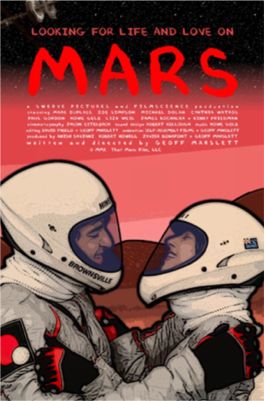
It's 2014 and three astronauts are on a mission to Mars to see if life in any form actually exists there. They're in a rush because the European Space Agency has sent an unmanned space craft for the same purpose, and to possibly retrieve a previously lost Mars probe. Before take off, our heroic crew had never met each other. They had never rehearsed their tasks. There we not made aware of what the mission would entail. They were unsupported and insulted by ground control. It would seem that in 'Mars,' NASA and its procedures have taken a giant leap backward to the time of George Pal and his take on science fiction. The film is in rotoscope, with the simplification of craft, space and planetary details, but in a vivid palette. It's like a graphic novel that moves and with just about real people. The story is a basic transformation-of-character-under-duress-of-space-travel. The surprise ending is given away very early on. The science is the most comical element of the film.
RU There

Jotze is a Dutch professional gamer in Taiwan with his team for a competition. He meets a prostitute, Min Min, and is smitten. She invites him to meet her in avatar form on her favorite virtual site where she relaxes, Second Life, and they pretty much sit there and type to each other. They couldn't have had an actual relationship instead of a virtual one because: (1) most importantly, she didn't want to; (2) he is too socially inept to conduct one (he didn't even realize she didn't want him); and (3) culture today is so electronic, with online dating, Facebook friends, chat rooms, etc., people are just more comfortable relating through the interface of their choice. Not being a gamer myself, I found the Second Life environment not only far inferior to the actual Taiwanese countryside, but even dull and simplistic compared to other computer generated environments such as that in "Avatar' (2009) or 'How to Train Your Dragon' (2010). Of course, they're 3D motion pictures, but how can you settle for video game technology after having experienced something so far superior -- just for the opportunity of killing pixel enemies? Gamers are so easily satisfied. 'RU There' is a sad reflection on present day emotional life. If we can only relate to others through technology, we have lost the ability to relate at all and are truly alone.
Special Treatment

If you've never thought about the similarity between high-end (excuse the pun) role-playing-prostitution and psychiatry/psychoanalysis then 'Special Treatment' will clarify it for you. Isabelle Huppert (58 year old French star), plays an aging prostitute who feels she has been dispensing therapy to her clients for years. This may just be a rationalization and she has reached a point in her life and career where it just doesn't work for her anymore. In a situational reversal, she feels she needs therapy to be able to find the emotional strength to get out of the business. Just about all the characters in this film are either prostitutes or psychiatric professionals, and neither group seems any happier than the other. We can ponder what that means. Though beautiful and elegant, Huppert just doesn't come off provocative, sexy or even therapeutic. I was reminded of Kathleen Turner in Crimes of Passion (1984) and her camouflaged, passionate, tortured China Blue. The French may be known for love and romance, but America trounces them for passion, both physical and emotional. And to make one more sweeping generalization, in French films, all the women, like Huppert, are classy and attractive, and all the men are old, fat and/or ugly. Where are the handsome Frehmen?
Kaboom (2011)
Director/Writer: Greg Araki
Cast: Thomas Dekker, Haley Bennett, Juno Temple, Chris Zylka, James Duval, Andy Fischer-Price, Nicole LaLiberte
Time: 86 min.
Filmmaker Greg Araki has gotten over this youthful angst and now knows how to have a rockin' good time, even a Bacchanalian fest. His film technique has matured as well. His cardboard sets and colored lights seem more playful and intentional than reflecting an inability to disguise a low budget. Kaboom follows Smith (Thomas Dekkler) , a college freshman who is not metrosexual, ambisexual or confused. He lusts after men, but has lots of satisfying, if not equally, sex with women. Let's just call him BI, and sexually untroubled. There are lots of nubile nudes, both girls and boys, rolling around together, and for many viewers, that would be enough. But strange things start happening on this academically undemanding campus, including encounters with witchcraft, prescient dreams, murder, cults, psychedelic fugues, paranoia and possibly a threat to life on earth -- all in good fun. |
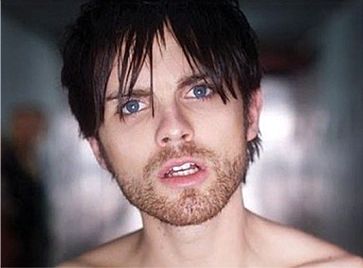
Thomas Dekker as the boy in the middle
of a supernatural mystery |
Sanctum (2011)
Director: Alister Grierson
Executive Producer: James Cameron
Writers: John Garvin, Andrew Wight
Cast: Richard Roxburgh, Rhys Wakefield, Ioan Gruffudd, Alice Parkinson, Dan Wyllie
Time: 109 min.
Rated: R
It's difficult to understand the passion for spelunking -- strangely, a word never uttered in this film. Monochromatic gray walls in a pitch black, artificially lit environment (if the lights go out you're dead). Huge caverns to cramped wormholes that may dead end (literally). A lifeless underground environment where the discovery of bat guano causes excitement. The only thing going for it is that the explorers may be the first humans to see a particular hole in the ground-- as if anyone without this particular passion cared. Nonetheless, the cinematographer does a great job of keeping the actual cave and cave sets interesting to view. Also, the 3D photography techniques developed for 'Avatar' (2009) add depth and clarity. |
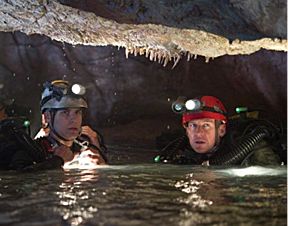
Ioan Gruffudd and Richard Roxburgh
preparing to take their breaths. |
In 'Sanctum,' an intrepid team of cave explorers investigate one of the deepest and most extensive network of caves in New Guinea to see where the water that flows into the cave leaks out into the nearby ocean. Well, I figure it's going to be some cavular tube that looks like all the other tubes in the vicinity, but a man (and a few women) has got to do what a man has got to do. The team encounters serious trouble when a torrential storm hits the area earlier than expected and everyone must evacuate the cave before it floods. A series of mishaps causes several members of the team to be trapped below ground forcing then to find another way out. Thus, the life and death struggle to survive ensues. Scientist and expert caver Frank (Richard Roxbrugh) must combat, while trying to save, financial backer and adventurer Carl (Ioan Gruffudd), as well as Frank's truculent son Josh (Rhys Wakefield) and the rest of the hapless group. The thrust of the film hinges on terrifying, dangerous situations that try Frank's ability to deliver his charges to safety. Those who like to watch people get bashed against rock walls, drowned, mutilated and be subjected to various other torments, will particularly enjoy 'Sanctum.' Those who enjoy fit male bodies in sleeveless wetsuits should also get a charge out of the film. Of particular interest would be Rhys Wakefield's biceps.
This story is based on the actual experiences of Andrew Wight who wrote the story and play, and co-wrote the screenplay. Wight led a party of 15 spelunkers in an Australian cave which partially collapsed. Fortunately, not as emotionally charged or devastating, they all got out of the cave two days later. The action in 'Sanctum' is fast, thrilling and highly charged. Unfortunately, the dialogue is simplistic and cliched, causing many in the audience I sat with to chuckle, especially at the most dramatic moments. Claustrophobes and nyctophobes be warned.
Another Year (2011)
Director/Writer: Mike Leigh
Cast: Jim Broadbent, Ruth Sheen, Lesley Manville, Peter Wight, Oliver Maltman, David Bradley, Karina Fernandez, Martin Savage
Time: 129 min
Gerri (Ruth Sheen) and Tom (Jim Broadbent) are the nexus of a group of people, all attracted to this older couple because of their calm, compassion and common sense. This is truly a charmed couple. Gerri is a medical counselor who discusses emotional problems with patients. Tom is a soil engineer helping in the construction of underground water conduits which secure safe drinking water and waste disposal for neighborhoods. So, they have both developed careers which help humanity. Their home fringes the countryside and is filled with plants and flowers. They even have a plot in a community garden and regularly work with the earth and eat their own fruits and veggies. Getting the message? These people are grounded! Even their son (Oliver Maltman) is a social worker who falls in love with a nurse. Golly, what a blessed family. |

Gerri (Sheen) and Tom (Broadbent) hosting friends at home. |
Now, if you've ever read Kurt Vonnegut's 'Cat's Cradle' you will be familiar with the religion he created called Bokononism. In it, groups of people form true connections which he calls a karass like spokes of a wheel, and the hub of the wheel, the wampeter, is the central thing that holds them together. Things like religion, nationality, political parties are just granfaloons or false and unimportant associations. The wampeter is what actually holds people together in groups even if they feel unrelated to the other members. While watching 'Another Year,' I kept thinking that the one central thing that is a commonality to all the other characters in the film is their attraction to and even need for Gerri and Tom; so, in a sense, this couple who might also be their own duprass, are the wampeter of the karass. Got it? Watching Tom and Gerri in their idyllic lives might be dull except for their friends and family who bring their emotional pain and suffering into the equation.
These friends each relate an aspect of the human condition, and who better to write/direct such humanistic, slice of life stories of the middle and working class British than Mike Leigh? His filmography includes such examples of genre as 1988's 'High Hopes,' 1996's 'Secrets and Lies,' and most recently 2008's 'Happy-Go-Lucky'. His method is to write a bare bones script and improv with his gifted actors in rehearsal till the full bodied script is perfected. Then shoot. 'Another Year' seems a bit more sober and less dramatic, but Leigh's still got that naturalist and relatable touch that makes associations and empathy with all his characters and their situations easy and authentic.
Red Hill (2011)
Playing October 11, 8:15 at the Century Cinema
Director/Writer: Patrick Hughes
Cast: Ryan Kwanten, Claire van der Boom, Steve Bisley, Tom Lewis, Christopher Davis, Kevin Harrington
(Australia)
Time: 95 min.
Rated: R
Remember 'High Plains Drifter' (1973) starring Clink Eastwood as yet another nameless stranger seeking revenge against the men who wronged him? Perhaps it's easier to remember Javier Bardem's relentless killing spree while seeking the stolen cash in 'No Country for Old Men' (2007). If you like the avenging wraith leaving a trail of bloody bodies behind him, you might just like 'Red Hill' from Australia. |
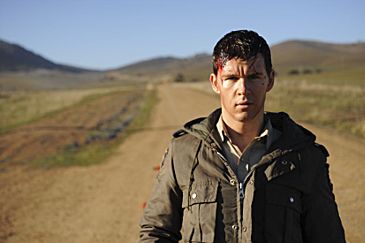 Ryan Kwanten making sense of the nightmare.
 |
We follow a new deputy Shane Cooper (his name an obvious tribute to the Western genre) (Ryan Kwanten) of the small town of Red Hill. It's his first day on the job, having moved out of the city to give his wife (Claire van der Boom) a more peaceful and less stressful environment in which to safely conclude her pregnancy and raise their son. This is not Mayberry and the townspeople and fellow lawmen are far from the friendly, down home, cheerful people Sheriff
Cooper
might have hoped for. Television reports of a prison break and an escaped murderer, aborigine Jimmy Conway (Tommy Lewis), cause the Sheriff, Old Bill (Steve Bisley) to move into action, putting together a posse and a plan of action for what he knows to be an impending life or death battle. Deputy Cooper has gotten a whole mess more than he bargained for and as this one day continues, he tries to make sense out of the chaos and bloodshed that follows. (To be continued when the film is released...)
No big surprises to this Kangaroo Western, no particularly powerful performances, though Ryan Kwanten and Claire van der Boom are likable enough, and Steve Bisley ornery enough. It's interesting to watch the down under approach to the genre in this expansive country with as big a sky as anything Montana or Texas can boast.
Gulliver's Travels (2011)
Director: Robert Letterman
Writer: Joe Stillman and Nicholas Stoller from the book by Jonathan Swift
Cast: Jack Black, Jason Segel, Emily Blunt, Amanda Peet, Billy Connolly, Catherine Tate, Chris O'Dowd, T.J. Miller, Emmanuel Quatra
Time: 93 min.
Rated: PG
This latest version of 'Gulliver's Travels' is a more up-to-date interpretation of the 1726 (amended 1735) novel by Jonathan Swift. Originally a thinly veiled political satire about how the English government was constantly at war with just about any country for the meagerist of reasons as well as commentary on human nature, today's version is a romp for Jack Black with lots of rock and roll. He's doing his Jack Black schtick, as usual. Still basically the same story -- Lemuel Gulliver sails into a maelstrom to arrive at Lilliput, the kingdom of very little people. He is captured and tied up by the population who quickly learn to love and depend on him for protection from their mortal enemies, the Blefuscudians. There is also a princess (Emily Blunt) who wants to marry a shy commoner (Jason |
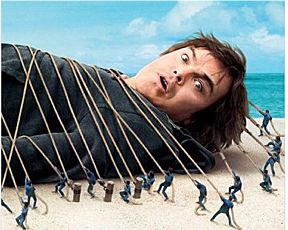
Jack Black as Gulliver subdued by Lilliputians. |
Segel). I was happily surprised to see the King and Queen of Lilliput played respectively by Billy Connolly (for his great Scottish delivery in everything he does) and Catherine Tate (for her worthy contribution to Doctor Who from 2006 to 2010).
I found interesting that the present day Lemuel Gulliver finds Lilliput in the Bermuda Triangle. Also, when he visits the giant-populated land of Brobdingnag, he finds remains of another travel, a jet pilot, also lost in the Bermuda Triangle. Ah, this answers so many questions. The special effects seem a little bit off, with Jack's lighting and focus slightly different than the Lilliput background and little characters. The advances in technology aren't really that much superior to, say, Ted Danson's 1996 TV miniseries of the same name, which didn't benefit from 3D as Black's does. Danson's also covers more of Gulliver's adventures. I would love to one day see all of Gulliver's destinations and interactions, as original written by Swift, on big screen with 3D and perfect effects. Modernizing the situation doesn't really seem necessary since so little of human nature, politics or personal relationships has changed in the past 225 years. The humor and satiric wit, as originally written, far surpass Black's knuckle knocking, belly thrusting, and dancing.
Rabbit Hole (2010)
Director: John Cameron Mitchell
Writer: David Lindsay-Abair play and screenplay
Cast: Nicole Kidman, Aaron Eckhart, Dianne Wiest, Miles Teller, Sandra Oh
Rated: PG-13
Time: 92 min.
Becca (Nicole Kidman) and Howard (Aaron Eckhart) are going through the worst nightmare any parent can experience: the loss child of their child. Four year old Danny (Phoenix List) ran into the street to catch his dog and was hit by a teen driver. Now, how to deal with the unbearable grief? Seems from this film and others covering the same territory, each person has his or her own way of suffering or coping, and just being in the proximity of a spouse exacerbates the process, causing a rift that challenges the marriage. 'Rabbit Hole,' which explores this issue, is a walk in the park compared to, for instance,'Morning' (2010) starring Jean Tripplehorn and Leland Orser. Their grief is so extreme that both should check into mental hospitals due to |
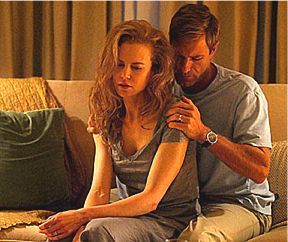
Kidman and Eckhart as grieving parents commiserate. |
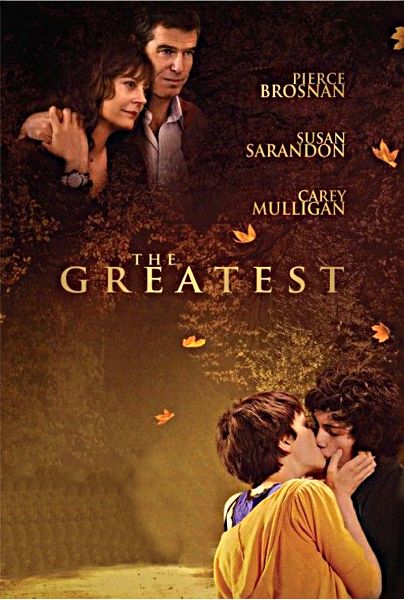
total breakdowns and being a threat to themselves. Of course, watching their suffering, he with extreme deprivation and agoraphobia, she desperately trying anything including sex with strangers, is much more interesting to watch than a stay in a hospital and drug therapy. In 'The Greatest' (2009), with Susan Sarandon (queen of all grieving mothers for her performance in 'In the Valley of Elah' 2007) and Pierce Brosnan, their son was an adult and his pregnant girlfriend arrives on their doorstep offering a replacement. Naturally, they have mixed feelings about this development.
Kidman and Eckhart in 'Rabbit Hole' offer a more easily identifiable response to their loss. They try to accept each others process, try group sessions with other grieving parents, try reconciling with the offending driver who accidentally killed their son, and just cry and vent. The audience will feel their pain and identify with their plight. But I can't help but wonder the aim of such a genre -- grieving parents. It can't be called entertainment; perhaps it is cathartic for grieving parents. I don't know. This screenplay was adapted from the stage play by the same author, David Lindsay-Abair, and won a Pulitzer Prize for drama in 2007 as well as several Tony Award nominations. Fortunately for him, Abair has no personal experience of the loss of a child. Still, the subject of offspring death has been a career booster in the past. Sam Shepard's Pulitzer Prize winning 'Buried Child' (1979) catapulted his career as well.
John Cameron Mitchell, known for his outrageous and powerful, 'Hedwig and the Angry Inch' (play 1998 and film 2003), which he co-wrote and starred in, takes a totally different direction from German transgender rock singer to grieving suburban American couple. Yet, this topic hits even closer to home, his having experienced the death of his 4 year old brother when he was 14. His own family's reaction to the film does not corroborate that this genre film actually does help grieving parents. The Mitchell family didn't give the group hug he had hoped for; they didn't experience any catharsis. So, be warned -- the fine performances by the cast, the heartbreaking story line, the pain and loss may be all that is offered by 'Rabbit Hole,' perhaps nothing more.
Casino Jack (2010)
Director: George Hickenlooper
Writer: Norman Snider
Cast: Kevin Spacey, Barry Pepper, Kelly Preston, Jon Lovitz, Rachelle Lefevre
Time: 108 min
Rated: R
Jack Abramoff is complex and not-wholly evil, selfish,greedy though his actions has caused millions of dollars in loss to Indian tribes, corporations, and individuals. He is deeply religious, a committed family man who would never consider cheating on his wife though beautiful women are constantly thrown in his path, he generously gives to charities and builds institutions for good works. Yet, he wields power as a lobbyist on Capitol Hill to gain great wealth at the expense of others. He tempts, bribes and bullies senators and congress people to do as he and his special interest clients desire. Thus, he erodes the very core of democracy and the Constitution. |
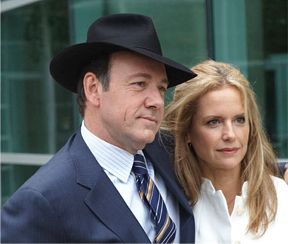
Kevin Spacey and Kelly Preson as the Abramoffs |
It's only fair to say he sees himself as a moral man and in many aspects of his personality, he is. It's his associates who make the decisions that lead them all into corruption and even murder. He warns them that is not the path to take and, at the least, bad Karma will follow. But Jack's flaw is that he doesn't stop them, does not protest enough. He succumbs to temptation and knowingly allows them to proceed. That is the flaw in this otherwise brilliant, loving, charming man. This is a very engrossing study of a real character.
And who better to play this very high energy, manipulative and ambitious man than Kevin Spacey? This is the kind of character that Spacey has thrived on his whole career, from 'Glengarry Glen Ross' (1992) and 'Swimming with Sharks' (1994) to 'American Beauty' (1999). His most successful portrayals have been of the fast talking, aggressive, self-possessed, driven men. This is no exception. His co-stars are just as adept in their roles: Barry Pepper as Michael Scanlon, Abramoff's even more driven partner with less common sense or morality and Jon Lovitz as a sloppy, pathetic investor in a cruise ship gambling scam. Kelly Preston plays Abramoff's wife who unsuccessfully tries to keep him in line.
This film shows us poor saps who only vote our representatives into office what they do once they get there. Names of actual people are named and what they did clearly delineated. By the end of the film, I found myself actually rooting for Abramoff, hoping he would bring down the system that bit his hand as he fed them -- exotic vacations, prostitutes, political contributions and anything else that would sway them to turn their backs on their constituents.
All Good Things (2010)
Director: Andrew Jarecki
Writer: Marcus Hinchey, Marc Smerling
Cast: Ryan Gosling, Kirsten Dunst, Frank Langella, Lily Rabe, Philip Baker Hall, Michael Esper
Time: 101 min.
Rated: R
Blue Valentine (2010)
Director: Derek Cianfrance
Writer: Derek Cienfrance, Joey Curtis, Cami Delavigne
Cast: Ryan Gosling, Michelle Williams, Mike Vogel, John Doman, Ben Shenkman
Time: 120 min.
Rated: R |
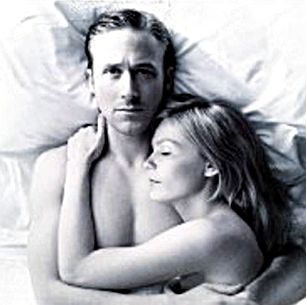 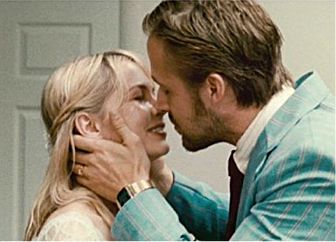
Blue Valentine with Williams and Gosling / All Good Things with Gosling and Dunst |
Remember the early word on Sean Penn for films like 'Racing with the Moon' (1984) and 'At Close Range' (1986)? He was considered a consummate, serious and extremely talented young actor. Remember Edward Norton and the buzz he created with 'Primal Fear' (1996) and 'American History X' (1998)? These actors proved that Hollywood could still produce thoughtful, powerful films interpreted by masters of the acting craft. Ryan Gosling is the latest contributor to this tradition. From 'The Notebook' (2004) to 'Half Nelson' (2006) and 'Lars and the Real Girl' (2007), Gosling has already run a very wide gamut of characters, all believable and compelling. This year, even just this month, he has honed in on two very different characters in rather similar situations making both a disturbed murderer and a loving, easy going family man equally believable and even sympathetic characters.
In both 'All Good Things' and 'Blue Valentine,' Gosling portrays a man married to a sweet, even adorable, blond. Both men are deeply in love with their wives. Both have large dogs. Both couples have to make a decision about a pregnancy. There is even a nude shower scene at the same point in their relationships -- an attempt to soothe the rough patch between them and rest a moment in each other's arms. Nonetheless, their marriages disintegrating and there is nothing these men can do to stop it. Both deal with the loss of their beloveds.
'Blue Valentine''s Dean is a working class guy who never wanted to be tied down to any particular woman until he met Cindy (Michelle Williams). For him, it's love at first site. He readily recognizes the significance of this important change in his outlook, accepts this new perspective and woos her until she relents and marries him. When they have a daughter, he embraces fatherhood and completely commits himself. I see Dean as a true avatar in the Hindi sense, not James Cameron's or Japanese anime's. It is said there is a particular number of people alive in the world at any one time who have reached enlightenment and are truly at peace and happy. If they ever become aware they have reached this enlightened state, it is robbed from them and they again want and feel unfulfilled. Perhaps this is caused by pride. In any case, Dean is blissful with his family life and desires nothing more than to continue as he is. Cindy tries to encourage him to seek more from himself in terms of a career -- do more than just be a house painter, earn more, challenge himself more. And this is the crack that eats away at their marriage. Perhaps the self-examination she encourages is the cause of his losing his avatar state. It's a heartbreaking thing to watch -- his loss of everything that made him whole and blissful. Gosling doesn't need cheap props to delineate his character; therefore, it is a shame that cigarettes were used in extremis to make over abundantly evident that he was a certain 'type' -- whatever that may be. Watching chain smoking only make me cough. It doesn't add to the character, but only shows that the director was insecure about his ability to get his actor to reveal his character and relied on a crutch instead. It got to the point that I no longer cared about what might happen to the character in the future, since the ever present cigarette must dominate his future (not seen in the film).
Gosling's David Marks in 'All Good Things,' is a damaged, tortured soul who could not overcome the impact of his mother's suicide or his ensuing life with his cold, manipulative, high powered real estate tycoon father (Frank Langella). Under different circumstances he might have been as well adjusted and happy as Dean in 'Blue Valentine'; we get glimpses of the man David might have been and struggled to become. But even his marriage to Katie (Kirsten Dunst) couldn't save him. He falls deeper and deeper into ... well, not a good place. Actually, this film doesn't bother to disguise the fact that it is actually the filmmakers' imaginings of real life person Robert Durst and his wife who disappeared in 1982. The police suspected foul play on the part of Durst, but couldn't find enough evidence to try or convict him. Yet, it would seem director Andrew Jarecki and writers Marcus Hinchey and Marc Smerling have done just that. They say they conducted many interviews and re-read all the evidence, and based on this, have built a complete scenario of Durst's crimes. Much of the story takes place between David and Katie, with no other witnesses or evidence to corroborate the filmmakers' story. Okay, Durst probably is guilty of everything they claim, but if the legal system of the United States couldn't condemn him, is it fair that they should? Trial by movie really makes me very nervous. I wouldn't want to be Robert Durst now that the film has been released. He is still alive and working in real estate in Florida. Good luck to him.
The profile of this poor little rich boy is spine tingling and gripping, all due to Gosling's artistry as an actor. Actually, the same can be said of his interpretation of Dean, the unaffected, loving, working class, family man. All cast members add to the veracity of the stories and, thus, deepening our involvement in their lives. Both films really ought to be seen as a double feature. Then, the depth of Gosling's artistry can be appreciated, as well as our ideas about love and marriage tested to the fullest. As powerful and gripping as both films are, I don't recommend them as date films. One shows a woman pulling out her marriage for her own reasons, the other, the husband doing what he feels he must to end his. There are no ties that bind unconditionally here.
Rare Exports: A Christmas Tale (2010)
Director / Writer: Jalmari Helander
Cast: Onni Tommila, Jorma Trommila, Ilmari Jarvenpaa, Per Christian Ellefsen
Time: 80 min.
Winter in the Northern Hemisphere is dark and cold. In the northern reaches of the Northern Hemisphere it's even darker and colder, until you get to the Arctic Circle where the sun doesn't rise for months. Much of Finland is above the Arctic Circle and light is in very short supply. So, it's kind of difficult to be cheerful during the Christmas season. 'Rare Exports,' a holiday season film from Northern Finland is a perfect example of the doom and gloom that can arise in an environment bereft of sunlight and warmth. Instead of Santa being the jolly, overweight bearer of gifts and joy for children, he is an otherworldly kidnapper and punisher of children, good or bad. Instead of toy making little elves, his minions are zombie-like, scrawny, old men. Santa is a doom bringer akin to the boogie man. |
Better watch out. Better be nice. |
To protect their children, the inhabitants of the reindeer-roaming Korvatunturi mountains long ago captured this evil doer and buried him in a man-made mountain of ice and earth. Today's archeological team searches for, finds and digs him up. What ensues is a battle between reindeer herding men and an ancient evil presence replete with fireworks, explosions, near death helicopter rides in a climactic chase.
What strikes one about this film is the serious attitude taken by filmmaker Helander and the cast. This film is more like 'The Thing ' (1951) in its sense of drama and darkness than a holiday movie. On its surface, it's a horror movie in which a resourceful child, his father and neighbors fight to save the lives of the children kidnapped by a supernatural force. It's not played for laughs, but it is hysterical. Don't expect to be fed jokes; the humor is in the situation, not pratfalls and yuks. You might want to warn your children that this new (to your children, not northern Europeans) view of St. Nick is not appealing, but a nice mixture of horror and ethnography. This is just how some old world historians view Santa, so keep the cookies and milk near the fireplace for a gift bearing visitor on Christmas Eve just in case they're wrong.
The Legend of Pale Male (2010)
Director: Frederic Lilien
Subject: Pale Male
Time: 85 min.
The Red-tailed hawk had not lived in New York City for a hundred years -- until one suddenly appeared in 1993. Onlookers, stunned and awed by his appearance, named him Pale Male, since, upon researching the red-tailed hawk, he was found to be paler than average. And so a cult to the bird was born. It didn't hurt that he picked the best neighborhood in Manhattan to call home -- Fifth Avenue and 74th Street, which is right across the street from Central Park's boat pond, replete with copious benches for comfortable bird watching and lots of easy pickings for an avian predator in the form of pigeons, rats, squirrels. It's like a Hollywood movie star living an apartment with huge picture windows on Sunset Boulevard. From a clique of hawk watchers who regularly met and swapped stories about their latest observations of Pale Male, his reputation grew to that of an international tourist attraction and headline news item in a struggle between nature lovers and priggish co-op owners on the upper east side.
|

Pale Male in all his glory. |
This film demonstrates in vivid, emotional terms how nature starved city dwellers have become. It's an urban commentary that the endeavors of one hawk captured the hearts of so many even though there are lots of urban animals, including those stated above, as well as ducks and swans, plus pets like dogs, cats and domesticated birds, and the captured creatures inhabiting Central Park Zoo just a few blocks away. New York City is truly removed from nature and Pale Male's fans demonstrated their need to keep him well, literally. They took to the streets, banners and posters waving, shouting for the protection of Pale Male, his mates and their offspring when threatened.
Fortunately for us in the San Francisco bay area, the governmental and corporate response to wildlife is more positive. When falcons were found nesting on a North Bay bridge, biologists and ornithologists were immediately called in to assure their survival and comfort. When a sea lion was found blocking the way of a man trying to approach his boat on Pier 39 slip, a meeting was held in City Hall and the decision was that boats would be removed from two docks, pontoons added and a fence and bleachers built so the sea lions could come and go as they pleased without worrying about the crowds that converged on the area to watch and cheer them. Need I remind San Franciscans about the Wild Parrots of Telegraph Hill? It was even stated in the documentary of the same name that there are now more conures in San Francisco than in their Central American homeland. We even view wild hawks as enemies since they prey on 'our' parrots, having killed the hero of said film, Connor, the only blue headed conure among the ever growing flock of red heads. Nature in its wildest form is close and pretty much in harmony with our sophisticated urban lifestyles. Hopefully, urban sprawl in the Bay Area will stop and the threat to other wildlife,. such as mountain lions, coyotes and deer will end.
But New York City is another story, and a more bereft one in terms of nature. Frederic Lillien, a Belgian who traveled to the U.S. to find himself and avoid being a lawyer in his father's firm, came upon Pale Male while walking in the park. There he found his future as a wildlife documentary filmmaker. He started this pursuit 18 years ago, and released 'Nature: Pale Male' in 1993. It garnered a multitude of awards at the time, aired on many PBS stations and was viewed in several film festivals. You might find this latest documentary familiar. It is, in fact, a continuation of 'Nature...' Lilien returned to New York to continue the film based on events that occurred after his first film was 'done.' The question always is -- when is a documentary finished? Perhaps with the release of this latest film, the Pale Male story is complete, but this special hawk has left a legacy. So, even if you have seen a New York City hawk film in the past, there is more to be said and seen. Even nature loving San Franciscans who go whale watching, or check out the migration of elephant seals at Ano Nuevo Beach in nearby San Mateo, or cross the Golden Gate Bridge to Marin and climb Hawk Hill to look down on hawks lazing in the air below them hunting for field mice and voles, will enjoy 'The Legend of Pale Male.' It has much to offer; not just a wild hawk, but the people who love him and join together in their own way of rejoicing nature.
The Chronicles of Narnia: The Voyage of the Dawn Trader (2010)
Director: Michael Apted
Writer: Christopher Markus, Stephen McFeely, Michael Petroni from the book by C.S. Lewis
Cast: Georgie Henley, Skander Keynes, Ben Barnes, Will Poulter, Gary Sweet, Terry Norris, Bruce Spence, Tilda Swinton, Anne Popplewell, William Moseley, Arabella Morton
Time: 115 min.
'The Chronicles of Narnia: The Voyage of the Dawn Trader' is truly all about the voyage, not the destination. Sure, Narnia is threatened and the kids and crew of the good ship Dawn Trader have to expel the threat, ergo the need for the voyage. This threat is nameless and disembodied; an evil that will eventually ruin this idyllic land. Pretty vague, but it's good cause to suck the two youngest Pevensie children back to Narnia to help fight the good fight, collect swords and lay them on some table, teach a spoiled cousin how to be brave and moral, yada yada yada. Whatever. The point is it's a beautiful film to watch, and 3D doesn't hurt. I just love traveling with them and the rest of the crew, including King Caspian, to the different islands with their various terrains and creatures. Be warned: a final monster is pretty horrific and may scare very young children. |

Aslan maintaining order. |
The story is less gripping than 'Lord of the Rings'; the children and other characters are less engaging than those of 'Harry Potter,' his friends and enemies; the humor and various plot complications of 'Stardust' or 'Elle Enchanted' are absent. But just take a day cruise on a fantastical ship and enjoy the ride.
Tiny Furniture (2010)
Writer/Director: Lena Dunham
Cast: Lena Dunham, Laurie Simmons, Grace Dunham, Jemima Kirke, Alex Karpovsky, David Call, Merritt Wever
Time: 98 min.
Aura (Lena Dunham) has just graduated from a mid-Western college and returns home to her successful photographer mother (Laura Simmons) and antagonistic younger sister (Grace Dunham) in Tribeca, Manhattan, New York. The adjustment is difficult, but since we, the audience, know nothing about her from before she left for college, we don't really know if it's an actual adjustment problem or if she's always been an insecure whiner. Yes, she has to make decisions now she didn't have to before, like starting a career or even just getting a job, moving into her own apartment with a college friend or staying with her family. But the personality we're presented with is an aimless, unmotivated young woman who yearns to be taken advantage of by men. Was she always that person? |

Lena Dunham - writer, director, star with a lot on her mind. |
Okay, I'm not real keen on this girl or how she tackles her problems or doesn't (rather than eagerly grasp at life). I, too, had to face the same problems upon graduation a century ago and perhaps I was as unsuccessful as she is in this film, but I had a great time doing it. Thus, it's all about one's perspective and character, not an unsolvable situation which justifiably causes self pity and laying on the floor in the depths of ennui and confusion while toying with tiny doll furniture. Also, Aura has no savvy about people that I have always believed was a gene developed in the environmental niche of New York through Darwinian mechanics. You really have to have this gene to survive in an environment of physical danger from thieves, financial danger from con artists, and emotional danger from men like those Aura pursues. Or you just have no self-esteem and be desperate to replace a lover who broke up with you, like Ora. My heart would go out to her except I'd rather slap her out of it.
Giving credit to the filmmaker and actors, 'Tiny Furniture' rings very true. We all know girls like this. We all know situations like this. The guys Aura meets, the parties she attends, the gallery shows, the very streets are all quintessential Tribeca. If you're not familiar with the neighborhood, it used to be a warehouse/industrial area near the southern tip of Manhattan. People started sneaking into non-residential lofts, hiding from fire inspectors in the 1960's and stayed until it finally became legal to live there. Over time, it became a very artistic area, then trendy, and now since Robert DeNero made it famous with his Tribeca Film Festival, incredibly expensive and exclusive. Those who moved in before its most recent transformation struggle to keep their rents down and stay. Seems like Aura's mother is either very successful in her artistic pursuits because she has a vast, two story work space and living space or she's been there since the good old days. I, personally, would never move out no matter what strife existed in this small nuclear family. That kind of space in Manhattan or even anywhere in New York City is comparable to a sprawling estate in Pacific Heights for Tenderloin rent.
What makes is film most ring true is that the film is writer/director/star Lena Dunham's semi-autobiography, and her mother and sister play ... her mother and sister, and it takes place in her actual loft-home. Obviously, Lena Dunham exaggerates her inability to get off her duff, find direction and make something of her life. Not only is 'Tiny Furniture' a tribute to her ambition, but it's her second feature, following 'Creative Nonfiction' -- all by the tender age of 24.
The King's Speech (2010)
Director: Tom Hooper
Writer: David Seidler
Cast: Colin Firth, Geoffrey Rush, Helena Bonham Carter, Guy Pearce, Michael Gambon, Timothy Spall, Jennifer Ehle, Derek Jacobi
Time: 111 min.
Ever wonder what the King or Queen of England does for a living. They don't rule their country anymore. That's done by Parliament. Seems English royalty just make appearances and speeches. If a king can't speak, he can't do his job. Take this already difficult situation and add the approach of World War II and a couple of the best orators who ever lived speechmaking for the opposing side: Adolph Hitler and Benito Mussolini. The King and his country are in big trouble. Leaders must rouse the people into action and support. Without a voice, it's impossible. And this was the situation for King George VI of England (Colin Firth) in the years leading up to the War. It's not like he hadn't tried any number of doctors to help him with his severe stuttering problem, but none had worked -- until his wife, Queen Elizabeth (Helena Bonham Carter), eventual Queen Mother of future Queen Elizabeth II who to this day still reigns, found Lionel Logue (Geoffrey Rush), speech therapist. |
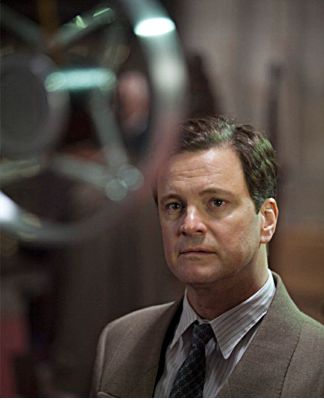
Colin Firth as the newly crowned
King George VI
apprehensively
approaching the microphone. |
Imagine a foreign commoner calling the King at their first meeting Bertie and asking about his relationship with his father! Logue felt psychoanalysis was a major part of therapy to rid the King of his meddlesome speech defect. Equal status between patient and therapist was also essential. He included body and voice exercises and no smoking as well. Unfortunately, King George only abided this rule while in the presence of Logue, and eventually died of lung cancer (not in the film). There were clashes and arguments between the two, but eventually, as history shows, Logue was successful and King George guided his people with calm, eloquent speeches through the War till its conclusion. The beauty of historical films is that, as an educated audience, we know the end, but the interplay of characters on a very personal and human level is a true reward. 'The King's Speech' is bountiful in this respect.
This is a very smart, humorous, witty movie. It is historically fascinating seeing the relationship George had with his brother, the abdicated King Edward VIII (Guy Pearce) (who was pressured out of his position due to his impending marriage to twice divorced American Wallace Simpson, but, more importantly, because he was a Nazi sympathizer, which was delicately suggested in the film). It was fascinating to learn the roots of George's speech problem and it was wonderful watching his relationship with Queen Elizabeth and their children, Elizabeth and Margaret.
Colin Firth obviously worked very hard and successfully to perfect his stuttering; all hearts in the audience go out to his character in his several painful attempts to speak publicly.
Kudos to writer David Seidler, himself a one time suffer of stuttering. At one point he asked the Queen Mother (Mrs. King George VI) if he could write a play about King George and his problem, and she agreed, but only after she died. He waited 30 years since she lived to the age of 102. Director Tom Hooper was also eminently qualified to direct this historical royal story, with experience directing Elizabeth I , starring Helen Mirran, for British TV.
Ahead of Time
Director: Rob Richman
Time: 73 min.
It's always wonderful to be reminded or or introduced to extraordinary people. It's rare when they are women, especially coming from a time when getting a college education and attaining status was socially improbable. Let's throw in for obstacle's sake that this particular 98 year old, Brooklyn-born woman who is a successful author, explorer, journalist and humanitarian is a Jew who established herself when antisemitism was rampant in the United States. That is why the biopic 'Ahead of Time' is so aptly named. Ruth Gruber is extraordinary not only for her accomplishments in the face of social, religious, and gender biases, but for her unselfconscious humility in the face of these achievements. It all seems so easy for her. It doesn't hurt be brilliant, hard working, fearless, adventurous, curious and socially aware. Combine these traits and you have someone who not only reports the news, she makes it. |
Ruth Gruber -- always in her prime |
I hesitate to list her adventures and accomplishments. They should be discovered in the viewing of the film. It seems odd that she has been forgotten by almost everyone. But then, so much of women's history is. Another reason to see the film. Women and young girls should see it to remind themselves there should be no limit to anyone's aspirations. Men could learn a thing or two from the film as well. Fortunately, Gruber was also a filmmaker and photographer, so there's much archival footage and stills evidencing her travails and landmark works. The audience will be constantly surprised by her exploits in disparate parts of the world during historically significant periods. She was there, recording, reporting and contributing to outcomes. Her charm and lucidity at her present age is inspiring. Thanks to Rob Richmond in his directorial debut, her legacy will not be lost.
Love and Other Drugs (2010)
Director: Edward Zwick
Writer: Edward Zwick, Charles Randolph, Marshall Hersokwitz from the book 'Hard Sell: The Evolution of a Viagra Salesman' by Jamie Reidy
Cast: Jake Gyllenhaal, Anne Hathaway, Oliver Platt, Hank Azaria, Judy Greer, Josh Gad, Gabriel Macht, George Segal, Jill Clayburgh
Rated: R
The plot line of this film may be fodder for women's channels: passionate relationship between two very beautiful people thwarted by a woman's incurable illness. She wants to be noble by letting him go, but still can't help whining about her dismal fate. He wants to be a good man and stay with the woman he loves, but also wants to escape the fate of tending to an eventually deteriorated body. Very melodramatic, very sexy, very heart wrenching. |

Anne Hathaway and Jake Gyllenhaal comfortable in their skins |
But due to the superior acting skills of stars Anne Hathaway as disease victim and Jake Gylllenhaal as drug salesman and a sensitive yet not over schmaltzy script, there's not so much tear jerking as compassion elicited from the viewer. And then there's the bodies. These two should be bronzed for posterity. At the top of their physical form and with lots of nude scenes to show them off, even your football fan boyfriend will enjoy this film, even if the lessons to be learned in the story escape him.
Plus, besides the relationship storyline, there's the pharmaceutical business exposé that captures one's interest. Drugs are hawked to doctors by top predators who can earn hundreds of thousands of dollars a year by delivering the right pitch and the right payoffs. Doctors can't help but be swayed by the relentless barrage of attention. Some even make a list of demands, anywhere from free lunch to exotic vacations to women for sex just to listen to a pitch for a drug or to accept some free samples. Doctors are even aware that prescribing some drug is not always the best course of treatment for a patient, but writing prescriptions for a tranquilizer or antibiotic will satisfy a patient, knowing he or she has received something concrete, a pill that has been advertised endlessly in TV commercials -- so much more satisfying than the old adage, 'Drink plenty of fluids, rest and call me in the morning.' This also substantially increases the doctor's bottom line. So, patients beware. Is the doctor helping you or appeasing you while accepting expensive gifts for prescribing certain drugs? 'Love and Other Drugs' takes place around the time Viagra was introduced to the market. The monetary boon to doctors getting a whole new demographic into their offices and Pfizer and its employees raking in profits was astounding. Pfizer can't be happy about this film and it's depiction of how this and other drug companies market. I really appreciate that the film used actual drugs' and drug companies' names. So, enjoy the romance and take heed of the factors that influence medical care. Do you really need that antibiotic, tranquillizer or sleeping aid?
White Material (2010)
Director: Claire Denis
Writers: Claire Denis, Marie N’Diaye, Lucie Borleteau
Cast: Isabelle Hubert, Christopher Lambert, Nicolas Duvauchelle, Isaach De Bankolé, William Nadylam
Time: 102 min.
Maria Vial (Isabelle Hubert) starts her day as if it were any other day. But today is different. Her workers are leaving en masse, declaring it's too dangerous to work there any longer. There's a revolution. The military are fighting the guerillas, among them a band of armed children, and the fight is spreading throughout this unnamed African country. A helicopter flies overhead, its French soldier yelling down to Maria that the French army is leaving; there is no longer any protection for her and other French colonists. She should leave now. Her ex-husband, Andre (Christopher Lambert) is trying to sell the coffee plantation she works and lives on before it is worthless and the revolutionaries take it over. The mayor of the nearby town tells her to leave for her own safety. |
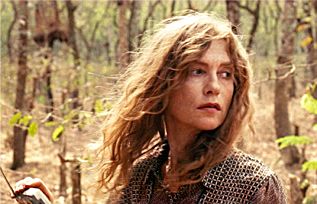
Isabelle Hubert, colonialist, getting the message. |
But Maria knows no other life than that of running her plantation and she adamantly refuses to accept the obvious. Like Isak Dinesen generations before in 'Out of Africa' (1985), she will stay on her little coffee plantation no matter what. This is a study in denial and the fate of all foreign settlers. History shows that almost all people who are victims of imperialism will fight, no matter how long it takes, to win their country back. It was true in all African states, India, Indo China. Not true in the Americas only because the Spanish and European invaders decimated the native populations. Another film opening November 26, 'Outside the Law' coincidentally shows the struggle of another African country for independence from France, Algeria. This film depicts the different path three Algerian brothers take in their quest for Algerian independence and a return to the land that was in their family for generations, but given to French settlers in their childhood. Their struggle takes place in France, and utilizes terrorist tactics to wear the French down, while others fight in their homeland, which was dramatically documented in the 1966 film, 'Battle of Algiers.'
Maria forcefully does whatever she can to keep on keeping on. She finds new workers, she travels by truck, bus, foot taking care of business as the danger heightens. Her panic slowly rises as she can no longer ignore the signs of the end of her way of life. She notices child size dirty foot prints in her bathtub, a woman who quit working for her that morning is wearing her jewelry, men with guns blocking the road demand payment for her to pass. How much will it take for Maria to finally relinquish her hold on the life she leads? White material refers to all the possessions once owned by colonists, but are now up for grabs during the insurrection. We get to watch the changes in day to day life from the colonists' perspective. W are asked to sympathize with her plight. But will we? She's beautiful, innocent of the history of overtaking this foreign land. She was born in this country and has worked hard. She knows no other life. Revolution is a messy, unorganized and brutal. People whom she had worked with, was friends with, are now not to be trusted. I found it interesting that she did not behave like a stereotypical imperialist. Her relations with locals were relaxed, pretty respectful and superficially not racist. They also treated her with the same color blindness. But she simply is not a black African and she owns land that should be owned by the native people, so they believe. She is in the way. Times have changed. It is frightening for both her and the Africans to go through this transition.
Claire Denis, writer/director of 'White Material' was raised in Africa and lived through this very situation. Her first feature film in 1988, the semi-autobiographical, 'Chocolat,' addressed these same issues.
Note: It was fun to see Christopher Lambert in Africa again since his breakthrough film was 1984's 'Greystoke: The Legend of Tarzan, Lord of the Ape,' though I didn't recognize him till I read the credits.
The Next Three Days (2010)
Director: Paul Haggis
Writers: Paul Haggis, Fred Cavaye, Guillaume Lemans
Cast: Russell Crowe, Elizabeth Banks, Liam Neeson, Brian Dennehy Michael Buie, Moran Atias, Remy Nozik, Jason Beghe, Ty Simpkins, Olivia Wilde
Time: 122 min.
Russell Crowe plays John Brennan, a community college literature teacher who has the perfect life: a wonderful relationship with his beautiful wife, Lara (Elizabeth Banks), a young son, Luke (Ty Simpkins), an extended family that shows no signs of dysfunction. He is a truly happy man until his wife is arrested and convicted for a murder she didn't commit. Through a rapid fire series of unintentional and accidentally arranged evidence, she is inextricably tied to the brutal murder of her boss. All hope is lost with no cause for appeal or reprieve. Not only has John and his son lost wife and mother, but she is suicidal. A new man of resolve emerges to deal with this hopeless situation where others might accept their fate and sorrowfully move on. |
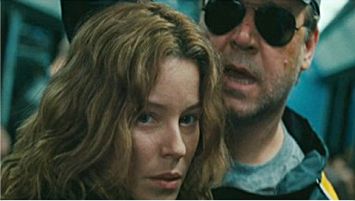
Elizabeth Banks and Russell Crowe on the run. |
John starts with research on major points of jail busting, interviewing a master prison escape artist, Damon Pennington (Liam Neeson). He learns that he must change who he is to his very core principles, risking everything to attain his wife's freedom. This is the most intriguing aspect of the film -- a mild mannered man's transformation. His minutely detailed plans may be thwarted by the police at any point, due to their own expertise, his mistakes and unforeseen changes in circumstances. That leads to thrilling, fast paced tension
I love John Brennan because he is such a devoted husband and father. Neither during the good nor the hard times of his marriage does he ever see any woman as a sexual object or potential mate. What a guy! I love John Brennan for his single mindedness of purpose even at the expense of his well ordered life, all his possessions, and possibly his or others' lives. I thrill at watching John Brennan under pressure -- his resourcefulness is awe inspiring.
In short,. this is a compelling love story propelled into an escape film about people we want to see overcome their insurmountable problems. The audience wants John to to win, but can't imagine him being able to do so. Still his solutions are not too far fetched to snap disbelief, just nerves. The theater floors will be strewn ankle deep in popcorn by the time this film concludes.
Note: Unfortunately, we only see Liam Neeson for one short scene. The commercials and trailers are misleading -- Neeson's part is larger than a cameo, but smaller than we'd all like to see.
Genius Within: The Inner Life of Glenn Gould (2010)
Director: Peter Raymont and Michele Hozer
Time: 106 min.
This biopic of Glenn Gould, iconic pianist, known not only for his music, but his idiosyncrasies, is not only amazing because of the archival footage that so fully documents his life, but is a true pleasure to watch and listen to because his music fills almost every moment of the documentary. '32 Short Films about Glenn Gould' (1993) imaginatively and creatively re-enacts episodes of Gould's life and philosophy through narrative shorts and is well worth watching for all Gould fans and those who would become fans. But "Genius Within...' shows us the actual Glenn Gould, phobias, hypochondria, divo behavior, various psychological warts and all. This film has to be the end-all of documentaries of Glenn Gould. I can't imagine there is more to be uncovered about him. Now I know Glenn Gould -- well perhaps not the 'genius within or the inner life,' but all a film can relate about another human being. I also know his music through recitals from his first appearance in New York in 1955 to his very last recording. |
 Glenn Gould - the intensity of his stare, the intensity of his playing.
 |
Having once heard his name and music on the radio, I, a mere neophyte who likes classical radio in the background as I work on my computer, was awed and moved by his unique sound -- it made me stop working to fully listen. Having then seen '32 Short Films ...,' I was intrigued and fascinated. Now, having seen 'Genius Within...,' it is Gould on disc I listen to as I write this. Now, I compare his 1955 Goldberg Variations to his 1981 version of the same work. In the film, we learn how he melded his unique technique with his innate talent. Childhood, concerts, love life, peccadilloes, eccentricities, character, are all explored, and never boring. Gould left a legacy of his recordings, which he much preferred to make over concert tours. Unfortunate for those who would have flocked to his concerts, fortunate for us who can still enjoy his talents long after his death and for posterity. You may not think you like this type of music, but if you like any music at all, Gould deserves a hearing and you deserve to be exposed to him.
'Today's Special' has a light, warm, and charming masala of all these ingredients. There are no surprises here if you've already seen an expatriate Indian film before. Some are very dramatic, some are farcical. This film is more a light romantic comedic search taken by a young man, Samir (Aasif Mandvi)-- in his career (to take him to the next level from sous chef to imaginative, risk taking master chef); in his family life (from disappointing son to save-the-farm hero); in love (not that there's anything wrong with Indian girls, but ....). Samir is a likeable enough character whose journey is fraught with frustrations and disappointments until he hooks up with magical cab driver/adventurer/chef Akbar (Naseeruddin Shah) who teaches him to throw away the recipes (and health codes) and cook with the head, heart and stomach, and live the same way. There are lots of beauty shots of Indian cuisine to whet one's appetite.
Four Lions (2010)
Director: Chris Morris
Writers: Chris Morris, Jesse Armstrong, Sam Bain
Cast: Riz Ahmed, Arsher Ali, Nigel Lindsay, Kayvan Novak, Benedict Cumberbatch, Julia Davis, Craig Parkinson, Preeya Kalidas, Wasim Zakir, Mohammad Aqil
Time: 102 min.
Rated: R
Al-Qaida meets the Three Stooges plus one. Laughs -- political and slapstick, infantile and dark --are fast, abundant and wistfully wish fulfilling. Wouldn't the world be a better place if terrorists were buffoons, simplistic not-even-near-do-wells who are so stupid they're thrown out of a terrorist training camp and go it alone to make their mark for jihad and go to a heaven full of virgins for them to rape? |

Barry, Omar and Waj fumble in their attempts
to bring the world back to the dark ages. |
Four would-be terrorists, Omar (Riz Ahmed), Waj (Kayvan Novak), Barry (a Caucasian malcontent with a huge case of Reichian impotent rage who uses Muslim extremist vengeance to ease his neuroses) (Nigel Lindsay), and Faisal (Adeel Akhtar), attempt to fulfill destiny by killing as many innocent people as possible in the name of Allah. The problem is one is stupider than the next. For instance, we see them trying to make a terrorist video, but constantly interrupt the recording to criticize the size of the plastic gun being held by the spokesperson. To live a little longer, one decides to attach small bombs to crows rather than himself and train the crows to fly into office windows -- to no avail. This secret cell of four can't keep a secret as to the location of their hideout replete with fixings for bombs and get lots of visitors looking for a place to chill out. In short, they can barely keep themselves from becoming their own victims.
Though writer/director Chris Morris says his vast research uncovered just such examples of humorous incompetency, I can't help but feel this view of terrorism in Europe and Pakistan is a way of diffusing fear among us democracy loving capitalists. We will certainly feel more confident and less fearful of terrorist threats having seen this film. But should we? I recently reviewed 'Fair Game,' which recreates the true story of CIA agent Valerie Plame and her husband, ex-Ambassador Joe Wilson who both did research into White House claims of Iraq having weapons of mass destruction which was the motivation for the invasion of said country oh so many years ago. They found no such evidence. Their insights in this film look bad for the Bush administration, but comforting for us Americans.
Perhaps we're all tired of being afraid and want a little relief. And perhaps there's no point in being afraid since we common citizens of the Western World really can't do anything about the terrorist threat. So, let us see 'Fair Game' and stop considering building bomb shelters a la the cold war. Let's enjoy the biting humor for 'Four Lions.' As true as this depiction in Four Lions may be, as moronic and ineffectual as these characters are, letter bombs are exploding as I write this review. So, don't open letters from Yemen or anywhere else east of the Mediterranean and let M5, CIA and other international agencies do their job.
It's a very reassuring comedy to watch. Yet, though Chris Morris says he does not criticize the culture or the religion of these specific terrorists or terrorists in general, Muslim fanatics are known for their lack of humor about any kind of comedic pot shots. Will the stars of this film survive; will all the people attached to this film escape retaliation for depicting jihad terrorists in such a pathetic light? Who will get the last laugh?
One thing, though. The most frightening moment of the film for me was when Omar and his wife (played by Preeya Kalidas) have a discussion at their kitchen table. Their young son, maybe 10 years old or so, joins them and exclaims how wonderful it is to die for jihad, what a good death and what a wonderful afterlife is in store. The parents smile and agree. This, not the exploding bombs, the training camp in Pakistan, the wild pursuit through the streets of an unnamed city in England, chilled me to the core. The next generation is trained and eager to take the place of this, with no end in sight.
For Colored Girls (2010)
Director/Writer: Tyler Perry
from the original stage play 'For Colored Girls Who Have Considered Suicide When the Rauinbow Is Enuf' by Ntozake Shange
Cast: Thandie Newton, Whoopi Goldberg, Kerry Washington, Anika Noni Rose, Michael Ealy, Omari Hardwick, Janet Jackson, Loretta Devine, Kimberly Elise, Phylicia Rashad, Tessa Thompson, TJ Hassan, Richard Lawson, Reagan Michelle, Macy Gray
Seems like all colored girls' problems are colored men, not social distinctions, not history of slavery and concomitant disadvantages, not prejudice -- or at least any associations between their man problems and social problems are not made distinct on 'For Colored Girls.' Also seems that all their man problems could be solved with a little forethought and self respect. We follow eight black women who live and work in Manhattan -- from a building manager to a fashion magazine executive to her assistant to a nurse to a dancer to a religious fanatic to a social worker to a bartending sex addict. Each in a different way has been negatively effected by black men from boyfriends to acquaintances to fathers and husbands. Besides the overriding message of all back men are trouble, two perhaps more useful messages ring out -- take responsibility for your own problems and get support from your sisters (in the larger sense of sisterhood). |
All the girls join arms and hands
to find strength to carry on. |
This is definitely not a date movie. Every man coming out of the theater will be angry that his gender was depicted so disparagingly; every woman will loose all faith and trust in her escort. The stories are painful and ring true to many women's experiences, though hopefully, women have gotten their lives more in control and fewer of these stories are being repeated since the choreopoems and play was first written 35 years ago. All the actresses give emotional, heartfelt performance. Many perform very poetic monologues as difficult as any from a Shakespearian play. I was surprisingly moved by Janet Jackson's soliloquy in intense close up. With so little experience in front of the camera, she unabashedly dug deep.
These stories are universal, regardless of color or nationality, and all women can see themselves represented by one or another of the characters. It's not fun, but it is enriching. Perhaps go with your girlfriends and have a long 'waiting to exhale' discussion afterwards.
Marwencol (2010)
Director: Jeff Malmberg
Subject: Mark Hogancamp
Time: 83 min.
In April of 2000, Mark Hogancamp was beaten so brutally in the parking lot of a bar he frequents in Kingston, New York, that he lost all motor skills and his memory. In time and with physical therapy, he got the majority of his motor skills back, but had to rebuild his mind, memories, personality and courage. When his Medicare insurance ran out, he developed his own form of therapy; he built Marwencol, a miniature Belgian village filled with GI Joes, Barbies and other small people he detailed with paint, clothes and stories. He also added buildings, vehicles and props to enhance the authenticity of his actuated imaginings. Through one particular doll, he became the hero of this World War II ravaged town; fighting Nazis, falling in love and having various adventures with characters who often represent people he knows in his Kingston neighborhood. Then he photographs tableaus with a camera that doesn't even have a working light meter. |
|
Mark is still fragile, and saying he will never be the same is an understatement. Before the violent incident, he was a hard drinking, divorced, Navy veteran who dabbled in art. No longer able to use a pen or brush with dexterity, he builds a world and shoots it. Is he a better though damaged person? This is something he wrestles with each day. This film shows his thug-imposed 'fresh start', and how, with his limited resources, he decides who he is going to become. 'Marwencol' is true triumph of the spirit and a fascinating look into the workings of a damaged mind in the act of rebuilding itself. The photographs which have been shown in a New York City gallery with great success are so lifelike and realistic, one has to remember they are dolls and not archival photographs. Exploring Hogancamp's mind through his stories and vivid, eerie photographs is fascinating and has no shortage of unexpected detour
Monsters (2010)
Director/Writer/Cinematographer/Visual Effects: Gareth Edwards
Cast: Whitney Able, Scott McNairy
Rated: R
Time: 94 min.
With a miniscule budget, I have to accept that everything I saw in Monsters, including aged signage in many places warning of the infected zone, military area, danger, and other weathered markings that added to the veracity of the situation were made in a computer. So were the skeletal remains of buildings, towns, fighter jets, military tanks and even dead monsters and humans. I was agog at how on the one hand, this film was shot much like war documentary, and on the other, it looks like a Hollywood production of a war zone to which a lot had to be added to create the appearance of gorgeous, verdant Central American locations.
I was fooled by the authenticity of the look into thinking this was a good movie. It took a second thought, and a third to realize the plot was teetering on insultingly ludicrous absurdity. Yes, a U.S. probe could and probably will one day bring back life from other planets or moons in our very own solar system. And yes, such a craft |

Whitney Able and Scott McNairy
braving the monster infected zone. |
could easily crash,. exposing microbes to the best environment for life yet found. With water, oxygen and carbon dioxide, sunlight and warmth, any physicist would say this is the luckiest place yet known for life to grow and diversify. These life samples could easily burgeon into anything in a short time, even hundred foot tall, octopus like, land floating (an imaginative stretch) monsters. So, I could easily buy the premise -- even that the probe would crash in Mexico, so near Dallas and NASA.
But no one has a cell phone? And the multimillionaire publisher-father of a girl who is stranded in Mexico ( with no plausible reason why she was there in the first place) would simply send a private jet to pick her up. Therefore, no trek through the monster infested jungle with an employee-photographer as protector would take place.. Suspension of disbelief snaps at a certain point -- maybe the glowing organic bulbs on the trees was my last straw. All the great cinematography, attractive stars, cool monsters, and bloody violence against indigenous peoples falls by the wayside when one thinks about all the plot faux pas. I leave unsatisfied and only want to complain over a latte with friends later.
Fair Game (2010)
Director: Doug Liman
Writer: Jez Butterworth
Cast: Naomi Watts, Sean Penn, David Andrews, Sam Shepard, Noah Emmerich, Michael Kelly, Bruce McGill
Time: 105 min.
What an odd couple! Stranger still is that this is a true story. Joe Wilson (Sean Penn), high profile, outspoken, retired Ambassador from the United States to Niger, Africa, married to Valerie Plame (Naomi Watts), a CIA operative who lives the life of an Ambassador's wife, on the one hand, and has a completely hidden identity as an spy, on the other. The strain on their marriage must have been tremendous at the best of times. Joe and Valerie's parents knew she is CIA, but she couldn't talk about her missions, her access to certain information, her actual day-to-day life when she isn't housewife and mother of twins. What keeps them together is their love for each other and their mutual sense of patriotism and belief in the tenets of democracy. They both dedicate their lives in their own ways to upholding the Constitution and maintaining the security of the country. All is about to change with the outing of Valerie Plame in the Washington Post. |
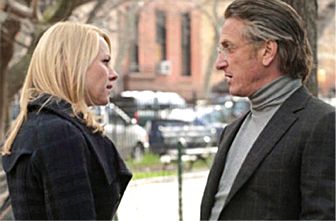
Valerie Plame (Naomi Watts) and husband
Joe Wilson (Sean Penn) discuss strategy. |
We get to see Valerie's actions in protecting the American way of life, including gathering information regarding weapons of mass destruction which fear leads to the invasion of Iraq shortly after the September 11th attack on the United States. She is logical, well informed, and unemotional about the information she and others in the CIA are able to retrieve. Most critical in Bush's decision to invade Iraq, or so he said, is the presence of 'yellowcake' and metal tubes, both of which his cabinet convince Bush are necessary for the development of weapons of mass destruction, specifically atom bombs. Valerie knows this is not the case and advises as much. Joe is also asked to go to Africa, using his contacts and knowledge of the area to see if goods from Africa necessary for the production of nuclear bombs made their way to Iraq. He reports after his visit that it was impossible to have transported such goods. In an act of retaliation against the two of them for their response to the Presidents's need to prove war against Iraq necessary, Lewis 'Scooter' Libby (David Andrews), a high ranking Bush administration official, outs Valerie Plame as a CIA operative in an article by Robert Novak in the Washington Post. Joe Wilson alleges that the disclosure was part of the Bush administration's attempts to discredit his report about his investigations in Africa and the op-ed describing his findings because they did not support the government's rationale for the 2003 invasion of Iraq.' (quoted from Wikipedia).
Once exposed, Valerie is fired from her career job, a cascade of lies about her appeared in the press, and aspersions against her husband are cast as well. Joe insists on taking the high road, talking to the press and on television about the facts behind the lies. Valerie wants only to fade back into obscurity and let the whole ugly incident pass.
I'm not giving away anything. It's all historical fact and clicking on some of the above links will reflect that. You all probably remember a lot of it. But this film really probes the political maneuverings and strategies behind the headlines. This is a thought provoking and revealing film about how the government works -- Bush's, Vice President Dick Cheney's, and Lewis Libby's lies to disguise their actual ambitions in Iraq, as well as jeopardizing those who disagree with them. On a more intimate level, it shows the biggest hurdle in Valerie and Joe's marriage. Could they withstand the barrage of lies against them and deal with each others different approaches to handling the situation? Penn and Watts, together again since '21 Grams' (2003), are convincing as a long-time married couple who deal with secrets, loss, frustration and deep love as only long-time marrieds do. They seem comfortable in their skins and in the skins of the characters they portray.
As the film progresses, or the plot thickens, the tension builds to a fever pitch -- this is a true spy/action/thriller, and it all really happened. You don't have to remember the incidents depicted in the film; you don't have to take a particular interest in politics. 'Fair Game,' taken from the title of the book Valerie Plame wrote, is a pot boiler and a love story which will keep you in your seat for 105 packed minutes.
Conviction (2010)
Director: Tony Goldwyn
Writer: Pamela Gray
Cast: Hilary Swank, Sam Rockwell, Minnie Driver, Peter Gallagher, Melissa Leo, Bailee Madison, Juliette Lewis, Karen Young
Rated: R
Time: 103 min.
Betty Ann Waters (Hilary Swank) and her brother Kenny (Sam Rockwell) were very close as children, in large part because their mother had little interest in them and left them to their own devices. As a result, Betty became a very responsible mother and bar manager. Conversely, Kenny was a troublemaker and rabble rouser who collected a colorful rap sheet. Still, they were both each other's best friends. When Kenny is accused and convicted of a murder he claims he did not commit, Betty Ann stops at nothing to get him exonerated. This includes getting her GED, college and law degrees at the cost of her marriage and even the custody of her children so she can fight the legal battle for him. And that was only the beginning of her struggle to gain Kenny's release. When he was convicted, forensics was in its infancy. Seventeen years later, Betty Ann enlists the Innocence Project to re-evaluate the evidence and prove Kenny's innocence. Still, release is not eminent. But she bravely and relentlessly forges on. |
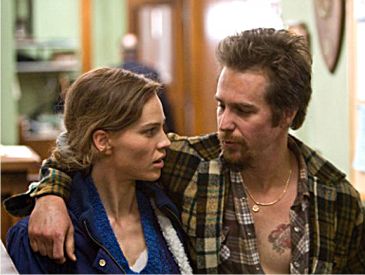
Hillary Swank and Sam Rockwell fighting the system. |
'Conviction' is based on the true story of Betty Ann Water's indomitable fight, unwavering loyalty and single mindedness. When all is said and done, Betty Ann only wants to be a bar manager and mother, and has no intention of using her law degree for any other purpose than the release of her brother. Watching the film, I wondered if Kenny should even be released, whether he is guilty or not; he is so volatile and violent, it would seem likely he would wind up behind bars anyway. Of course, that is just cruel thinking, but it did cross my mind he might not be worthy of the effort being spent and the sacrifices being made. And by the end of the film, the strongest message I found swimming in my head was 'Legalize Consensual Incest.' No joke, these two not only deserve to be together, but any other relationship they could form with others would be a pale shadow of what they had together, not that there was any suggestion of a sexual inclination between them. Their dedication to and love for each other is the stuff of legend.
Hillary Swank gives a solid and convincing performance as Betty Ann. Her sacrifices are painful, but her biggest fear is that she is not up to the task. Her example proves that we are all capable of great things given the impetus. Sam Rockwell is terrifyingly real as a no-collar, good hearted guy who just can't control his anger and frustration and can't resist a good time. I still can't get a handle on Sam's face. He is the perfect invisible actor whose individuality is sacrificed for each role he plays. I swear I can't recognize him from film to film. Is he really the same guy from last year's 'Moon' or either of the two guys he played in 'Gentlemen Broncos', also from 2009? Probably, lack of recognition as an extraordinary actor is due to not being able to recognize him from role to role. But try to keep an eye on him, or at least remember his name. He's worth it.
Leaving (2010)
Director: Catherine Corsini
Writers: Catherine Corsini and Gaelle Mace
Cast: Kristen Scott Thomas, Sergi Lopez, Yvan Attal, Bernard Blancan, Aladin Reibel, Alexandre Vital, Daisy Broom
Time: 85 min.
British expatriate Suzanne (Kristen Scott Thomas - an expatriate herself), living in France, has been married over 20 years to a man she probably never loved. And that kind of relationship certainly doesn't withstand the test of time. She and her family, including two teenage children (Alexandre Vidal and Daisy Broom) live very comfortably in an art filled, modern house with her husband, the doctor Samuel (Yvan Attal). She might have felt a little restless and decided the antidote to that certain form of ennui would be to go back to work as a physiotherapist. But she needs more than an interesting job to fulfill her. Entre Ivan (Sergi Lopez), a Spanish construction worker building her office in the backyard. Their attraction is undeniable and they both fall deeply, passionately and inextricably in love. |
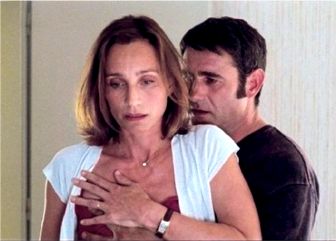
Kristen Scott Thomas and Sergi Lopez getting familiar |
It's easy for her to give up her lifestyle, her home, her job and whatever else her vindictive husband tries to take away from her. For some inexplicable reason, husband Samuel just wants her back and will hurt her any way he can to get her. You figure out the French; I can't. I can understand the attraction Suzanne feels for Ivan -- the passion beyond physical attraction (though there is plenty of that) which she has missed in her married life of routine, polite behavior and security. She risks everything for love and in the process she reaches the depths of despair and finds peaks of bliss -- and we get to watch it all for the price of admission.
'Leaving' reminds me of last year's 'I Am Love,' starring Tilda Swinton. Both heroines are middle aged, expatriate wives with teenage children and live in their wealthy, respected husband's countries. Tilda plays a Russian living in Italy. Both have very explicit, very erotic affairs with very inappropriate men and give up everything for a life of sensual pleasures in their rustic mountain retreat. I find Kristen Scott Thomas' Suzanne much more relatable, human and warm. Tilda Swinton's Emma seemed to have been drained of all human characteristics by her formal, sterile life until the spark is reignited by her paramour. Husbands beware: wives trapped in routine, unexciting, loveless, uninspired lives will seek what they're missing. And it seems to be knocking at their doors.
Nowhere Boy (2010)
Director: Sam Taylor-Wood
Writer: Matt Greenhalgh from the memoir by Julia Baird
Cast: Aaron Johnson, Kristin Scott Thomas, Ann-Marie Duff, David Threlfall, Josh Bott, Ophelia Lovibond, David Morrisey , Thomas Sangster
Time: 97 min
There have been a lot of films made about John Lennon at various stages of his life. IMDb.com counts 42, but I wheedle that number down to 15 where he was a fictional character or a minor visitor to the story. And there are more films on the way. We don't get tired of investigating the lives of extraordinary people, those who have contributed in a meaningful way to our culture and our own personal histories. Because Lennon and McCartney's music so influenced their time, and that of many of us (still alive), our earnest curiosity into the man remains undiminished. On his 70th birthday, we review and enlarge upon his childhood and teen years. We all know that John (Aaron Johnson) was raised by his Aunt Mimi, his mother having abandoned him when he was 5. In 'Nowhere Boy,' we find out more about those years and his relationship with the two most influential women in his life -- till Yoko Ono. Mimi (Kristin Scott Thomas) was the stern, even stoic, |
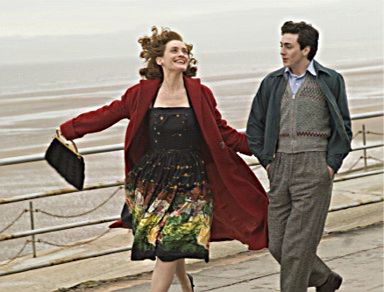
Ann-Marie Duff as John's mother, Julia,
and
Aaron Johnson as John Lennon in a lighter moment |
conservative who preferred John stay in school and get a reliable job. But she was the one who bought John his first guitar. Julia, his mother (Ann-Marie Duff) was passionate, musical, fun loving and flighty, yet the guilt of having given up her son always darkened her outwardly playful demeanor. Though outwardly these two women are so opposite in character, we see their very complex and deeper emotions.
We also start to understand Lennon's psychology -- how he was effected by his abandonment, his upbringing by his stern aunt, the reunion with his mother and their renewed relationship. All this is going on as he reaches manhood and strives to set out on a career in music. These were particularly difficult times for Lennon. On the one hands, he wants answers, apologies and amends. On the other, there are no satisfactory explanations for abandonment and only more pain could come with full disclosure.
Lennon's biting wit, sarcasm and underlying anger become more understandable, his need to express himself and find catharsis, his drive to form a band and be successful. That is, if we are to believe the subtle interplay of characters. Unfortunately, John can no longer tell us how accurate this interpretation of the bare facts are in this film. Fortunately, Julia Baird, John Lennon's half sister, wrote a memoir upon which the screenplay was based. Much of the film's contents was witnesses by young Julia at her mother's home, which adds to the veracity of the film.
All the actors were very talented, but it's an extra bonus when actors look like the characters they play. Aaron Johnson seems to have really gotten into Lennon's skin, making up with character what he might not have in physiognomy. It was very interesting watching John's relationship with Paul McCartney start and grow, but I just wish Thomas Sangster looked less like an adolescent Leonardo DiCaprio and more like Paul. Kristin Scott Thomas and Ann-Marie Duff share enough of a resemblance to each other to convince the audience of their sisterhood, if not to the characters they portray. It was a very satisfying and elucidating glimpse into Lennon's intriguing past -- compassionate and sometimes ugly , joyous and heartbreaking, like real life is.
Tamara Drewe (2010)
Director: Stephen Frears
Writer: Moira Buffini from the graphic novel by Posy Simmonds
Cast: Gemma Arterton, Roger Allam, Bill Camp, Dominic Cooper, Luke Evans, Tamsin Greig, Jessica Barden, Charlotte Christie
Time: 107 min.
From the Thomas Hardy novel, Far From the Madding Crowd, to a graphic novel by Posy Simmonds, to the screen, 'Tamara Drewe' is a retelling of many classic English pastorals with a modern twist. It's fast paced, funny, witty and charming. The more you're familiar with these kinds of stories and characters, the funnier it is. In this case, a young woman, Tamara Drewe (Gemma Arterton), returns to her childhood country home, a beautiful, successful journalist. The new twist is she's not the typical ugly duckling who naturally matures into a raven beauty. She had surgical help in the form of a rhinoplasty or nose job. We even get to see Tamara with her original noise in a flashback, and the difference in overall appearance due to those additional few ounces is stunning. |
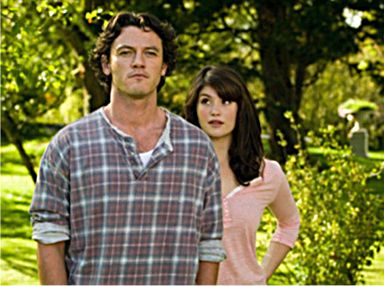
Country Lad (Luke Evans) smitten with
new-nosed,
city-wise Tamara (Gemma Arterton). |
The country home in question, Winnards, was bought by her parents from a family that had owned it for many generations. Now, Any Cobb (Luke Evans),no longer owner of Winnards, works across the dale as a handyman at Stonefield, home of Nicholas Hardiment (Roger Allam) and his wife, Beth (Tamsin Greig), who run a retreat for authors and would-be authors who find inspiration in this bucolic setting. What happens between these two households, and a shack at a bus stop where two very bored teens hang out and dream of rock stars and romance, is convoluted by betrayal, budding love, rekindled love and writer's block. There's even a cattle stampede and a bit of controlled British mayhem.
One thing I still don't understand no matter how many times I see it happen -- women have, even crave sex, from very unattractive men, and not even for money or security. I can't fathom why Beth Hardiment would want to have sex with her husband, Nicholas. He's old, he's wrinkly, he's built like a pear, and obnoxious to boot. Yet, not only does she love him and want to continue their relationship, but seems countless women not only have sex with him, they want him to leave his wife for them. Sure, he is a well known mystery writer, but knowing someone famous and maybe using his contacts to get a book of your own read by a publisher is one thing, rubbing up against him is quite another. There is far too much of this going on in 'Tamara Drewe,' and it just dumbfounds me.
And if you enjoyed this one, rent 'Cold Comfort Farm' (1995). It refers back to even more classic English tales from mysterious goings-on in the shed, to who gets to inherit the estate, to an orphaned flapper in London having to live with the country relatives. And it stars the pre-'Underworld,' pre-sexy Kate Beckinsale.
All My Friends Are Funeral Singers (2010)
Director / Writer: Tim Rutili
Cast: Angela Bettis, Emily Candini, Reid Coker, Kevin Ford, Megan Hovde-Wilkins, Karol Kent, George McAuliffe, Michael McGinley, Sierra Magdalena Mitchell,
Alan Scalpone, Molly Wage, Wesley Walker, Joe Adamir, Jim Beckner, Ben Massarella, Tim Rutili
Time: 86 min.
Zel (Angela Bettis) is a medium, as was her grandmother, who lives in a cluttered old house filled with not only the flotsam of generations, but lots of ghosts. Unfortunately (for me, at least), some of these ghosts are experimental folk musicians whose sounds range from the |
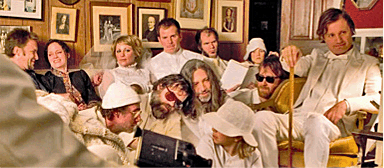
Medium Zel (Angela Bettis) in black with her ghostly 'family'. |
gentle plucking of a zither to deafening cacophony. The music group Califone, headed by director Tim Rutili, supplied the musical ghosts. Another of the ghosts is a documentary filmmaker who interviews the other ghosts, finding out how they died and what they think of the afterlife. These ghosts don't know much since they're stuck in the house, a limbo station, waiting impatiently to walk into the light.
Zel thinks of them as her family. They even help her in her work, relieving a friend of an evil eye curse that causes headaches, picking winning horses, and just keeping her company. But they want out and tensions are building, and taking a toll of poor Zel.
This dark comedy is a refreshing new take on ghosts, psychics and life after death. The film had an unprofessional look probably caused by 16 mm camera and film or perhaps it was an intentional dream quality. The acting was very good and the characters charming, each in their own way. I even found the brash, almost grating neighbor a welcomed intrusion. And her conversations with her deceased husband through Zel certainly reminded me of home and lacked the formality of typical 'other side' contact.
Dumas (2010)
Director: Safy Nebbou
Writer: Gilles Taurand, Safy Nebbou
Cast: Gerard Depardieu, Benoit Poelvoorde, Melanie Theirry, Dominique Blanc
Time: 105 min.
France
Alexander Dumas (Gerard Depardieu), one of the most famous writers in France (and interestingly, though not brought up in the film, of mixed race -- just a little factoid), does not write alone. Some would call his associate, Auguste Maquet (Benoit Poelvoorde) his ghost writer, meaning he does all the writing and lets Dumas put his name on the work. Others might call him a collaborator since Dumas contributes lots of ideas and even pages of prose. But it is questionable of any of Dumas' efforts end up in the published novels. No one actually says anything about their relationship since no one knew about it. It's obvious why Dumas was the front man. He was flamboyant, outgoing, even outrageous. He lived beyond his means, threw great parties, and if his lovers alone were all literate
|
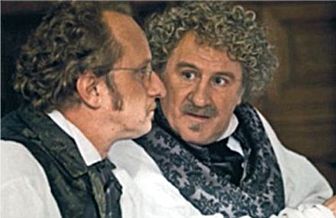
Benoit Poelvoorde and Gerard Depardieu
brainstorm over the Three Musketeers |
and could buy his books, his financial success would be assured. Dumas did have one particular close relationship -- with his secretary, Celeste Scriwaneck (Dominique Blanc), who was his rock and from whom he carefully guarded his more lascivious secret life. On the other hand, Maquet seemed more like a staid college professor, which he actually was. He was a good husband and family man who had never strayed and was critical of Dumas' dalliances. That is until he met Charlotte Desrives (Melanie Thierry) who, due to a switch of hotel rooms between Dumas and Depardieu, begs the wrong writer to get her father released from prison.
Here is where we start to see a reversal of character which is intriguing and surprising. Maquet is so infatuated with this much, much younger woman that he risked relationships with wife, family, and Dumas, even his freedom and his life to win favor with Charlotte while Dumas proves his true loyalty and deep love for Celeste. Maquet becomes impetuous and fool hearty while Dumas turns out to be the stable, cool thinking guy who stabilizes a risky situation.
Both Depardieu and Poelvoorde are sublime as these diametrically opposed yet deeply dependent figures. Mid-18th century France is beautiful and still in political turmoil after the revolution and Bonaparte's failed empire building. It teeters between a renewed revolution and loyalty to the re-established monarchy. Again, these are times that try men's souls. Both Dumas and Maquet are swept into it; Dumas because of his prior youthful stance on freedom fighting, Maquet because of his infatuation for this femme fatale. The denouement is exciting and unexpected. Notice all my French words?
Eep! (2010)
Director / Writer: Mieke de Jong
from the book by Iep!
Cast: Huub Stapel. Joke Tjalsma, Diederik Ebbinge, Kenadie Jourdin-Bromley, Madelief Vermeulen, Ties Dekker
Time: 80 min.
Holland
This is an imaginative and beautifully shot film. A bird watcher, Warre (Huub Stapel), finds a little living creature in the grass under a tree and no adult bird around to claim her. But this little thing is a bird person with the body and head of a baby, though she is small enough to fit in a palm, and wings instead of arms. The little special-effects creature is brought home by the bird watcher to his wife, Tine (Joke Tjalsma), who insists this will be their child whom she will raise. Eep (because that'd what she says) or Birdie (because that's a girl's name that aptly describes her) grows to childhood in short order. This teeny, hirdlike child has difficulties speaking as if
|
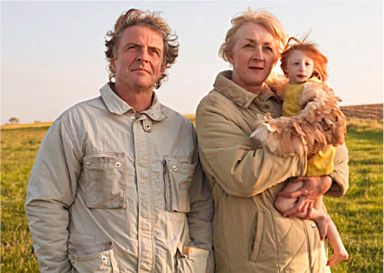
Warre, Tine and little Eep watch the birds fly south. |
her mind can only form bird sounds, and starts feeling her natural instincts to fly which she finds irresistible. The adventure through the Dutch countryside begins when Warre and Tine decide to follow Eep and bring her back once she has flown the coop. Along the way, we meet various colorful and sympathetic characters who want to help save Eep from the North Sea she must cross if she is to follow the migration south to warmer climes for the winter. (I have a problem -- the North Sea is north of The Netherlands, not south. She is flying in the wrong direction!) Here's the amazing thing. There are no special effects used for this tiny bird child -- except her feathered arms and her flying among birds in the sky. The part is played by Kenadie Jourdin-Bromley who has primordial dwarfism, suffered by less than 100 people in the world. Born at 2 1/2 lbs and not expected to live more than a few days, Kenadie is now 7 1/2 years old and an international movie star. Ethereal is an understatement -- not just because of her size, but, if I may use a tired and nebulous word, her aura. She is called by many a little angel and her effect on people cannot be denied. Now her legacy not only includes a documentary about her seen on cable and PBS stations, but this wonderful children's film. Hopefully, we'll see more of her in films in the future. She truly is magical as well as beautiful and a great, if awkward, flyer.
The Most Important Thing in Life is Not Being Dead (Spain) (2010)
Directors: Olivier Pictet, Pablo Martin Torrado, Marc Recuenco
Writers: Pablo Martin Torrado, Marc Recuenco
Cast: Emelio Gutierrez Caba, Francisco Nortes, Marian Aguilera, Marce Montala, Carles Aguimbau, Albert Auselle
Time: 82 min.
Jacabo (Emelio Gutierrez Caba) has reached an age where he tends to reflect on his life. These thoughts are pleasant in that he is thankful for his beautiful wife (Marce Montala) and loving family, and his satisfying career as a piano tuner. So why does he have those unsettling dreams about waking up as a young man (Francisco Nortes) in a field with a cuddly sheep? Why does he often see a strange man (Carles Aguimbau) eating food from his kitchen and using his bathroom, then promptly disappearing? Why does he suffer from insomnia? Why does he hear a piano when no one else does? |
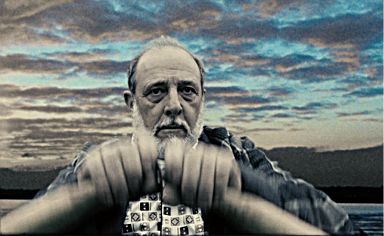
Jacabo behind the oars dreaming in vivid color. |
My first conclusion is that this is a magical realistic interpretation of his mid-life crisis. For instance, Jacobo, a piano tuner for many generations and very proud of it, always thought that with a good deed, a few prayers, and a good night's sleep, Jesus would take care of the pianos, and they were always fine the next day. His dreams which refer to the Greek myth of Io and Zeus with color saturated skies and that same recurring lamb in a rowboat who changes color and gives cryptic hints to Jacobo's dilemma must have deep psychological meaning -- perhaps due to the pressures of life during the dictatorship of Generalissimo Francisco Franco, a reign of political and social oppression that lasted almost 40 years. But really, is that stranger in his home a dream or an intruder? And after all the questions are answered, I still don't know how his pianos get fixed and why his neighbor's wasn't. This is a very funny story about love in the time of dictatorship and after, about life and the ultimate success of life being staying alive to appreciate it.
Fanny, Annie & Danny (2010)
Director/Writer/Cinematographer/Editor: Chris Brown
Cast: Jill Pixley Carlye Pollack, Jonathan Leveck, Colette Keen, George Killingsworth, Nick Frangione
Time: 82 min.
There's dysfunctional, and then there's Fanny, Annie & Danny's family. There is no pretext of trying to get along or even liking each other. This is dysfunctional on meth, figuratively. The blatant hate, fighting, even rage is shocking. It's raw, angry and downright brutal. But it is Christmas and the family gets together -- mostly because they all love the prodigal son, Danny (Jonathan Leveck), who is actually a con man who bilked the rock band he was trying to promote and now they want their $20,000 back or they call the police on Monday. So, like any favored son and brother, he cons his family, including his gravelly throated harridan of a mother (Colette Keen), his harpy of a sister, Annie (Carlye Pollack) who is consumed by |
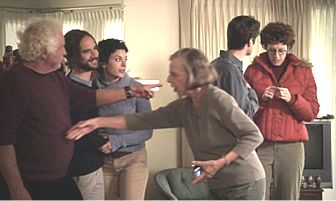
The family assembled: George Killingsworth, Nick Frangione,
Carlyn
Pollack,
Colette Keen, Jonathan Leveck, Jill Pixley,
like a ticking time bomb. |
arrangements for her upcoming wedding to an unemployed, impotent, pot head who is actually the nicest guy (Nick Frangione) in the film -- which she doesn't appreciate, his oldest sister, Fanny (Jill Pixley). Fanny was just laid off her job at a chocolate factory, and it's not likely she'll find another job soon with her OCD, mental handicap and possible autism. Let's all sing obscure Christmas songs around the electric piano and have some turkey! The worst is yet to come.
See Bonnie Steiger's Interview with writer, director Chris Brown.
See the trailer at YouTube.
Opal (2010)
Writer/Director: Dina Ciraulo
Cast: Nayeli Adorador-Knudsen, George Maguire, Carrie Paff, Gabriel Marin, Ben Beecroft, Keven Rolston
Time: 79 min.
See Bonnie Steiger's interview with Dina Ciraulo about "Opal". How did Dina find this once notorious character? What motivated Opal to stray from her original path as a naturalist and become a journal writer and possibly hoax perpetrator? We'll get Dina's perspective on Opal and the strange, long life she led. |
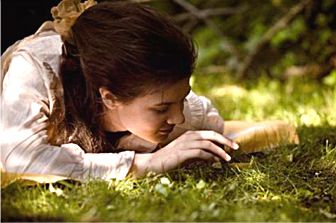
Nayeli Adorador-Knbudsen as
a contemplative Opal |
An actual historic figure though mostly forgotten, Opal Whiteley's life began in the Oregon woods where she frolicked among the giant redwoods and the tiny insects and butterflies. Opal, a self-taught naturalist, not only played in the forest, but truly appreciated and contemplated the wonders of nature around her and the importance it played in the spiritual lives of people. As a child, Opal kept journals about the beauty and wonder of nature and her life experiences. These naive and refreshing reflections on the world around her made her famous in her adult life when published in a national magazine.
Dina Ciraulo, writer director of 'Opal' follows this extraordinary woman's life from children to her entrance into college, no small feat for any woman in the early 20th Century, especially on a partial scholarship, through her efforts to get her book on her observations of nature published, to her fame as contributing writer for the Atlantic Monthly for her serialized retelling of her childhood journals, to her fall from fame and grace due to questions about the veracity of her journals, her background and perhaps her very sanity.
The River Why (2010)
Director: Matthew Leutwyler
Writers: Thomas A. Cohen, John Jay Osborn, Jr. from the novel by David James Duncan
Cast: Zach Gilford, Amber Heard, Kathleen Quinlan, Dallas Roberts, William Hurt, William Devane
Time: 104 min.
Gus (Zach Gilford) decides to leave home and live in a cabin on the river which he calls the River Why because it wriggles through the valley of the Oregon mountains in a path that looks like the word Why in script. It's a relief to get away from his parents' constant arguing -- Dad (William Hurt) is a renown and published fly fisher and Mom (Kathleen Quinlan) is all about bait. They must be very much in love since they have nothing in common. But the major draw, nay, the consuming passion and joy is being able to fly fish uninterrupted and unabated by himself. He plans a daily schedule in which he allows himself 14 1/2 hours of fishing a day. He plods along shallow rivers in his waterproof hip boots, exploring various fishing grounds. Life is perfect -- so his melancholy surprises him. In his non-fishing time, he ties flies which he sells at a local shop and he hangs out with a philosopher friend, Titus (Dallas Roberts), shooting pool, arguing idea. |
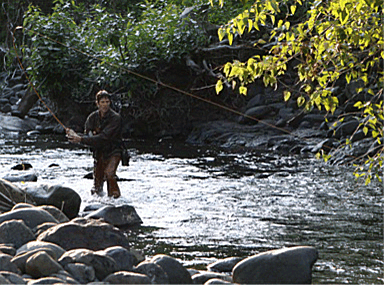
Gus (Zach Gifford) angling for the big one. |
There's lots of time to ponder while fly fishing, even though Gus never has to wait long to get a bite. His thoughts drift to matters of the existence of the soul, God and nature, if killing fish is really a harmless sport, and if he'll ever again see that beautiful girl (Amber Heard) he spotting giving fly fishing lessons in a mall. This is a beautiful film shot in the lush, verdant wilderness of Oregon. I can't blame screenwriter/project developer / entertainment attorney Thomas A. Cohen for holding on to his dream of bringing the book to the screen. I interviewed Cohen in 1989, at which time he had already written the script and was deep into development. I'm glad he persevered. And even though San Francisco native, director Matthew Leutwyler moved on to Los Angeles to become a very successful film producer and director, he came back to helm this production.
It's called a crime comedy, but you have to listen very closely to catch the humor. It's dry, deadpan and hysterical -- in a very Nordic way. Ulrik (Stellan Skarsgard) has just been released from prison for having committed murder, just like 'Mr. Bjarnfredarson' in neighboring Iceland, review above. There seems to be a run in post-prison adjustment films from Scandinavia this year. But Ulrik is not at all like Georg Bjarnfredarson in character. He really is a very gentle man -- he's never harms children or women or even cause a woman embarrassment by rejecting her advances, he has very good table manners, and keeps silent rather than airing his opinions. But he is actually a low ranking career gangster who has killed. Ulrik has reached a point in his life where he wants to follow the straight and narrow; he's tried of his criminal ways and wants to start fresh. Ah, but can he? Obstacles are put up in his path that he has to either overcome or succumb to. Even the bleak, dreary, featureless Norwegian vista and numbing suburban environment seem to offer no hope. No fjords, mountain ski trails or medieval towns in this film, only the view of Norway seen by inhabitants on a daily basis.
Ulrik is a very sympathetic character one can't help but root for. Hopefully, he'll figure out a way to smooth out the wrinkles in his path to a crime free life. Stellan Skarsgard is fun to watch acting in his native language, after having been identified in films such as the 'Bootstrap Bill ' trilogy as our hero's father, Bootstrap Bill. Now, instead of being engrained in the hull of the Black Pearl, he's an auto mechanic ex-con dealing with the stupidity and duplicity of his gangster boss (Bjorn Floberg) and his sidekick (Gard B. Eidsvold) (seen flanking him in the photo, left, about to purchase a gun for his next crime). He also has romantic problems to deal with that seem insurmountable. It's all fun, in a rather glum way. But be patient and you just might see Ulrik give a hearty laugh.
Twigson () (2010)
Director: Asleik Engmark
Writer: Brigitte Bratseth based on Anne Cath Vestley's novel Lillebror og Knerten
Cast: Andrian Gronnevik Smith, Petrus Andreas Christiensen, Pernilla Soerensen, Jan Gunnar roeise, Asleik Engmark
Time: 71 min.
Norway
From the Children's Festival section of the Mill Valley Film Festival 2010, Twigson is pure fun the adults can easily sit through with their children. Junior (Adrian Groennevik Smith) and his family have just moved to the beautiful Norwegian countryside. It doesn't take but a few minutes for Junior to realize that children are few and far between and he needs a new playmate, one of his own making. As his dad prunes a nearby tree and scatters branches and twigs, Junior finds Twigson, and human like twig who can talk and move (if not walk on his own). They become close friends instantly and life in the country is complete. On walks in the woods they fight dragons and spy a princess on a horse named Pegasus. They have run ins with the carpenter whom Twigson doesn't trust. They avoid the nasty little girls who they meet at the general store who would steal Twigson and smother him with their doll's kisses. Life is very eventful for Junior and Twigson as the seasons change. While they keep each other company, Junior's parents struggle on to earn a
|
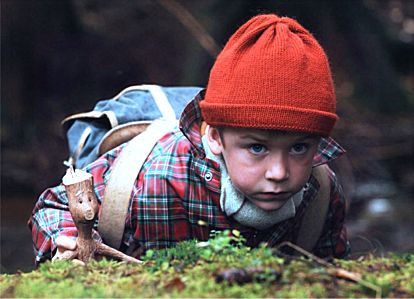
Twigson and Junior (Adrian Groennevik Smith) stalk a dragon. |
living and keep their new wonderful though decrepit home. Let's all just forget we're adults for 70 minutes and enjoy our time with Junior and Twigson. Let's play with Twigson, too. I'm willing to overlook that Twigson has a bit of an attitude and changes his stories to fit the also changing circumstances. Things tend to work out in this world they've created -- if you never give up. We have to be reminded that children are better at problem solving than adults who tend to overcomplicate things and get unduly emotional. '
Buried (2010)
Director, Editor, Co-producer, Music Editor and Producer: Rodrigo Cortes
Writer: Chris Sparling
Cast: Ryan Reynolds, voices of Robert Paterson, Jose Luis Garcia Perez, Robert Clotworthy, Stephen Tobolowsky, Samantha Mathis, Ivana tMino, Erik Palladino, Anne Lockhart, Michalla Petersen
Cinematograper: Eduard Grau
Time: 95 min.
Rated: R |
Bonnie Steiger and Ryan Reynolds - tete a tete |
What a disturbing movie! Claustrophobes out there, be warned. The whole film takes place in a buried crate with one man inside, Paul Conroy (Ryan Reynolds). He's a truck driver, contracted as a civilian to drive supplies in Iraq. Did he think this was an easy way to make big money? His convoy is ambushed. He's knocked out somehow, hard to remember, and he wakes in this crate not much larger than a coffin with only a cell phone, a flask of water, a lighter, and his anxiety pills. Wait a second! This guy suffers from anxiety and takes a job in a war zone? We find out all this and more through his desperate phone calls.
This has to be one of the worst nightmares imaginable, so horrible that most don't have the courage to dream it. Reynolds is incredible, alone in the box, trying desperately to save himself. The range of emotions, from fear, horror, anger and subtleties in between are all heart wrenchingly honest. The story was powerful and believable. One wonders how many people this has happened to without the general public's knowledge. The cinematography never got routine or boring. Director of photography Eduard Grau has discovered every possible way to shoot a box which serves the story and keeps us in there with the action. This film is not for the feint of heart, but a true tour de force for filmmaker Rodrigo Cortes and Reynolds. It also exposes yet another view of the conflict in the Middle East.
Bonnie Steiger had the opportunity to discuss the film with Ryan Reynolds. Please watch this and other celebrity interviews with Bonnie.
The Romantics (2010)
Writer/Director: Galt Niederhoffer from the novel by Galt Niederhoffer
Cast: Katie Holmes, Josh Duhamel, Anna Paquin, Malin Akerman, Jeremy Strong, Candice Bergen, Adam Brody, Elijah Wood, Dianna Agron, Rebecca Lawrence
Time: 95 min.
Rated: PG 13 |
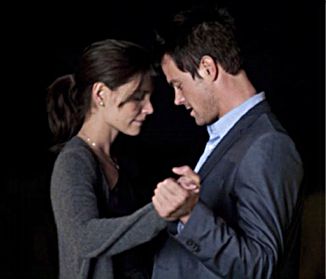
Katie Holmes and Josh Duhamel
rekindling or saying farewell? |
Weddings seem from recent films more about the guests, family and friends, then the bride. It is a microcosm of their lives from birth, or in this case college, to the nuptials, causing a fomenting of old loves, frustrations, resentments and even hate. Remember 'Rachel Getting Married' (2008) with Anne Hathaway as the sister of the bride, or 'Evening' (2007) with Venessa Redgrave on her deathbed remembering her youthful self (Claire Danes) as bridesmaid for her best friend, to name just two? The Romantics is no exception.
Laura (Katie Holmes) is asked by her best friend Lila (Anna Paquin) to be Maid of Honor at her marriage to Tom (Josh Duhamel), Laura's long time love. Laura tries to be mature and brave and civilized about it, but friends keep pouring salt on her wounds with innocent remarks such as 'How are you holding up?' After the wedding rehearsal and dinner, including insulting and revealing toasts, the serious drinking begins.The close knit collection of friends, including Malin Akerman, Jeremy Strong, Adam Brody, Rebecca Lawrence, self named Romantics from their college days, and brother of the bride, Elija Wood, cavort and carouse the night away. It's a wonder no one was taken to the emergency room for alcohol poisoning. Mostly, the bonds of fidelity are tested among them. And deep into the night, Tom tries to explain to Laura why he made his decision.
It's a bitter story of love lost in the environs of upstate New York, among the majestic old homes, the green hills, the breeze swept trees and ruffled waters of the nearby river replete with bobbing boats and the ominous sky that threatens the outdoor wedding on the morrow. No real surprises here, no revelations, but a pretty powerful confrontation between bride and maid which makes clear both their positions. Paquin was the epitome of control and determination. Holmes was very sympathetic as the forlorn lover. Duhamel was, well, a guy, weak, confused and perfectly typical in his waffling. His hardest decision was not who to marry, but which side to part his hair, which, by the way, appear to have been cut between takes of him in the mirror prepping and the actual wedding minutes later.
Catfish (2010)
Directors: Ariel Schulman and Henry Joost
Central character: Nev Schulman
Time: 94 min.
Rated: PG-13
You've heard the story dozens of times already, but this time you see the whole evolution of an internet relationship -- fraught with first excitement, then emotions and desire, then shocking revelations. Fortuitously, Nev Schulman, a New York photographer and Facebook pen pal, shares office space with two documentary filmmakers, his brother Ariel Schulman and Henry Joost. All the twists and turns of Nev's internet, phone and face-to-face relationship with the family and their friends he first meets t |
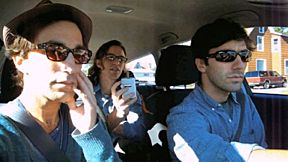
Ariel Schulman - shotgun, Henry Joost - rear,
Nev Schulman - behind the wheel on the road to the truth. |
Through his Facebook account are recorded. It all starts when Nev receives through snail mail from an 8 year girl in Michigan, Abby, a painting based on one of his published photographs of dancers. He often speaks by email and phone with Abby's mother, Natalie, and eventually Abby's beautiful sister with whom he falls in loves. Over time, we get to watch the progression of Nev's emotions from enchantment with the precocious, talented and charming Abby, to passion for Megan, all bolstered with actual packages from Michigan filled with cards, notes and artwork, including a lovingly depicted portrait of Nev based on his Facebook photo. The outcome of his relationship with the various family members could be predicted, but is still surprising, as are his reactions to their various actions. This is a fascinating cautionary tale of how 21st century, plugged in, laptop and palm device toting people conduct their relationships. Wish I could say more about it, but don't want to ruin the act of discovery the audience goes through with Nev as he and his cohorts learn more about human frailty, loneliness, desperation and imagination.
I couldn't figure out why Nev wasn't already taken. Not only is he desirable for the standard reasons: young, handsome, healthy, artistic, earning a living, and seems to be a really good man, but be lives in one of the biggest cities in the world. He's surrounded by all kinds of women, literally millions of women. Because of his profession, he meets hundreds of beautiful, talented and intelligent women. Why is he traveling thousands of miles to meet someone he has fallen in love with from a distance? Is Nev flawed in some way that his brother is too close to see and expose on film? Or are people as a society no longer able to form relationships without an Internet crutch? Is that the deeper, hidden message in the film? How many photographic subjects has Nev not thought of as possible mates who may have been? How many has he met at parties, sat near in restaurants, brushed by in the subway, even been introduced to by his mother that he has ignored because he didn't meet them through Facebook?
Undertow (Contracorriente) (2010)
Director/writer: Javier Fuentes-Leon:
Cast:
Manolo Cardona, Tatiana Astengo, Cristian Mercado
Time: 100 min.
I'm not a fan of coming out movies. American gay films tend to be kitsch, camp and superficial. Everything is for laughs, and after a while the laughs get tired, especially when all these coming out films cover the same issues pretty much the same way. My favorite gay themed film is 'Lilies' from Canada back in 1996. It was a powerful story imaginatively told. Being a closeted gay was an issue and a pivotal force to the ensuing action which far exceeded the problems of keeping a boyfriend or getting acceptance from one's family. It was a real story set in a fairytale land (pardon the pun). |
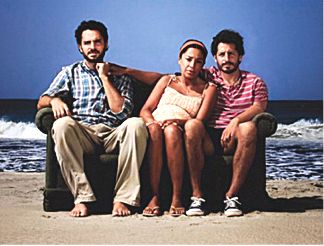
Cardona, Astengo, Mercado -- a man, his wife and
the ghost of his lover.
A little Crowded. |
Now, finally, another coming out film that is powerful, unsentimental and honest in its depictions of social issues, forbidden love, emotional conflicts and morality -- and it's got a ghost! This one, 'Undertow,' is Peruvian, set in a little fishing village about a married fisherman who is in love with an openly gay artist. It's hard enough being gay in the most backward U.S. subculture, but in a microcosm of machismo there are no options, no San Francisco to escape to, no living with neighbors who know you're gay.
Miguel (Cristian Mercado) loves his wife (Tatiana Astengo) who is expecting their first son. He loves her physically and emotionally. He loves his life as a fisherman among his friends, relatives and neighbors in this close knit community. And as much as he is in denial, he loves Santiago (Manolo Cardona). Miguel has tried to figure out a way to conduct his clandestine relationship without being exposed. Never be seen together; never discuss Santiago, even in passing; laugh at the homophobic jokes with his friends; travel by boat to a distant beach to meet with Santiago; never let Santiago take photos or paint him. It all seems to be working until one day Santiago goes missing. Eventually, his drowned body is discovered. Now, here's the problem. Santiago's ghost haunts Miguel with the one request that he is buried with the religious rights practiced in this village so he can finally rest. And here's the kicker -- Miguel likes Santiago hanging around in his same old corporeal self. Finally, Miguel can walk down the street holding Santiago's hand without fear. No one can see Santiago but Miguel. They spend lots of time together, Miguel unafraid and happy. Santiago insists he must go; he needs the rites performed. For Miguel to comply, he has to come out, lose his wife and son, his place in this ideal little society, well, ideal except for it's homophobia. This is when he learns what it really is to be a man, to stand for what he believes in, to do the right thing.
Just recounting the story line of the film explains why it is such a powerful and original film. Watching the look on Miguel's face as he walks down the street with Santiago unafraid for the first time is in itself is exhilarating and poignant to the point of tears. Also, the village could easily become a tourist destination after this film -- it's so lovely, the ocean and surrounding hills so picturesque. The cinematography by Mauricio Vidal is often breathtaking. The direction by Javier Fuentes-Leon is subtle and convincing, as are the performances of the actors. This mature and polished work is doubly surprising coming from a first time feature filmmaker. I'm so glad he gave up his medical career to take up filmmaking. I look forward to his future projects.
Heartbreaker (L'arnacoeur) (2010)
Director: Pasqual Chaumeil
Cast: Romain Duris, Vanessa Paradis, Julie Ferrier, Francois Damiens, Helena Noguenak, Andrew Lincoln, Jacques Frantz
Writers: Laurent Zeitoun, Jeremy Doner, Yohan Gromb
Time: 104 min. |
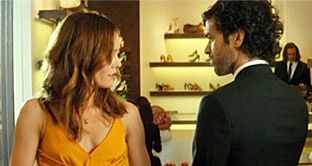
Paradis and Duris face off in the game of love. |
Here's a novel idea -- hire a professional con man to break up your daughter, sister, or friend from a man who is just not good enough. This boyfriend could be described as a loser, brute, lout, jerk or even more colorfully. If he isn't making her unhappy now, he certainly will in the future. Honestly, if the Heartbreaker did exist, I'd hire him myself for a certain sister of mine. Alex Lippi (Romain Duris) will show her the error of her ways compassionately and ethically. With his sister (Julie Ferrier) and her husband (Francois Damiens), they form a Mission Impossible team who with exhaustive research, split second timing, disguises and farcical maneuvering, save the targeted woman from a grim fate. Alex is not only charming, he is specifically the dream man each young woman finds ideal. When they no long want their boyfriends, he lets them down easy and encourages them to live their lives to the fullest and not to settle again. All ends happily, except for the jerks these women leave, but who cares?
Here's the snag. Alex is hired by a rich (Jacques Frantz) industrialist to save his daughter from someone who is actually a real Prince Charming (Andrew Lincoln) . He's handsome, devoted, rich.... perfect. And the daughter, Juliette (Vanessa Paradis - Johnny Depp's long time paramour) eagerly looks forward to the upcoming nuptials. If it weren't for the loan shark and his goon threatening Alex with immanent harm and death if an outstanding debt is not immediately paid, he wouldn't take the case. So, on very little notice, with little time to prepare, under stress from the loan shark, and feeling morally conflicted about the whole situation, Alex and his associates take to task. It's funny, charming, original and endearing. The beginning of the film shows Alex and his team at work in many of his previous cases -- different women with different ideas about the perfect man, in many different countries with lots of split second timing and psychological acuity at work. It may be the best part of the film, but stay anyway and watch Alex's fortress of professionalism and isolation come tumbling down.
Unfortunately, there is no doubt that within a couple of years, Hollywood will get its hands on the script, butcher it and transform yet another original French comedy into typical fast food, multiplex fodder. Take for example previous French comedies > Hollywood drek.
Dinner for Schmucks (2010) from Le Diner de Cons (1998)
Cousins (1989) from Cousin Cousine (1975)
Pure Luck (1991) from La Chevre (1981)
Father's Day (1997) from Les Comperes (1983)
The Man with One Red Shoe (1985) from Le grand blond avec une chaussure noire (1972)
The Birdcage (1996) from La cage aux folles (1978)-- this one is really the only good one among the pack mostly due to Robin Williams', Nathan Lane's and Hank Azaria's spot-on performances.
All the American versions are a pale, slapstick, insensitive version of their far superior inspirations. So, make a point to see Heartbreaker to get the full effect of the humor, originality and charm before Will Ferrell and Jennifer Anniston botch it up.
Bran Nue Dae (2010)
Director: Rachel Perkins
Writers: Rachel Perkins, Reg Cribb, Jimmy Chi based on the stage musical by Jimmy Chi & Kuckles
Cast: Rocky McKenzie, Jessica Mauboy, Geoffrey Rush, Ernie Dingo, Missy Higgins, Ningali Lawford-Wolf, Deborah Mailman, Tom Budge, Magda Szubanski
Time:88 min.
Rated: PG-13
Australia |
 Geoffrey Rush in center.
The whole gang
breaks into song and dance. |
Bran Nue Dae is taken from a stage play developed by writer/rock musician Jimmy Chi who himself was raised in the remote Northwest coastal town of Broome, Australia, in the1960's. The musical comedy, which made its debut in 1990, was an instant success because of it's catchy music, political message, touch of bawdiness, and its being a universal coming-of-age story.
Young Willie (Rocky Mckenzie in his first acting role), religiously brought up by his single mother (Ningali Lawford-Wolf), is about to leave his idyllic home of Broome, where he would fish, hang out with friends, and dream of being Rosie's (Jessica Mauboy) boyfriend. He is being sent to the mission Catholic school in Perth to eventually become a priest. Though a devout young man, the idea of leaving home and ending all hopes of a happy, un-celebit, life with Rosie are unacceptable. After a run in with Father Benedictus (Geoffrey Rush), he runs away, hoping to get back home. Along the way, he meets up with an old hobo, Uncle Tadpole (Ernie Dingo), who says he will take him back to Broome, his hometown as well. And the road trip begins. They soon fall in with a couple of hippies (Missy Higgins, Tom Budge) traveling in a Volkswagen van and convince the young couple Broome is the place to go. Meanwhile, Father Benedictus is in hot pursuit. Along the way, we get to see a few thousand miles of beautiful, desolate Australia, hear a bunch of bouncy tunes, and learn a bunch of life lessons along with Willie.
Some outrageous songs include one about a boy meeting a girl and asking her for sex, "Seeds That You Might Sow.' She says, 'Well, I like baloney or perhaps a sausage roll, but if you don't use those condoms, then you cannot poke my hole.' Did I hear that right? Or the song in response to racist remarks directed at the students in the mission school by Father Benedictus goes: "There's nothing I'd rather be than to be an Aborigine and watch you take my precious land away.' And from the same song: 'I'd be satisfied to rebuild your convict ships and sail you on the tide,' referring to the settlement of Australia by English convicts brought by ship to relieve the overcrowded prisons back home. That's telling him!
Standout performances by Ernie Dingo as Uncle Tadpole. His pathos, wisdom and great voice was an anchor the whole film seemed to hinge on. And Deborah Mailman as Roxanne, a town slut hungry for action and booze, with a squeaky, little voice and disarming manner lit the screen with each appearance. Unfortunately, there were no professional dancers. When it came to the tap dance sequences, the camera shot only above the waist and a tap audio track was added. There was a lot of red dust kicked up, dirt not being the best tap environment. That was probably the funniest part of the film.
Director Rachel Perkins, herself indigenous, has made a name for herself in the film and televisions industries with previous features, including musicals, and the longest and most expensive television documentary ever made, all about indigenous peoples. It's great to finally see the world or even just Australia from the perspective of the Aborigines. Too bad more of their work isn't getting to the U.S.
The Agony and The Ecstasy
of
Phil Spector (2010)
Director: Vikram Jayanti
Interviewee: Phil Spector
Time: 102 min.
This is an embarrassingly sycophantic tribute to Phil Spector who, it would seem, could not possibly be guilty of the murder charge against him due to his being a genius. Even the title of the film suggests a comparison to Michelangelo whose 1965 biopic is named 'The Agony and the Ecstasy.'
Because the music he produced is so divine, director Jayanti, chooses to play it uncut, with video over it of old TV show performances, as well as the 2007 trial against Specter for the murder of Lana Clarkson. I would have preferred to hear more of that fascinating trial, and perhaps a bit more balanced clips of testimony that did have audio. |
Talk to the hand and ignore the wig. |
As to the interview portion of the film, in which only Spector speaks, yes, I'm sure there were no holds barred by off-camera interviewer/director Jayanti, but neither were holds offered. Jayanti is more than a fan; he is an obsequious supplicant who only wants to be in the presence of the man who compares himself to DiVinci and Bach. Hey, the wall of sound was nice, I grant, but really, get a grip! Spector even finds his work as a music producer far superior to the original compositions of George Gershwin. In comparison, the total of Spector's original compositions consists of 'Don't You Worry, My Little Pet,' and 'To Know Him is to Love Him,' for his group, The Teddy Bears, he co-wrote 'Spanish Harlem' (though in the film he credits himself with writing it), and he co-wrote 'You Lost That Loving Feeling.' He also co-wrote the failed Leonard Cohen album, 'Death of a Ladies' Man,' upon which he is silent in this film. There is no resemblance of proportion in Spector's mind or this film. In fact, it is a fascinating study in narcissism -- talk about the short man overcompensating. Spector resents John Lennon and Paul McCartney's knighthood for their entire body of work (Paul more than John since John had a kind sentence for him: 'You kept rock and roll alive for 2 1/2 years while Elvis Presley was in the Army.' Spector has only snide remarks for McCartney who publicly stated he didn't like Spector's work on 'The Long and Winding Road.' Spector considers himself an under-appreciated loner because he did not receive an honorary doctorate from some prestigious university. My jaw drops at his hubris. I guess his being inducted as a non-performer in the Rock and Roll Hall of Fame (not mentioned in the film) isn't worth bragging rights for this self-proclaimed industry outsider.
The omissions are glaring. Spector refers twice to someone named Phillip (adopted son who died of leukemia at age 9). This story is so much more compelling and telling than how Sean Lennon calls Spector the genius geniuses go to? There is no mention of his 1974 car crash and ensuing head injuries which necessitated over 700 stitches to his head and face. How might that have effected him? There is no mention of the second trial, the first having been declared a mistrial, which ended in the conviction of Spector for murder. Sure, this film was first released in 2008, before the second trial started, and though it seems to have not effected the outcome of the trial, a coda could have been added for this 2010 release at least referring to it. Instead we hear Spector talk about his producing 'My Sweet Lord,' for George Harrison, but he doesn't refer to his not noticing the song's glaring resemblance to 'He's So Fine,' another Motown classic by the Chiffons which topped the Billboard Hot 100 for 4 weeks in 1963. This led to a plagiarism lawsuit that Harrison lost to Bright Tunes Music Corporation. One would think Spector would have been familiar with this tune and nipped the accidental fraud in the bud. By the way, why do Spector's hands always shake so violently? Does he have Parkinson's or is he just nervous? Did Jayanti even notice?
Jayanti is so blinded by Spector's music producing accomplishments, he forgets to investigate any other sides to the man, including his history of violence. I'm not accusing Jayanti of unbiased documentary filmmaking; all documentaries are biased. But they are well researched and we3ll produced enough not to be so obvious. This film is merely a tribute to egotism, and the director doesn't even realize it.
Jean (Vincent Lindon) is a construction worker with a beautiful and loving wife (Aure Atika) and a great little boy (Arthur Le Houerou). The family is truly happy, if not exuberant, and Jean has no complaints. Something happens, not so much when he meets his son's teacher, Veronique Chambon (Sandrine Kiberlain), but when she plays the violin for him. Jean becomes transported by the music, and it seems each time he listens to either her playing or recordings of superior musicians playing, he falls deeper and deeper in love with her. She's not beautiful, she's very somber and possibly depressed, but the world of music she introduces Jean to compensates for her shortcomings in a much more powerful way.
By the first kiss they share, Jean is torn, knowing he has a perfect life, if not a spectacular one. Yet the attraction to the world of music Miss Chambon has opened to him and its associated physical love is overwhelming. He becomes agitated, angry, confused, conflicted -- all the symptoms of a man torn by passion over duty and common sense.
You might find the film overly long and painfully slow; we see the inner lives of the would-be lovers in real time. They think, they gaze into nothingness, they look lovingly or ponder a love that cannot be. They do it well, and perhaps Europeans are on the same time scale, but don't take stimulants before viewing this film or you'll crawl out of your skin. It would seem Jean loves the world of music Veronique exposes him to. But you can be a brick layer or a carpenter and still be allowed to buy classical CDs at stores or online. Even concert tickets are not out of the range of this family. I'm sure there's a radio station in that nameless little French village where Jean lives that plays classical music. Class structure isn't what it used to be, thankfully. Jean could afford violin lessons for his son if he wanted. So, the cause of this illicit relationship -- exposure to the elegance and beauty of music -- is tenuous at best. It's a novel idea, but perhaps more applicable for an earlier time. It's hard to rouse sympathy for Jean and his paramour. One can only whisper to the screen, 'Get over it.'
A Woman, A Gun and
a Noodle Shop (2010)
Director: Zhang Yimou
Cast: Sun Honglei, Xiao Shenyang, Yan Ni, Ni Dahong, Cheng Ye, MaoMao, Zhao Benshan
Writers: Xu Zhengchao, Shi Jianquan from the original film 'Blood Simple' by Joel and Ethan Cohen
Time: 95 min.
Rated: R
China
Zhang Yimou, one of the most celebrated directors of the 'Fifth Generation', with credits which include 'The Red Sorghum,' 'House of the Flying Daggers,' and 'Raise the Red Lantern' is an aficionado of Cohen Brothers movies. He specifically loves and wanted to do a remake of 'Blood Simple,' their debut film and impetus for their lasting careers. Big mistake. Don't tamper with perfection. 'A Woman, A Gun and a Noodle Shop' is a pale shadow of the original in terms of plot |
The cuckold and the assassin, plotting in the desert. |
twists, suspense, and overall mastery of the genre. Though the stories are basically the same -- nasty old man who owns a large establishment finds out his much younger wife is cheating on him with an employee. He bribes a crooked cop to kill them both. Nothing goes as planned -- Zhang's film is so 'Chinese' in flavor (as he intended) that the resemblance to the original wouldn't be noticed but for one small scene. Who could forget when the cop's hand is pinioned to the wall by the wife's knife as he reaches through a hole, rendering him vulnerable? Otherwise, there is little to recommend this new version. The acting by the very experienced cast is decidedly Peking opera-like, with broad slapstick movements, lots of yelling and stylized over acting. None of the characters in the film engender sympathy, each more flawed and unattractive than the other. The building of tension is slow and never reaches the desired intensity.
What's good about this film? The locale, a red and yellow striped desert, not of dunes, but stubby hills of hard packed sand, under the tumultuous sky, brooding with distant storms that never reach us, was eerie and beautiful. Still, the many lingering landscape shots eventually deadened my wonder and it seemed the desert drained of its color. The noodle tossing in the kitchen of this desert outpost restaurant was truly amazing. Did the actors playing the cooks learn this expert craft for the film? I'd think it would take years to perfect the motions. It put pizza dough spinning to shame, with much larger pies being flung higher and into much thinner membranes than pizza, later to be sliced into broad noodles and tossed into broth. I was also surprised by the wind activated whistle which warned of the coming police troop on horseback. This early whistle, held aloft like the colors of a fighting battalion, was a precursor to the siren. But why would the police want to warn people they were coming? It's not like they needed traffic to part for them. There wasn't another soul on the desert road for miles. Between the gun, brought into the mix by a Persian merchant and which exploded with the ferocity of fireworks, and the pizza-ish spinning, we are subtly reminded of the contributions of the Chinese to western culture. But this film is not one of them.
Machete (2010)
Directors: Ethan Maniquis, Robert Rodriguez
Writers: Robert Rodriguez, Alvaro Rodriguez
Cast: Danny Trejo, Robert De Niro, Jessica Alba, Steven Seagal, Michelle Rodriguez, Jeff Fahey, Cheech Marin, Don Johnson, Lindsay Lohan
Time: 105 min.
Rated: R
Robert Rodriguez is mad as hell and he's not going to take it anymore. 'Machete' is obviously a backlash to the Arizona anti-illegal alien laws. Though set in Texas, 'Machete' is a call for all Mexicans, illegals or wannabes, to raise up their hoes, rakes, machetes and AK47s against the jingoistic racists who would close the border, to group their low riding cars into flanks of armed battalions against those who would gun them down or build a wall on the border, to fight the good fight. And leading them is Danny Trejo playing Machete himself. He's a good man, a bad ass, and stone cold, butt ugly. If you're interested in a bit of plot, Machete was once a Mexican lawman who's wife and |
Are those plastic butter knives? |
daughter were killed by ambitious cartel boss Torrez (Steven Seagal). Machete ends up a few years later an illegal in Texas looking for day labor jobs. Instead, he's contracted to kill Senator McLaughlin (Robert De Niro) who is running for re-election of a platform of 'Stop the vermin; close the borders.' Of course, Machete wouldn't just kill anyone, even this evil, Mexican hating Nazi. Along the way, we find Mexican American Immigration Agent Sartani (Jessica Alba) re-evaluation her position, underground legend 'She' (Michelle Rodriguez) moving up from giving food and finding work for new illegals to arming them, Lt. Stillman (Don Johnson) using border runners as target practice, and aide to the Senator, Booth (Jeff Fahey) working the power behind the throne. Cheech Marin is a breath of fresh comic relief as a priest who aids and abets his brother, Machete, with a well equipped church (including many closed circuits cameras and mics in the confessional).
Lindsay Lohan seems to have found time between parties,drug and alcohol induced stupors, court appearances, visits to jail and rehab to take on a little part in this film. She plays the daughter of one of the bad guys; she's drugged and drunk and wants to be a model with her own sex web site, and, with her equally immoral mother, has sex with strangers. Two words: type casting. But if it's worth $10 to you to see Lindsay's nipples, this film is a must.
Okay, the plot is only a vehicle for the mayhem and bloodshed we all expect and crave from any Rodriguez film. There can never be too much slaughter, and Machete's weapon of choice, the standby machete, as well as any other blade he can lay his hands on, including scalpels to weed whackers, has a very high splatter factor. (Actually, I can never enjoy a good machete killing since these were the tools of choice in the Rwanda genocide. Sorry for the serious note, but I couldn't help thinking of that as I watched the agility with which Machete beheaded and hacked -- and my heart sank.) Not to say there weren't a plethora of other weapons -- lots of big and little guns, small missiles, etc. If you enjoy a lighthearted romp through stylized slaughter, this film should satisfy you. If you seriously get off on it, run to a therapist.
Soul
Kitchen (2010)
Director: Fatih Akin
Writers: Fatih Akink, Adam Bousdoukos
Cast: Adam Bousdoukos, Moritz Bleibtreu, Birol Unel, Anna Bederke, Pheline
Roggan, Lucas Gregorowicz, Wotan Wilke Mohring, Dorka Gryllus, Demir Gokgol
Time: 99 min.
Germany
A restaurant,
bar, club by definition has to be fun, especially if it’s run
by a Greek. Troubles of entrepreneurship, like health codes, back
taxes, a temperamental chef, a girlfriend moving to China, an aching
back, a no-account brother, and even a man who will stop a nothing
to get him to sell the restaurant are all par for the course. This
German film made by Turkish/German filmmaker Fatih Akin is a fast
paced, tightly scripted, romp through multi-cultural Hamburg which
will keep you rooting for the good guy and hoping he’ll open
a restaurant called Soul Kitchen in your neighborhood. |
 Soul Kitchen's proprietor and
deadbeat brother discuss business. |
William Vincent (2010)
Director/writer/editor: Jay Anania
Cast: James Franco, Julianne Nicholson, Martin Donovan, Josh Lucas
Time: 100 min
It's a simple story, really. A man falls for his gangster boss' girl. More explicitly, when a young man is given the opportunity to lose his identity and start over, he takes it. His past, whether dark or just dull, is never known. He, now William (James Franco), ends up in New York City and is noticed by a gangster (Josh Lucas) who likes his style and offers him a job as a messenger, picking up and dropping off envelopes. William is introduced to the nameless gangster's right hand man, Victor (Martin Donovan) and his prostitute Ann (Julianne Nicholson). The rest follows to its inevitable conclusion.
|
|
This film moves very slowly. It is for each viewer to decide if the whole cast and crew are on quaaludes or if it is an artistic and poetic expression of the human condition. Franco's William is, if not brooding, at the very least enervated; his love for Ann, though lethargic, is the only sign of life in him. Donovan's Vincent is a working thug who would fit better into a career in accounting. Still, his was the most empathetic role. He was simply human, with a dram of feelings and physicality -- more than the other characters mustered. Nicholson's Ann was more of a sleepwalker than a women who earns her keep in the throes of passion. When she asks if she can lie down, she does lie down unmoving, wrapped in a borrowed kimono with her eyes closed. And our evil gangster, played by Josh Lucas, needs little energy expension to be a threat. Therefore, he doesn't waste any.
This is a minimalist film where each word, each movement, is fraught with intensity. It's interspersed with nature film footage William is supposed to be editing for television besides his job as a mess anger. This much be very significant footage; in any case, it's really pretty. It seems to be always night, or uncomfortable day anticipating night. Close ups of Franco's unmoving face linger. Silences are stretched beyond meaning -- meaning I wondered why the silences were so long. I may be an impatient Luddite who is missing the point or it may be just a really slow movie. If you like poetry and New York films, check out the very same James Franco as the young, enthusiastic poet, Allen Ginsburg, in 'Howl.' Or if you want to see Franco in yet another Mill Valley Film Festival entrant, check out '127 Hours.'
Mr. Bjarnfredarson (2010)
Director: Ragnar Bragason
Writers: Ragnar Bragason, Johann Aevar Grimsson, Jon Gnarr, Petur Johann Sigfusson, Jorundur Ragnarsson
Cast: Jon Gnarr, Joerunder Ragnarsson, Petur Johann Sigfusson, Agusta Eva Erlendsdottir, Margret Helga Johannsdottir, Sara Margret Nordahl
Time: 109 min.
Iceland
It's not easy for a child to overcome parents' expectations. In 'Mr. Bjarnfredarson,' we follow three adult men who can't find any happiness or even stability in their lives unless or until they do become their own persons and follow their own paths. |
|
Georg (Jon Gnarr) was raised by a zealot of a single mother (Agusta Eva Erlendsdottir) who molded him from infancy to follow feminist theory, green politics and organic dieting -- all great causes, but stunting in their application on a small child, and possibly intentionally punishing. And as awful as she was to him, she was a lamb compared to her father. Daniel (Jorunder Ragnarsson) lives a secret life, unbeknownst to his parents and even his wife. Rather than follow the prescribed career as a doctor for which he was bred since childhood, he goes to art school. Olafur (Petur Johann Sigfusson) never wanted to do anything with his life, but accidentally found his calling as a radio personality. Now he has to deal with job satisfaction.
It's no wonder all three met in prison. the offenses are vague and unimportant to the plot except that they were unable to live in society as adults. Upon each man's release, it's again no wonder they are drawn to each other, if not by friendship, then by similar problems. Georg is overbearing, obnoxious and compulsive, so disliked he was released from prison early just to get rid of him. Daniel lives in fear of being found out by his family, constantly having to sidestep situations that may expose him. Olafur is a slacker who mooches off others and is adept in finding excuses. None have any social skills.
Their progress in finding themselves (a term I finally empathize with) and happiness is often painful, humorous, and rewarding for themselves and the audience. This film was a group effort with the director also writing along with many of the cast members, and was developed from a successful Icelandic television series in which they all rose to fame. So, it was well researched and the characters were well developed. Unfortunately, there is not much of Iceland to see in this film. I always look forward to Icelandic films because I find it a mystical and extraordinary place. Seems Director Ragnar Bragason and cinematographer Bergsteinn Bjorgulfsson were rightfully more interested in telling this very human story and not making a travelogue. I can understand that. San Francisco backdrops often overwhelm films, boosting tourism at the cost of the story.
Ever travel alone in a country you’ve never been to before? It’s lonely, you feel reflective and vulnerable, but adventurous at the same time. That is what Juliette (Patricia Clarkson-- Far From Heaven, The Station Agent) is experiencing while alone in Cairo, Egypt. Juliette is a magazine editor, mother of adult children and wife of a UN diplomat. She was supposed to meet her husband in Cairo for a holiday, but he was stuck dealing with a crisis in Gaza. Her husband asks his former assistant, an Egyptian now living in Cairo (Alexander Saddiq most well known as Dr. Bashir in Star Trek: Deep Space 9), to meet her at the airport, explain the situation and offer her companionship till he arrives. How could she not fall in love: the tall, dark, sophisticated gentleman, the sites and smells of the ancient and bustling city, the desert, the heat, the Nile, the best coffee in the world? Will she succumb to this charming, exotic man? Will they see the Pyramids together? This is a love story not only about two mature, intelligent and self-possessed people, but between Syrian-Canadian writer/director Ruba Nadda, who was entranced by Cairo on her first visit, and the city itself.
Nanny McPhee Returns (2010)
Director: Susanna White
Writer: Emma Thompson from the
Nurse Matilda books by Christianna Brand
Executive Producers: Emma Thompson, Liza Chasin
Cast: Emma Thompson, Maggie Gyllenhaal, Rhys Ifans, Maggie Smith, Asa Butterfield, Oscar Steer, Lil Woods, Eros Vlahos, Rosie Taylor-Ritson, Ralph Fiennes, Ewan McGregor
Rated: PG
Time: 109 min. |
Emma Thompson: unibrow, warts, snaggle tooth,
brillo hair,
and a forlorn black bird |
Nanny McPhee (Emma Thompson) is a practitioner of corporeal punishment on children through the use of magic. She is a product of the Victorian Age, if not earlier, and her use of child psychology is primitive, to say the least. This was so in the first 'Nanny McPhee' (2005), and it continues with this latest installment. Now she forces the unruly children to beat themselves near unconsciousness in their first lesson in improved behavior. When they still won't apologize, she threatens to destroy their most precious possession -- letters from their father who is off fighting in World War II. For the next lesson she gives them a disease and paralyzes them so they can't get out of bed! Little cousin Celia says, 'That can't possibly be legal,' and these days she would be so right. Their mother never sees the stern nanny's tactics. Where are those teddy bear hidden cameras when you need them? Never mind. Seems Nanny's disciplinary tactics work and the children, and all of us, love her, literally warts and all.
Bedraggled Isabel Green (Maggie Gyllenhaal) has 3 children (Asa Butterfield, Oscar Steer, Lil Woods) who constantly fight, and she's about to get her niece and nephew (Eros Vlahos, Rosie Taylor-Ritson) from London, supposedly to take them out of harms way -- blitzkrieg bombings of London during the war. These new juvenile additions turn out to be more problems, being spoiled rotten and uncooperative. Her husband, we'll call him Mr. Green (Ewan McGregor), whose part is so small we barely have time to recognize him, is off fighting the good fight. As if Isabel didn't have enough to frazzle her, she works at the general store for Mrs. Doherty (Maggie Smith), who is senile and keeps messing up the goods, both dry and wet, and Isabel must clean up after her. Oh, my, now the farm may be lost due to Isabel's gambling addicted brother-in-law Phil Green (Rhys Ifans). All this in the first 15 minutes of the film. Of course, inanimate objects and the very wind itself tell Isabel she needs Nanny McPhee!
Of course, Nanny brings everything to rights. It's easy with a magic cane and a little black bird with a checkered past and an uncontrollable passion for eating window putty. There are some enchanting special effects like a synchronized swimming team of piglets, barley racing through the sky forming lovely cloud patterns, a baby elephant asleep with the children and more. Emma Thompson is so wise in her ways for bringing back these lovely little English stories about country life, core family values, and magic. Why should a little child abuse ruin the show? She is as much a writer as she is an actress, having won Academy Awards for writing the screenplay for 'Sense and Sensibility' ( 1995), as well as for best actress in a leading role. There's something so calming comforting in her performances. She is always the rational, problem solver, motivated by love (just check out filmography), and she is again as Nanny McFee.
Vampires Suck (2010)
Directors/Writers: Jason Friedberg & Aaron Seltzer
Cast: Matt Lanter, Jenn Proske, Emily Brobst, Chris Riggi, Krystal Mayo, Crista Flanagan, Ken Jeong, Arielle Kebbel
Rated: PG-13
Time: 80 min.
They have to expect bad reviews when they title a film anything 'Suck.' One cannot resist saying, 'Yes, they do in this case!' Maybe because 'Vampires Suck' is advertised as a spoof, expectations should be lower than if it had been marketed as a smart, ironic, witty satire 'cause it isn't. There's a surfeit of the same slapstick gag -- projectiles to the head and other such jackass moves, but the film has few actual jokes or humor. For instance, Becca (Jenn Proske) asks Jack (Charlie Weber), 'Why did you take off your shirt just now?,' and he replies, 'Contract says I have to every 10 minutes of screen time,' and he holds up a piece of paper with Contract writ large on it. Yeah, we know. Not really so smart. The trailer even states: 'From the guys who couldn't sit through another vampire movie.' |

Lanter and Proske in a romantic moment.
An example of lame humor. |
Maybe it was their intention to finally put an end to this worn out, uninspired series by sucking whatever remaining life there was to Stephanie Meyer's brainchild and franchise.
The film follows the Twilight series very closely with little room for other social commentary (a dash of Alice in Wonderland falling down a rabbit hole due to a bullet to the gut, a Lady Gaga impersonator wriggling for a brief moment). Well, you see it all in the commercial. You're not missing much by skipping the rest of the 80 minutes.
This same writing/directing team of Friedberg and Seltzer did much better mocking horror, epic and spartan genres. Perhaps the Twilight vampires are just not enough to work with -- they are already pathetic, vapid and painfully dull. This movie didn't have a chance.
The Expendables (2010)
Director: Sylvester Stallone
Writers: Sylvester Stallone, David Callahan
Cast: Sylvester Stallone, Jason Statham, Mickey Rourke, Jet Li, Bruce Willis, Arnold Schwarzenegger, Dolph Lundgren, Eric Roberts, Randy Couture, Steve Austin, David Zayas, Giselle Itie, Charisma Carpenter, Terry Crews, Hank Amos
Rated: R
Time: 103 min.
You've got to hand it to Sly Stallone. He is in control of his fate, never waiting to be chosen for the breakthrough movie, fame, longevity. Having pretty much floundered for several years in the 1970's, waiting for his big break, he took things into his own hands. In 1976, he wrote and shopped 'Rocky', got it produced, and his fate was sealed. Many have followed in his path of writing and even directing/producing their own 'breakthrough' films, but few have succeeded, and none as famously. He understood what he was good at, never having produced and played the lead in yet another film version of 'Hamlet,' instead starring in countless Rockies and Rambos as well as many other action flicks. Things have understandable slowed |
Stallone in charge -- of the film and his career. |
down; at age 64, his marketability and physical endurance have waned. But yet again, Stallone resurrects himself with a formula that can't fail: co-star with a marketable younger star (in this case several, as well as many old action standbys) and a tried and true action plot which includes a jungle, a sultry beauty who needs rescuing, and literally tons of bullets rendering nameless and even faceless (covered in thick greasepaint) soldiers into splattering hamburger. He even adds some witty in jokes. On the one short scene with Bruce Willis and Arnold Schwartzenegger, he mentions that Arnold is testy because he wants to be President. In another scene, Eric Roberts refers to his Thanksgivings being short many family members (referring to his problems with sister Julia?).
Sly even recognizes the importance of good acting. Since Rocky, he went for the emotional gut as well as the slimy guts. This time he wisely enlisted Mickey Rourke, not to wield his knife and smash skulls, but to wield his needle as a tattoo artist and offer a powerful, understated, wrenching moment in which he recalls an experience which demonstrates that the mercenary looses his soul in the process of earning a living. As director, Sly gives Rourke all the time he needed in this scene, with so close a shot, poor Mickey's battered and stretched face more than fills the huge screen, and I didn't even recoil because I was so moved by his performance. Kudos also to Jason Statham as the second lead. He showed enough honest humanity to be convincing as a total person and not just a wrathful shooting, knife flinger. And it wasn't lost on me that Sly generously gave one of the best moments to Statham -- standing in the open hatch above the nose of the airplane. What a sight! It's as if he was straddling the plane as it charged the harbor of that little tropical island, his hands on the controls that decimate it to a huge conflagration!
That brings us to action. Action, action, action. I felt I was in a miasma of limbs and blood, flying fists and feet, bursting torsos, disembodied heads. I was sure the screen could not withstand all the bomb blasts, mountains of exploding flames, chemical explosions. Action? Well, yes.
Plot? Don't be ridiculous! We don't need no stinking plot. But we do have a rogue CIA agent who gets too greedy and wants all the cocaine profits for himself. We have a tropical island, and you know how much Stallone loves playing in the jungle. We have a group of manly men who only trust each other, and maybe not even that.
I can't recommend this film for those who don't want to stimulate their testosterone. But if you like the Mature rated genocidal video games (as if a Mature person would play them), you'll enjoy 'The Expendables.'
The Oxford Murders (2010)
Director: Alex de la Iglesia
Writers: Alex de la Iglesia, Jorge Guerricaechevarria
Cast: Elijah Wood, John Hurt, Leonor Watling, Julie Cox, Jim Carter , Anna Massey, Alex Cox, Dominique Pinon, Burn Gorman
Time: 108 min.
Rated: R
The film is more about smart people, perhaps geniuses, verbally sparring over philosophical points than about victims and killer(s). One side of the argument, taken by professor of logic Arthur Seldom (John Hurt) is that 'There is no such truth outside of mathematics. Therefore, philosophy is dead.' End of argument, or so he thinks. But foreign exchange student Martin (Elijah Wood) counters his argument repeatedly, not wanting to accept this nihilistic view and also hoping he can get Seldom to be his thesis adviser. It's fascinating and stimulating to listen to them. How often do we get to listen to such clever people discuss matters that ultimately have no bearing on our day to day lives? Intellectual oaf that I am, I was sure the philosopher, or anti-philosopher in this |
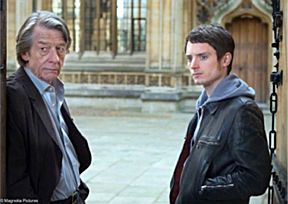
Mind boggling super sleuths (or are they?)
John Hurd and Elijah Wood |
case, Seldom uses to bolster his position, Ludwig Wittgenstein, and his erudite publication, 'Tractatus Logico-Philosophicus,' were made up, But no, this guy actually existed,. Seems he's got a huge following among modern philosophers, and several websites discuss his theories. Ludwig's complex philosophy is encapsulated by his remark, 'Philosophy is a battle against the bewitchment of our intelligence by means of language.' Chew on that a while.
In the midst of this intellectual battle between shriveled experience (Sample/Hurd) and supple youth (Martin/Wood), relationships are formed, sex is had, triangle formed, and murders occur. The arguing brainiacs deduce the murders are the work of a serial killer who leaves symbols behind as clues to his/her identity and that of the next victim. Police inspector Petersen (Jim Carter) is only too eager to listen to their discourse in the hope of finding the culprit. There's no crime scene investigation, actually little police work at all. And I find the conclusion a bit disappointing -- filled with loopholes and abruptly sewn together. I'm not sure it even makes sense or is nothing more than a convenient wrap up of a messy problem. Maybe if my I.Q. were higher, I would be shouting Eureka! instead of feeling a bit left out of the joke. Still, it was great fun trying to keep up with the philosophical and mathematical conversations, and roaming the hallowed streets and halls of the great Oxford University.
Spanish director Alex de la Iglesia has been developing a cult following in Europe with his previous edgy, dark though humorous films, but has figured out the means of vastly increasing his market -- the English language -- English and American actors speaking their native tongue and even an oh-so-English setting. Coincidentally, other non-English/American directors are using the same technique to enlarge their audiences. For instance, Dover Koshashvili, native of the Republic of Georgia,recently directed 'Anton Chechov's The Duel' with English, Irish and Scottish actors, and Alejandro Amenábar, Chilean born Spaniard directed 'Agora' with an all British cast . I expect more and more films will be made in English rather than the native languages of the directors and actors -- especially since Americans are averse to dubbing and too lazy for subtitles. English is the language of distribution and money. How convenient for us. Another more subtle technique Iglesia uses is to cast not only fine actors, but those recognized for their associations with films that curry favor with the younger audience. I really expected Hurd to offer Wood the perfect wand re his recurring character in 'Harry Potter,' especially with Wood's resemblance to Harry. I also expected to see a gold ring hanging from a chain around Wood's neck every time he took off his shirt a la 'Lord of the Rings.'
Get
Low (2010)
Director: Aaron Schneider
Producer: Dean Zanuck
Cast: Robert Duvall, Sissy Spacek, Bill Murray, Lucas Black, Gerald McRaney,
Bill Cobbs, Gracie the Mule
Rated: PG-13
Time: 102 min
Please watch my interview with Producer Dean Zanuck and Director Aaron Schneider at my page on Examiner.com. Also check out all my reviews and interviews at my Examiner home page. Don't miss new reviews and interviews by subscribing. |
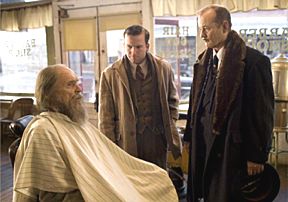
Duvall, Black
and Murray.
Out of the woods and getting ready to party. |
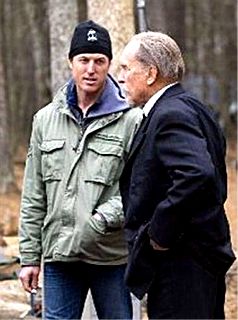
Producer Dean Zanuck commiserates
with legendary Robert Duvall.
|
|
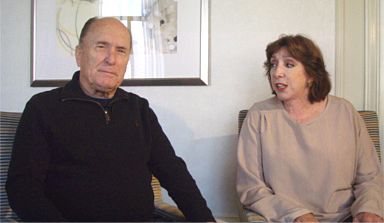
Robert Duvall and Bonnie Steiger |
Infamous Tennessee woods hermit Felix Bush Breazeale decides to return to civilization after 40 years of self-imposed isolation to be a participant at his own funeral. He rides into town and asks the local funeral director to arrange everything for him, tossing a wad of bills on his desk. Bush says he wants to hear what everyone would say about him at a funeral if he were dead. Actually, he wants to finally tell his story. He doesn't want forgiveness, especially from God ("I never did anything to Jesus"), for he has already punished himself for his trespasses. Now he wants to settle things. Based on a true story, this Depression era redemptive tale is, in turn, funny and tragic. Robert Duvall seems to have been born to play this role. It's unfortunate he had to wait 79 years to do it. Eighteen years his junior, Sissy Spacek plays a past relationship. Bill Murray is the wry, deadpan funeral director who wants to conduct some business while resisting the temptation of robbing Bush blind. If there are any plot flaws here, it doesn't matter. This is a tender, beautifully shot story about human tragedy and forgiveness.
From a family that defined Hollywood movie making, including grandfather Darryl F. Zanuck (who formed 20th Century Fox) and father Richard Zanuck (producer of 45 well-known features and counting), Dean Zanuck carries on the tradition of quality Hollywood filmmaking (not an oxymoron in this case). This time he pairs up with first time feature director Aaron Schneider, not only for the making of "Get Low," starring Robert Duvall, but to be interviewed by Bonnie Steiger for Examiner.com. 'Get Low' is based on the true story of ornery Tennessee hermit Felix Bush who, after 40 years of separation from society, wants to throw a 3 county wide party celebrating his passing. Thing is -- he hasn't passed, but he wouldn't want to miss hearing what people would say about him at his funeral. He hires funeral director Frank Quinn (Bill Murray) to advertise and oversee the bash, who, in turn, passes on much of the grunt work to his assistant, Buddy ( Lucas Black). As events unfold, the cause of Bush's self-imposed exile become made clear -- a tragic story of lost love, shame and guilt.
What about the script convinced Zanuck and Schneider to do the film and to prevail upon icon Robert Duvall to commit to it as well? How did Schneider deal with the diametrically opposed acting styles of Duvall and Bill Murray. Why did Duvall, at an age well past retirement, take on this role -- which turns out to be a tour de force he seemed to have been born to play? What were the difficulties and rewards of making this film in the back woods of Georgia (well, that's almost Tennessee)? All will be revealed if you just click on the button.
Charlie St. Cloud (2010)
Director: Burr Steers
Writers: Craig Pearce, Lewis Colick from the novel "The Death and Life of Charlie St. Cloud," by Ben Sherwood
Cast: Zak Efron, Charlie Tahan, Amanda Crew, Augustus Prew, Donal Logue, Kim Basinger, Ray Liotta,
Dave Franco
Rated: PG-13
This is a perfect example of how one should not assume one knows a whole movie based on the commercial or trailer seen on TV, no matter how often it's shown. I assumed Charlie's promise to his little brother Sam to play catch with him for an hour each day after sunset would expire when summer was over and Charlie went to college. That's all the commercial tells me. Well, it also shows how Charlie and Sam have a pretty unique and wonderful brotherly relationship, how they sail off the waters of their idyllic New England town and win racing cups, how Charlie is going to go off to college |

Charlie (Zak Efron) and brother Sam (Charlie Tahan)
enjoying the good life.
|
on a sailing scholarship, but first will teach brother Sam how to pitch, and how Charlie has a growing infatuation with a girl with aspirations to sail around the world. It also shows Sam dies in a car accident and we can safely assume Charlie was behind the wheel. All that in a one minute commercial.
So, why can't Charlie meet up with his new sailor girlfriend when summer is over? Ah, Charlie's original promise might have expired on Labor Day before Sam's untimely death, but not after. Charlie, driven by grief, remorse and guilt, decides to stay close to Sam, becoming the graveyard caretaker and foregoing college all together. Instead of the town success story and source of pride, Charlie is now a young eccentric no one even sees after the sunset cannons of this little seaside town go off until dark. How romantic! And it makes Charlie (Zak Efron at his most handsome yet and most forlorn and most sympathetic) the alienated, heartbroken hero no girl can resist -- in the film's village or the audience. I could hear the girls sighing and weeping in every quadrant of the theater. This is not a teen date movie. Every male date will feel he falls far short of the standard set by Zak and so will the girls..
Speaking of handsome, young, sexy graveyard caretakers, try to find a copy of Cemetery Man (1994), starring Rupert Everett. He, too, consigns himself to the lonely existence of a cemetery caretaker, but with a purpose. He must re-kill the newly buried dead or they walk as zombies in the streets of a little Northern Italian town wrecking havoc and destruction. It's possibly the first deliciously black comedic zombie film and should not be missed.
But back to "Charlie St. Cloud." There are other surprises as well one couldn't expect based on the commercial. These plot twists weave a deceptively intricate plot and give a certain satisfaction to the basic story of Charlie not wanting to give up his cool little brother (Charlie Tahan) while not wanting to lose the love of his life, adventurous, beautiful Tess (Amanda Crew). The whole movie was a very pleasant and unexpected surprise. When so many films try to entice audiences with the only 60 seconds' worth of a film worth viewing, 'Charlie St. Cloud' holds back the best for those who pay the price of admission and stay for the payoff.
Notes: Unfortunately, Kim Basinger seems to have only visited the set, then actually called in a scene. Sadly, poor, isolated Charlie needs to be on his on to ruminate on his situation, and Mom (Kim) moved to Portland (I believe Maine, not Oregon). I would have liked to have seen a lot more of her, especially since she looks better now than she has in the past few years. Good on ya, Kim.
Whereas, Ray Liotta looked awful, ah, but that was his character's fault, and none of his own. His small role did have a lot of impact. Just a cup of coffee, just a little chat on the value of life -- really got the film back on track when it was dipping into a nihilistic fugue.
Life During Wartime (2010)
Director/Writer: Todd Solondz
Cast: Shirley Henderson, Michael K. Williams,
Allison Janney, Michael Lerner, Dylan Riley Snyder, Ciaran Hinds, Renee Taylor, Paul Reubens, Charlotte Rampling, Ally Sheedy, Rich Pecci
Time: 98 min.
As often happens, the most outrageous and off kilter minds are housed within soft-spoken and unassuming people. Is he an accountant, entomologist or actuarialist? No, he's one of the most edgy and acclaimed filmmakers on the independent scene today. The works of Todd Solondz can be aptly described as darkly quirky, deadpan outrageous, over the edge controversial. Outwardly, all his films deal with middle class, American families and their daily lives, but turn to the underside of our culture quickly to reveal how seemingly good people deal with problems faced by so many of us. In 'Life During Wartime,' we return to the three Jordan sisters and the people the love whom we first |
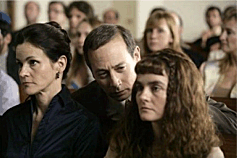
Alley Sheedy, Paul Reubens& Shirley Henderson |
met in Mr. Solondz's 1999 film 'Happiness'. He has recast these same characters with other actors. He tells us in his interview with Bonnie Steiger it's because time changes people. They have moved on; they are in many respects different now. Also, since he already directed the very talented actors of 'Happiness,' there would be no challenge in directing them again. Still, maybe he's just screwing with our heads. But admittedly, 'Life During Wartime" stands on its own; one doesn't have to have seen 'Happiness' to fully enjoy this, his latest film. Still it is fun to compare and contrast -- not the actors' performances, but where the characters have gone on to over the past decade.
We talk about where his ideas come from, how he deals with children in some very delicate situations, and generally probe the mind of this very funny, very serious, very unique filmmaker.
Orlando (1992 / 2010 re-released)
Director/Writer: Sally Potter
from the novel of the same name by Virginia Woolf
Cast: Tilda Swinton, Billy Zane, Lothaire Bluteau, John Wood, Charlotte Valandrey, Heathcote Williams, Quentin Crisp, Peter Eyre, Thom Hoffman, Kathryn Hunter, Ned Sherrin, Jimmy Somerville, Dudley Sutton, John Bott, Roger Hammond
Rated: PG-13
Time: 93 min. |
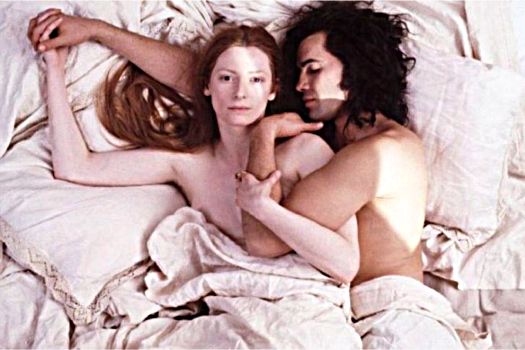
Tilda Swinton enjoying her feminine side with Billy Zane |
If any movie should be re-released from the vault, it’s 1992's ‘Orlando.’ It has withstood the test of time as a truly unique and relevant classic. ‘Orlando’ (Tilda Swinton) examines gender roles for both men and women from 1600 to the present day through the life the titular character. Young Orlando is from a titled family, well educated, and with an androgynous look that was very popular at the time. He is granted a land title by Queen Elizabeth I (Quentin Crisp) who calls him her favorite and cuddles him in her magnificent bed. Liz is very old and decrepit and as she strokes his young thigh, she says to him, “Do not fade, do not wither, do not grow old.” This royal decree sticks for Orlando doesn’t age. As the years pass, we watch Orlando fall in love, betraying his fiancé in the act (‘The treachery of men!’), and in turn get spurned by his paramour (‘The treachery of women!’). He goes through the several phases of life as decades pass (reminding one of Siddhartha’s lifelong journey), but he grows no older. His biggest changes include sexual identity and even sex itself (‘Same person. No difference at all. Just a different sex.’). Thus, she experiences the societal problems of being a woman through several ages. It is not until the latter half of the 20th century that she rejoices, “No longer trapped by destiny,’ at the fate of being a woman. I will not dilute the impact of these scenes by describing any more.
The dialogue is brilliant, delivered to perfection by Swinton and the rest of the cast. No words are wasted; conversation is succinct and precise. Occasionally, Swinton looks to the camera to make a remark, but often only her knowing glance is sufficient. And even that glance is subtle and brief. The costumes, though gorgeous and obviously the biggest line item in the film’s budget, only illustrate the foolish and constricting times which we explore.
Little has changed since the film was first released, and even if things had changed (unfortunately, in many respect and in many countries for the worse), the historical perspective alone would make ‘Orlando’ as fresh and exciting as it was two decades ago.
Anton Chekhov’s The Duel (2012)
Director: Dover Koshashvili
Writers: Mary Bing from the novel by Anton Chekhov
Cast: Andrew Scott, Fiona Glascott, Tobias Menzies, Niall Buggy, Nicholas Rowe, Michelle Fairley, Simon Trinder, Debbie Chazen, Graham Turner, Jeremy Swift
Time: 95 min.
The Russian Caucasus is a beautiful place for a vacation: majestic mountains and countryside, placid lake with pristine beaches, a picturesque village. It’s great to get out of the hot, dirty city for some rest and relaxation, but it seems the people who live there rather than just vacation there have way too much time on their hands. For some, like Laevsky (played by Andrew Scott), being posted to this idyllic resort is banishment from civilization – it breeds boredom and discontent. He spends his time drinking, gambling and complaining that he can no longer bear living with his mistress, Nadia (played by Fiona Glascott), a beautiful, young woman who left her husband, and therefore, society, to be with him. By the way, she’s bored, too, which gets her into all kinds of fashion and summer romantic dalliance trouble, as well. |

Looking for trouble, and I'm not referring to that
over-the-top chapeau. |
Laevsky is so distracted by his situation (his feelings akin to the much used phrase, ‘Oh, no, not another day in Paradise’), his behavior may be interpreted as a nervous breakdown. To add to the volatility of the situation, there are some in the village, neither vacationers nor slackers, who have meaningful work and resent such complainers. One such village inhabitant is naturalist Von Koren (played by Tobias Menzies) and his disdain for Laevsky’s slovenly lifestyle and many social faux pas verges on the maniacal.
Thus, the stage is set for this 19th century drama of manners among the middle and upper class Russians who so intrigued Chekhov. Little may go on, but all is magnified in importance because of it. A woman wears a new hat, a man stands outside a house at night just gazing at a candle lit window, another chooses to play another hand of cards rather than meet a friend at a café. Everything carries exaggerated weight where little else happens. Rumors fly and tempers flare.
The audience gets sucked into the growing tensions, and the minutia become as important to us as to the characters themselves. We know there will be a duel, but between whom and who will survive? And tellingly, do want him to or not? We begin to doubt our first evaluations of the characters as we see them respond to more dire situations. Perhaps the moral of the story here is sometimes a swift kick in the ass is the only way to stop a tantrum.
Note: Yes, all the actors did a wonderful job of sounding foreign, but I can distinguish an English, Irish or Scottish accent from a Russian one. Are there no Russian actors capable of doing these parts? For that matter, I would really appreciate hearing the correct accents for all films, especially when name stars are not associated with a film. Give the audience a little credit – give us realistic accents for films that take place in foreign countries. I am so tired of English playing Germans in American WWII films.
Ramona and Beezus (2010)
Director: Elizabeth Allen
Writers: Laurie Craig, Nick Pustay from the novel by Beverly Cleary
Cast: Joey King, Selena Gomez, John Corbett, Bridget Moynahan, Ginnifer Goodwin, Josh Duhamel, Jason Spevack, Sierra McCormick, Sandra Oh
Rated: G
Here’s a new and interesting idea for a plot: a good intentioned, but clumsy and over imaginative little girl, wants to help her family out of a financial situation that may force them to lose their house and move. Seems everything she does ends up causing catastrophes no matter how good her intentions. Okay, not so new, maybe even tired and frayed, and probably soporific for parents bringing their little ones to see ‘Ramona and Beezus.” Perhaps when Beverly Cleary wrote the Ramona and Beezus books in the 1970's she was the first to come up with this story line. There are certainly aspects of it that seem prescient on her part now: company
|

Ramona, Joey King, on a flight of fancy. |
downsizing and dad being let go to become a house husband, mom going back to work to support the family till dad gets another job, even dad deciding to pursue his bliss for a pay cut. How did Cleary know our great American dream would become so stressed?
Still, Ramona’s fantasies, and even her fears turned to day mares, are the best party of the film. I could have stayed in her imaginary worlds for the length of the whole film. They were just pretty places filled with dangerous cliff gorges and rope bridges, deep space filled with drifting flotsam and familiar planets, cotton ball clouds she passes in her parachute ride, the papier mache world she trudges past in her lonely walk away from home. As idyllic her home and neighborhood are, I’d stay in the FX world she creates.
Back to her real world, the kids will probably really enjoy the family dynamics. Ramona (played by Joey King) is mostly loved and appreciated by her big sister Beezus (Selena Gomez). They have their tender moments in which Beezus doesn’t necessarily want to give her sister away to anyone who might take her. The younger sisters in the audience will probably feel great envy and wish fulfillment watching the film’s namesakes’ relationship unfold. And you can’t ask for a greater dad than John Corbett (even though I’ll always think of him as the cool, philosophizing, chick magnet DJ from ‘Northern Exposure,’ and not the good-guy boyfriend from ‘Sex in the City’). Mom (Bridget Moynahan) is one of those rare women who can switch roles from house frau to breadwinner without skipping a beat and still be sensitive to her kids’ difficult transition as well. And Aunt Bea (Ginnifer Goodwin) is the aunt we all wish we had – someone who is just a little bit outside the family, but close enough to understand everything going on in it and know just how to make things better.
Okay, this family is as absurdly unrealistic in its perfection as ‘Father Knows Best,’ the 50's TV icon to which no real family could aspire. Hey, it’s a G movie and the audience is just going to have to deal with what they’ve been dealt when they resume their lives outside the theater – both the children and parents. But maybe things will be a little nicer at home after their dose of pure sugar they’ll get watching ‘Ramona and Beezus.’
Agora (2010)
Director: Alejandro Amenábar
Writers: Alenandro Amenábar, Mateo Gil
Cast: Rahel Weisz, Max Minghella, Oscar Isaac, Shraf Barhom, Michael Lonsdale, Pert Evans, Omayoun Ershadi, Sammy Samir, Richard Durden, Omar Mostafa Oshri Cohen, Yousef Sweid
Time: 127 min.
It’s been over 350 years since the birth of Christianity, and because Emperor Constantine of Rome converted to this new religion, it has finally gained some recognition. This is a big change from Christians' previous status of fodder for the lions in the Coliseum. 391 A.D. is a time of flux and flux hurts. ‘Agora’ takes place in Alexandria, Egypt, a place that, since Cleopatra and Julius Caesar, has been a part of the Roman Empire, famed for its library and being the seat of learning renown throughout the Western and Muslim worlds. Now, with their newly acquired political power, Christians, from elegantly clad and soft spoken Bishops to the hooded mobs armed with pockets full of rocks, have free reign to make Alexandria their own. Their tactics include some of the most barbaric and politically crafty methods devised up until that time. The main thrust of ‘Agora’ is the destruction of this one particularly advanced culture by these ruthless mobs of early Christians. The culture that flourished in Alexandria until this time was not just Egyptian, |
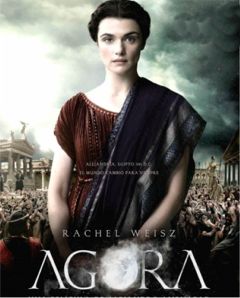
Rachel Weisz as Hypatia,
a doomed intellectual. |
but Roman, Hebraic, and Muslim – all to be replaced by mob frenzy and wanton destruction.
Perhaps worst of all, replacing knowledge, learning and and a philosophy which encouraged questioning in a quest to unravel the mysteries of nature, was enforced blind faith. God knows and Trust In God actually means don’t question, don’t learn, and if you do, you’re a heretic and must be killed. Thus, ‘Agora’ makes clear the roots of the Dark Ages which would last another 1200 years.
What courage it took for director Alejandro Amenábar to show Christianity in such an honest and unflinching light, especially in these very conservative times and especially himself being a Spaniard coming from Chile, both deeply Catholic countries. To bolster the veracity of his historic position, he and his staff carefully researched the history of Christianity and Alexandria at the time, and confirmed the facts with several scholars. Thus, this is a true story – so you Christians, just lump it.
To make the lumping a bit more palatable, Amenábar has duplicated the look of sand and sandal biblical epics of the past: the sweeping vistas, the huge sets, the multitude of extras. It even looks like the same film stock and lenses were used. But to excite today’s audience who is wise in the ways of the latest FX technology, we have sweeping CG/camera shots which start amid the stars and sweep into streets of the open marketplace, the Agora itself, in one grand unbroken movement. Not only is it breathtaking and awe inspiring, but it gives the audience, probably the vast majority of whom do not know where Alexandria, let alone Egypt, is, a sense of place (dare I say it - geography).
The film follows our heroine philosopher-astronomer-teacher Hypatia (Rachel Weisz), daughter of a scholar, and a scholar herself. She chooses celibacy because, as her supportive father (Michael Lonsdale) explains, she couldn’t continue her career if she were married. She has devoted her life to teaching (unfortunately, only boys) and studying. She often gets her ideas about astronomy wrong, but her mind is open, eager to alter a theory to better explain the movement of the planets and stars. Her enthusiasm for getting to the truth is more important than her setbacks.
Her slave Davus (Max Minghella) is always by her side, devoted to her, and as knowledgeable as any of her students, though he is unable to contribute to the class due to his lowly status. Davus is representative of the populace at this time of religious and cultural upheaval. His emotions and allegiances bounce back and forth between his loyalty to Hypatia / love of learning and his fervor over this new concept of non-slavery / self-empowerment. Through the whole film, he is firmly committed to one and then the other side – making sympathy for him impossible.
There are pros and cons to both sides clearly delineated in the film. The Egyptian/Roman cultures had slavery though there was peace and even the slaves’ lives, at least in this depiction, weren’t that bad. They were also tolerant of all other cultures flourishing in Alexandria. On the Christian side, there was one brief scene in which the monks distribute bread to the hungry and poor who are unnoticed by all but the Christians. Then these same Christian zealots slaughter Jews and Muslims in the street.
As we all know, the Christians are going to prevail. You didn’t even have to read the book first to know this. The Western world will slip into a millennium of ignorance, disease, intolerance. One wonders what the state of Christianity would be if Constantine had not recognized a crucifix in the sky, a trick of the eye caused by the interplay of clouds and sun.
Let
It Rain (2010)
Director: Agnes Jaqui
Writers: Agnes Jaqui, Jean-Pierre Bacri
Cast: Agnes Jaqui, Jean-Pierre Bacri, Jamel Debbouze, Pascale Arbillot,
Guillaume de Tonquedec, Frederic Pierrot, Mimouna Hadji, Florence Loiret-Caille,
Anne Werner, Laurent Jarroir, Jean-Claude Baudracco, Luc Palun, Marc Betton
Time: 99 min
Let
me stop you right here. I'd like to introduce you to my page on Examiner.com.
Please continue reading this review, and watch trailer, there.They
say you can never go home again, but in ‘Let It Rain’, Agnes
Jacqui (director, co-writer, star) tries. She plays Agathe, a successful
feminist writer on the threshold of a political career who goes back to
her home village to stump for an election. Not only does she have to deal
with her sister (played by Guillaume de Tonquedec) who irrefutably bemoans
‘mother loved you more,’ but also the bumbling documentarian
(played by co-writer Jean-Pierre Bacri) who wants to investigate the phenomenon
of a ‘successful woman.’ It doesn’t help |
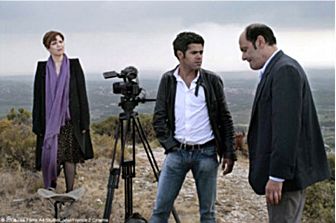
Agnes Jaqui watches
on as Jamel Debbouze and
Jean-Pierre Bacri discuss the fine points of
documentary filmmaking. Looks like rain. |
that she takes
an hour out of her busy schedule to answer his often barbed and biased
questions only to find he hasn’t turned on the camera. At the same
time, she is too busy for the man in her life (Frederic Pierrot) and is
confronted by the son (Jamel Debbouze) of her family maid (Mimouna Hadji)
who accuses her of bigotry and insensitivity. Agathe
is a proficient multi-tasker and workaholic, but she might have met her
match in this complex situation. Though the family country house in which
her sister and her family live is bucolic and almost medieval in appearance,
the countryside breathtaking, the village quaint and all the inhabitants
likable, in juxtaposition, the pace is frenetic, the situations complicated
and the effect dryly humorous. This is French comedy at its subtlest.
For
instance, we watch Agathe and the documentary crew walk miles through
the countryside to get to just the right majestic backdrop for her video
interview only to be thwarted by mother nature. A humorous moment perhaps,
but it carries no more weight in this story than when she and her sister
agree they can no longer afford to pay their lifelong maid who, therefore,
can no
longer afford to pay her divorce lawyer to end her abusive marriage. Thus,
the audience can’t just sit back and let the film happen; they
have to think and feel along with the characters. They laugh or feel
sympathy or even do both for each significant moment. Every remark can
be an insult or revelation. Every action can be acting out or actually
changing one’s direction in life. At the same time, issues are
addressed in a digestible way, the same way we deal with feminism, racism,
and other political issues in our small, perhaps insignificant ways,
but which may affect others profoundly.
On
the surface, ‘Let It Rain” is a slice-of-life light comedy
which scratches the surface of deeper issues just enough to catch one
off guard. Arrange time for a cup of decaf espresso after the film to
talk. It could be interesting conversation.
Despicable
Me (2010)
Directors: Pierre Coffin, Chris Renaud
Writers: Ken Daurio, Sergio Pablos, Cinco Paul
Cast: Steve Carell, Jason Segel, Russell Brand, Miranda Cosgrove, Dana
Gaier, Will Arnett, Kristen Wiig, Elsie Fisher, Danny McBride, Julie Andrews,
Jemaine Clement, Pierre Coffin, Chris Renaud
Rated: PG
Time: 95 min.
Let
me stop you right here. I'd like to introduce you to my page on Examiner.com. Please continue reading this review, and watch trailer, there.You
have to be under 10 years old to understand the plot of Despicable Me.
It goes something like this: Gru (Steve Carell) wants to be the world’s
greatest villain. So, he goes to a bank to ask for a loan to build the
necessary equipment to execute his ultimate diabolical plan. Why not rob
the bank? Perhaps I’mover- |

Gru
(Steve Carell) finally having some fun with the kids
(Miranda Cosgrove, Dana Gaier, Elsie Fisher) in gut wrenching 3D |
thinking this, but it seems to me this
story line is all about technology and business, as expressed through
Gru’s fierce
competition with his eccentric nemesis, Vector (Jason Segel) who looks
strikingly like a young Bill Gates (also known for his allegedly illegal
business practices). Is this film a disguised allegory on PC versus Mac?
It's beginning to make more sense to me now. Gru seems to already have a limitless fortune
(again like Jobs and Gates), as displayed by his house which sits atop
a vast factory, which contains ample space for the construction of a space
ship, a scientific research lab and housing for countless “minions.”
He also has an arsenal of cutting edge weapons like shrink rays, freeze
rays, and an array of futuristic battle vehicles for land and air. By
the way, what are those minions – some one eyed, some two eyed?
Did Gru find them on some oompa loompa-like island or planet? Did he create
them? I’m curious, but get no answers. I do get a glimpse into Gru’s
childhood in flashbacks which reveal his relationship with his mother
(Julie Andrews) and the psychological root causes behind his anti-social
behavior. Part of Gru’s nefarious plot includes adopting
three children (hauntingly reminiscent of Lemony Snicket’s waifs)
to gain access to Vector’s fortress home and steal some needed technology
(industrial espionage). The chipping away at Gru’s armor by the
three little orphans is a gradual and enjoyable process to watch. They
assume they’ve been rescued from the stereotypically cold and slave
driving orphanage’s Miss Hattie (Kristen Wiig) by a Daddy Warbucks
character -- bald, rich and with a heart of gold deep down, very deep
down.
The 3D visuals are stunning, the plot moves fast
while never losing heart and humor, the characters -- from Gru to the
kids to the amorphous, annoying squeaking minions -- are fun to watch.
Gru’s cohort scientist is only as a plot device to explain the technical
side of the story and seemed to be wasted on Russell Brand’s immense
comedic talent. The kids should enjoy this even if there’s not a
whole lot there for us grown ups.
Sun
Behind the Clouds (2010)
Directors: Ritu Sarin, Tenzing Sonam
Time: 79 min.
China invaded Tibet in 1959, causing the Delai
Lama and over 100,000 Tibetans to flee with him to Northern India. Those
who remained were subjected to and continue to be subjected to imprisonment,
torture, murder, the destruction of their monasteries, desecration of
their religious art, and all manner of subjugation to this foreign power.
In addition, over a million Chinese have moved into Tibet by railroad
to settle in this developing country and reap the profits of Tibet’s
natural resources, to the exclusion of the native population.
We knew all that before from many documentaries
and features, besides non-front-pages stories in newspapers over the decades.
All spoke in a more emotional palette (even the newspaper articles), each
with particular perspective about particular subjects: be it the rape
and murder of
|

And when he goes to
Nirvana, what interference will
the Chinese place in the way of finding a next Delai Lama? |
nuns, to the before and after photos of the physical destruction
of ancient buildings, to the life of the Delai Lama and the steps taken
to escape and then set up a temporary exile home for his country-people
in Dharamsala, India.
“The
Sun Behind the Clouds” is a good recap of the destruction of this
several thousand year old culture by the Chinese. We have a new generation
who may not be familiar with the recent history of Tibet and should be
made aware that this is not the distant past, and Tibet wasn’t always
a land of soldiers with guns harassing monks
in yellow robes. Richard Gere did a lot to promote the cause of Tibet
a decade ago, but Americans have a particularly short memory. The noise
made by Tibetan protests during the 2009 Olympics was literally and figuratively
drown out by the precision drum playing of thousands of choreographed
Chinese in the opening night ceremonies. So, even if there are no productive
efforts made by the international community on behalf of Tibet, at least,
let this isolated, once peaceful country not be forgotten.This film also explains the complex political
situation Tibet’s religious and de facto only leader is in. As a
Buddhist, the Delai Lama must promote only peaceful means to the end of
going home to Tibet again. But unlike Ghandi before him espousing peaceful
resistance, he must deal with the Chinese, not the British. The Chinese,
even in dealing with their own population who demonstrate for human rights,
are unmoving. Why should they listen to some monks at the edge of their
border? The rest of the world is very emotionally supportive of Tibet’s
situation, but none will sanction China while trying to deal with this
huge and technologically emerging world power. The Delai Lama changed
his public stance in the late 1980's from freedom for Tibet to a middle
of the road policy. He has tried unsuccessfully to broker a co-existence
between Tibetans and Chinese in Tibet with Tibetans’ autonomy. I
don’t really know what autonomy would mean in this case, but it
seems moot since the Chinese refuse to even discuss the matter with His
Holiness. I can certainly understand Tibetans’, both in Tibet and
in exile, disappointment over this change of policy. Many are compelled
to disregard their great leader’s position and protest within and
outside the country at peril to their own lives. Directors Ritu Sarin and Tenzing Sonam, themselves
Tibetans, give a sweeping background of the political situation, on the
one hand, following the Delai Lama as he speaks with almost-heads-of-state,
such as Prince Charles of England – more a friendly chat rather
than hard knuckled policy and tactics for returning Tibet to its people,
on the other hand, following exiled Tibetans on a 1000 mile march through
India and back to Tibet, where police regularly interrupt their progress
before they reach the border and probably their doom.
I have never felt so hopeless for the future of
Tibet. It will soon become a place of malls and mines and high rise apartments.
No more mysterious Shangri La peeking out of the mists of the greatest
mountain range in the world. Tibetans will become the wondering Jews
of Asia, homeless, but with a rich and unique culture upon their backs
and in their hearts.
Ondine (2009)
Writer / Director: Neil Jordan
Cast: Colin Farrell, Alicja Bachleda, Tony Curran, Stephen Rae, Tom Archdeacon,
Dervla Kirwan, Alison Barry, Norma Sheahan, Emil Hostina, Don Wycherley
Rated: PG-13
Time: 111min.
It’s so romantic and mysterious to bring
back an old fisherman’s legend to present day Ireland. Actually,
it would seem from watching “Ondine” that present day Ireland
isn’t that far removed from that of Celtic legend. The men still
go out in their fishing boats, cast out their nets and hope they will
be lucky enough to catch fish to support their families. The rustic domiciles
of these fishermen seem little removed from those we see in children’s
storybooks. The village in this film also seems little changed. But if
you look carefully, you’ll notice cars on the roads, modern clothes
in the shops, and too much hard liquor and juke box rock n’ roll
in the taverns.
Still,
the legend of the selkies pervades the atmosphere in this romantic film
which also reflects the modern day problems of a broken marriage, alcohol
addition, and a few unaccountable surprises. Colin Farrell plays Syracuse
(not to be confused with his hated nickname Circus), a fisherman, earning
a living from the sea and doing the best he can to be a responsible, loving
father to his daughter Annie (Alison Barry). One day, he finds |
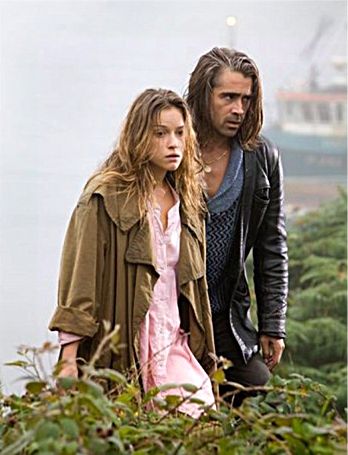
Alicja
Bachleda and Colin Farrell rising from the sea. |
a beautiful,
young woman caught in his net among the flopping salmon and other fishes.
He resuscitates her and brings her back to shore, letting her stay in his
dead mother’s remote and ramshackled house near the sea. She says
little about herself or how she came to be fished up in his net. Is she
a selkie, a seal who sheds her coat to live among people for 7 years, only
to return when she puts her hidden seal coat on again. Do his nets and lobster
pots fill as never before because she sings to the sea on board his boat
or is it a coincidence? Can she grant a wish -- to cure his daughter of
kidney failure or is he a fool to even hope? Syracuse is skeptical, but
can’t help falling deeply in love with this woman, be her seal, mermaid
or some other alien. His problems dealing with his complaining ex-wife,
his child’s illness, his constant unquenched thirst for alcohol, his
newfound love, all crescendo into something much more exciting than the
sum of these various parts.
Look back
to John Sayles’ “The Secret of Roan Inish” (1994 ).
In it the ancient myth is even more fully explored, giving total credence
to the folklorish aspects of the drama of a husband abandoned by a wife
returning to the sea, the fate of their son, and the repercussion to rest
of the family. If you’re captivated by the romance and idyllic locations
in “Ondine,” you should hard back to this previous century’s
offering of seals come to live among us in human form.
Holy
Rollers (2010)
Director: Kevin Asch
Writer: Antonio Mascia
Cast: Jesse Eisenberg, Justin Bartha, Danny A. Abeckaser, Ari Graynor, Jason
Fuchs, Q-tip, Bern Cohen, Mark Ivanir, Charlie Hewson, Elizabeth Marvel,
Hallie Kate Eisenberg, Andrew Levitas, Marc Rose, Omer Barnea, Stella Keitel
Rated: R
Time: 89 min.
Since first coming to America in the 1890's, the
Hasidic Jews have been able to maintain their cultural and religious identity
unscathed. Living in Brooklyn, taking the subway to work, walking the
same streets and seeing and being seen by their fellow New Yorkers, Hasidim
have changed very little in more than a century of exposure to the New
World and its noisy, obtrusive culture. Still, the strong |
Jesse Eisenberg as
a not-idealistic-enough Hasid. |
belief in God,
family and tradition has cemented this subculture to the exclusion of
almost any outside influence.
“Holy Rollers” is the remarkable,
but true story of the chipping of the previously indomitable wall between
Hasidic Jews and the rest of the world. In the late 1990's, Jews in New
York were bringing in large amounts
of ecstasy from Europe, using Hasidic mules to get through customs. Who’d
suspect Hasidic Jews of transporting drugs? This story focuses on one
particular young man, Sam Gold ((Jesse Eisenberg),
who within a few short months of being associated with this drug-running
organization, loses all of his former morals in the pursuit of gelt. He
is not only a successful mule, but is promoted to bookkeeper and recruiter
of more Hasidic mules. I have heard no comments thus far that “Holy
Rollers” is anti-semitic. This may be because in the depiction of
this operation all the other Hasidim frown upon his actions, and, let’s
face it, Jews are as likely to be involved in drug trafficking as any
other race, religion or culture. Also, the erosion of Sam’s cultural
identity is so sensitively written and performed, it is understandable
and even tempting for the viewers to follow his path. At the beginning of this story, Sam works in his
father’s fabric shop in the Lower East Side of Manhattan and is
frustrated that his father is such a poor businessman who won’t
take his advice on how to run the shop to make a better profit. Sam is
also hoping to culminate arrangements for a marriage. Unfortunately, the
girl and her family opt for another choice. Sam blames a lack of money
for all his problems, so when offered easy money, world travel, and helping
doctors get new medicine into the country, he chooses not to ask any further
questions and takes that first step outside his sheltered community. It
plays much like a fable of good being tempted by the devil, Mephistopheles
selling his soul for immortality, Sam rising in the world of illicit drugs
at the cost of his family and all he has been taught is good and of real
value. And it’s easy to see the fable-like qualities of the story
because Sam and his community of Hasidim seem so foreign and timeless
to us, the sophisticated audience. They dress and behave much as they
did when they first came to the U.S. over a hundred years ago. The moral
values are as simple and innocent as those held by country peasants of
that time as well. So, the clash with modern day drug dealers and dangerous
situations is all the more jarring.
This is the most empathetic rendering of the Hasidic
community I have seen in film, including several documentaries –
all the greater the loss to Sam at his self-expulsion. It’s an intriguing
story about this insulated community and the ecstasy trade. And as an
extra bonus, playing Sam Gold’s sister is Jesse Eisenberg’s
real life sister Hallie Kate Eisenberg, whom we haven’t seen enough
of since her memorable cola commercials of a dozen years ago.
Best
Worst Movie (2009)
Director: Michael Paul Stephenson
Cast: The cast of Troll 2
Rated: PG-13
Time: 95 min.
Best Worst Movie is a documentary about the cast
of Troll 2, a schlock horror film made back in 1990. Seems that over the
years, there has been a slowly growing cult following around this ultra-low
budget horror flick due to its awful acting, non-sensical plot, cheap
effects, and ridiculous premise – vegetarian goblins trick humans
into eating or drinking their specially prepared foods which turn them
into half human/half veggie daily specials, the goblins’ favorite
repast. We reconnect with the lead players of the film, most notably George
Hardy who waxes |

A movie based on these
masks has got to be fun. |
most philosophical about the whole experience of being
an actor then and being a cult favorite now along the revival circuit.
His perspectives, and those of his fellow cast members, reveal a lot about
unfulfilled careers, lost opportunities, and the meaning of fame.
I watched Troll 2 on IMDB.com and found it to
be not that bad at all. The photography was good, and there were enough
characters and situations to keep an audience interested. Most
strange was that the actual director and co-writer, Claudio Fragrasso,
and his wife and writer, Rosella Drudi, were not in the opening or closing
credits. Instead, Drake Floyd was credited for story, screenplay and directing.
We see a lot of both Fragrasso and Drudi in the doc discussing the fine
qualities of the film, so this couldn’t be a case of their not wanting
their names to be attached to the film, a la Alan Smithee. Too bad this
possibly interesting aspect of the film’s history was not pursued.
But
underlying this doc is a blueprint for people who want to pick up on any
one of the thousands of pathetically poorly made films, develop a plan
to promote it, hype it, create a cult following, and profit off it. Beware
the new film which has no actual following, but only highly promoted “premieres,”
including red carpets and invited press. With the success of several actual
cult films, distribution companies are trying to create their own cult
followings with just plain dull movies they bought for close to nothing.
Marketing lines like “The World’s Worst Movie,” or “Worst
Movie Ever Made,” will always draw a crowd, but if its only being
stated in advertisements paid for by the film distributor, it’s
bound to be an evening of disappointment. The latest Hitchcock rip-off
is no more the “worst movie” nor any more entertaining than,
say, “Naked Beneath the Water,” with the very interesting
premise of a reality show which beckons serial killers to submit their crime videos
for the title of Best Serial Killer of the Year (which show in the film
is hosted by Bonnie Steiger); or “In Search of Lovecraft,”
about a skeptical reporter sucked into the true horrific world of demons
and monsters (with stultifying performance by Bonnie Steiger as the straight-jacketed
victim of exposure to the dark elements); or “The Patient,”
in which a psychiatrist suffers a break down when confronted by Chinatown
evil (with wacky yet dark landlady played by Bonnie Steiger).
There is the fun kind of bad movie, and the boring kind. Troll 2 was more
fun that boring. It has lots of bad acting which can get boring once you
get used to the cadence of those untrained voices, and there’s the
silly plot, which with enough plot twists and turns holds one’s
interest. People don’t go to horror movies for plot or acting, anyway.
They go for fast paced horrific special effects. So, I don’t understand
why there is such affection for Troll 2. It’s medium slow, and all
the effects were obviously bought in a party and prank shop. But there
is a sincerity and naivety based on the director’s and actors’
serious efforts in making a good thriller.
The
documentary captures this naivety and the spirit of having once been a
film which causes both embarrassment and pride at the same time. We look
back at ordinary people who not only once had a moment of fame when the
film was made, but are reliving that past glory in the film’s newfound
popularity. There’s not a bad person among them, not even director
Fragrasso, who is sometimes short tempered and abrupt with his cast because
“they don’t understand” what was really going on in
the plot or his direction. But we love him as well for his deluded perceptions
and wonder how he has made 23 movies, and counting? Maybe we’re
the deluded ones.
Wild
Grass (2009)
Director: Alan Reanais
Writer: adapted by Alex Reval and Laurent Herbiet from the novel “L’incident”
by Christian Gailly
Cast: André Dussollier, Sabine Azéma, Emmanuelle Devos, Mathieu
Amalric, Anne Consigny, Edouard Baer
Rated: PG
Time: 104 min.
I once found a wallet, a big one with lots of
compartments stuffed with credit cards and papers. I even found some cash
in a very secretive section of it, though the money in the cash section
was gone. Without hesitation, I simply looked through the papers for the
phone number of the owner, called and said “I found your wallet.”
We made an appointment for the woman’s husband to come by and pick
it up -- her husband, just to be safe. He came by, he thanked me, took
the wallet and left. Incident was over. So simple, direct and final.Not so in Wild Grass probably because the wallet-finder
in this case, Georges Palet (played by André Dussollier) has been
damaged in some way and is under a lot of |
André
Dussollier -- in French films, women vie for him.
Or so say male directors. |
stress. He feels emasculated
by being a house-husband to his patient wife, Suzanne (Anne Consigny).
She does remind him to paint the door and mow the lawn, but she also thanks
him very sweetly when he does. Still, in subtle ways, it grates on him.
Also, it is suggested that George has had some health problems that might
interfere with his once clear thinking (maybe that's why he doesn't have
a job). To add to his frame of mind, Georges is going through a mid-life
crisis, though I think Dussollier was miscast in the role, being several
decades past such a crisis. He is a regular repertory member of Alan Resnais’
actors, having appeared is several of his previous films. Perhaps it’s
just habit on Resnais’ part to cast Dussollier. And at Resnais’
age, 88, it may be difficult for him to distinguish too old
In any case, George agonizes over what to do with
the wallet he finds in a shopping mall parking lot – call the woman
whose photo ID he finds in the wallet, go to the police and drop it off,
just forget it? He builds an elaborate fantasy life around this woman
who is a dentist and has the adventurous hobby of flying small planes,
Marguerite
Muir (Sabine Azéma). He behaves obsessively, imagining conversations,
writing long letters to her, visiting her home, attacking her car. He
also imagines she and other characters in his circle behave eccentrically,
or they actually do. Is he getting carried away by his over emotional
reactions to every little nuance of communications with Marguerite, his
wife, the police or is everyone a bit off kilter?
The
audience would do best to simply accept the plot turns, weird behavior
of the various characters, and assumptions of our good Samaritan/stalker
protagonist. This is a visually rich and imaginative reverie on the
consequences of a little action – finding a wallet. It goes out
of a rational comfort zone, but it is fun.
I
would like to add it was refreshing to see beautiful women in their
40's without that American afterglow of plastic surgery, Botox and other
abrasives to the skin that give that finely polished and taut look.
Both Sabine Azéma, as the wallet robbed dentist-pilot, and Anne
Consigny, as the bread winning wife of the wallet finder were beautiful
in their youths, and seem to be as comfortable in their middle age with
little wrinkles and softer skin. They look human, unfixed. And it just
hit me that we in America are so used to every actress and many actors
being “done”, we can no longer tell the difference. There
are actors and there are people, and the difference in appearance is
that of being “worked on.”
On
the other hand -- the male side, the French film community in general
still insists on very beautiful women being intrigued, in love, obsessed
with very old, very unattractive men. Is this projection on the part
of the directors? I am just so tired of seeing strong, intelligent,
independent, attractive women turning into jelly for old farts. The
jelly isn't part of this film, but the attraction is. This basic female
weakness is not an occasional occurrence. Just about every French film
shows women going very stupid over useless codgers. That’s just
my take on it.
The
Father of My Children (2009)
Director/Writer: Mia Hansen-Løve
Cast: Louis-Dominique de Lencquesaing, Chiara Caselli, Alice de Lencquesaing,
Alice Gautier, Manelle Driss, Manelle Driss.
Time: 110 min.
Gregoire Canvel ( Louis-Dominique de Lencquesaing)
is a French film producer with a wife and 2 children. If he’s not
on his cell phone while spending quality time with his kids, he’s
at meetings with various financial people trying to hold his failing film
company together. This is possibly an interesting place to start. But
the film barely moves from there. We spend lots of time with Gregoire
and his three beautiful daughters and patient wife as they go from historic
site to secret ponds
and streams
throughout the French countryside on weekends. We also attend countless
meetings with bankers, investors, distributors, film processors, and assorted
staff discussing the same problems over and over. They don’t have
the money to keep the company afloat and it seems |
Louis-Dominique
de Lencquesaing and real life daughter
Alice de Lencquesaing in a happy moment -- or is it? |
nothing can be done
to save it. And that is where we end up 110 minutes later. Gregoire, a very charming man (we know that because
we’re told several times), never comes up with any solutions, never
reigns in any of the runaway expenses, but only asks for money from various
money people. He is a really nice, calm, easygoing guy who bases his choices
of film production of the director’s artistic talents rather than
commercial viability. No wonder his company is failing. And all the people
he meets with are likewise charming, patient, soft-spoken, empathetic
and unable to help. Am I in France or Canada? His only solution is to
leave the problems for others to solve, and they can’t either. That
is pretty much the movie. Let me repeat – lots and lots of business
meetings where different people say the same thing over and over. Along
the way, we see him take under his wing a young screenwriter who only
comes back later in the film to retrieve his script. What was the point
of introducing him? We find out other facts about his past, but they are
never brought to fruition. Why were we told this stuff, how does it relate
to his actions? We see is wife attending meetings in his place, but she
is as silent and passive as he.
“The Father of My Children” is more
a fugue than a film. It poses a situation and we flounder in it, understanding
as little at its culmination as we did in the beginning. It just states
we have a financial problem (the dullest of all problems) and we’ll
just take lots of meetings till the final credits roll. Quel triste.
Paper
Man (2009)
Directors /Writers: Michele Mulroney and Kieran Mulroney
Cast: Jeff Daniels, Emma Stone, Ryan Reynolds Lisa Kudrow, Hunter Parrish,
Kieran Culkin
Rated: R
Time: 110 min.
Jeff Daniels has cornered the casting market on roles depicting
neurotic writers. First there was 2005's, “The Squid and the Whale,”
in which he was an author so self-deluded and obnoxious that it was hard
not only for his family, but for the audience as well to remain in his
presence. Then 2009 brought us “Arlen Faber,” about a writer
whose whole career is based on the lie that he was told all the answers
to life by God, which deception rendered him agoraphobic and crippled
with back pain. Now, in “Paper Man” Daniels plays a blocked
and not too successful writer who still depends on his childhood imaginary
friend to get him out of |
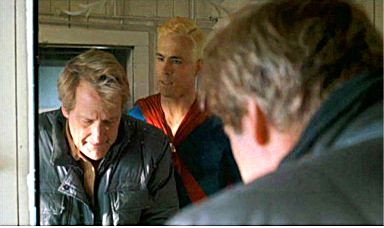
Jeff Daniels
and Ryan Reynolds.
Not easy to look at the man in the mirror. |
cinches and offer advice. Since an imaginary
friend, a figment of one’s own imagination, is only as knowledgeable
and self-aware as the imaginer,Richard, played by Daniels, isn’t
getting anywhere solving his problems. And did I mention this imaginary
friend, a super hero named Captain Excellent, wishes Richard would finally
grow up and move on? So no sympathy by the only one he depends on for
understanding. Times are getting hard. Richard has relocated to Montauk, the tip of Long Island, as
far as one can get from his home in New York going east without getting
wet. His wife, Claire (Lisa Kudrow) is the instigator of this move, ostensibly
to rid him of all distractions, so he can concentrate on his writing.
Meanwhile, she visits on weekends while continuing her practice as a thoracic
surgeon in New York. Sadly, something as minor as the pattern of the couch
upholstery can be enough of a distraction to halt Richard’s progress,
not even allowing him to get beyond the first sentence of his book about
the extinction of the American Heath Hen.
While distracting himself even further by taking rides around
the area on the children’s bike he found in his garage, he meets
a teenage girl, Abby (Emma Stone), and asks her to babysit for him on
Friday. He has no children. Nonetheless, a friendship begins. To say this
film is a comedy or even a dramedy is misleading. This is a sad, heartfelt
story about Richard and Abby. Both are damaged and find they need more
than imaginary friends can provide. There are some quirky lines like when
Abby comes over to babysit and says, “Where’s the baby?”,
and Richard responds, “There is no baby,”Abby
responds, “That makes I would like to know
why Richard is such a mess. I would like to know why it easy.” But underlying the odd behavior and unexpected retorts
to simple questions, there is self-destructive behavior, pain, loneliness
and a need for connection.
his really patient
and supportive wife stays with him – and saying “You used
to make me laugh,” is too hackneyed for this otherwise very smart
screenplay by husband and wife writers Michele Mulroney and Kieran Mulroney,
and completely unsatisfactory as an answer. Richard must have always been
immature. He always had an imaginary friend that Claire new about. He
only wrote one book whose unsold copies, stacked artistically, furnish
his beach home. I would like to know how he was able to write this first
book, why the publishers are ready to print his next? I have a lot of
questions, but it’s because I care about him and think about him
even after the film is over. In that sense, the film is a success. And
I care as much for Abby – smart, and nurturing, and always eager
to make a pot of soup out of things she finds in a kitchen to warm the
soul. But she is also willing to demean herself with a jerk who makes
it insulting clear that doesn’t give a damn about her.
I want to see these
two lost souls heal each other and themselves. Clearly, imaginary friends
are not up to the task. If you’re feeling unloved and unwanted,
your alter ego telling you he loves you completely and forever isn’t
enough to get you to the other side. Likewise, even Ryan Reynolds’
chiseled, blond, Adonis in tights can’t get you to write that book.
This film explores how strangers forming a bond just for one summer can
to what a lifetime of imaginary pals can’t.
Kites (2010)
Director: Anurag Basu
Cast: Hrithik Roshan, Bárbara Mori, Kangana Ranaut, Nicholas Brown,
and Luce Rains.
Writer: Anurag Basu, Robin Bhatt, Akarsh Khurana
Time: 130 min.
I am ready to admit I am now an avid fan of the
Hindi-Mexican soap opera genre – the banal plot about the star-crossed
lovers, the betrayal, the rabid gangster out for blood, oh, and our hero,
J., played by Hrithik Roshan, the most incredible hunk for whom I can
think of no comparison. I was barely able to silence my gasps for each
lingering close up of those incredible blue eyes that changed hue with
each scene: the vibrant blue when explaining his life to the camera - the
hustling, the dancing, the marrying illegal immigrants for a fee; the
dusky gray-
blue in the bright sunshine when he was trying to avoid eye
contact with the woman he loved who happened to be his fiancé’s
brother’s fiancé (oh, how deliciously lurid); the blue green
when they dance
together in the rain the night before her marriage to the son of the powerful,
rich casino owner; the dark and brooding hazel when she tells him they
can never see each other again. And that’s just the eyes!Hrithik
Roshan did not unnecessarily undress to expose his oh-my-god body, though
terms like unnecessary seem superfluous. He had to take his shirt
off when he came out of the rain, he had to wear only bathing trunks when
he was scuba diving off his fiancés yacht off their beach house
near Las Vegas (it doesn’t matter that Las Vegas is in the middle
of a desert), and as far as I’m concerned, he had to undress a whole
lot more than he did. My
point is that even with the great cinematography, the heart-thumping car
chase scenes, the poignant love story underlying the whole film, the violence
for those who enjoy that sort of thing, there would really be no reason
to see this film, but for Roshnan. As
for the story line: the 130 minute film time is simply a way of getting
a whole season of daytime television melodrama into one sitting. Boy marries
illegal immigrant girl for a fee so she can get a green card. |
Hrithik
Roshan -- need I say more? |
They part
and he starts wooing a rich girl. They get engaged and he finds out her
brother is going to marry his wife, the previous illegal immigrant, whom
he now loves. She falls in love with him and they desperately try to escape
this powerful, dangerous family to start a life of their own. It does
look, though, like no expense was spared on locations, prop guns, classy
cinematography equipment and experienced shooter and editor (obviously
money was spared on the actresses dresses which came right out of Foxy
Lady catalogue). The acting, especially by the protagonists, Hoshnan and
Mori, allowed me to forget for a moment that I was watching a predictable
horse opera. And did I mention he’s gorgeous? Yes, top of the line
eye candy. By the way, if you’ve read my reviews over the years,
or wish to start now, you know I don’t normally respond like a tweenie
to hunks. Maybe this time it’s because there wasn’t much else
new in this film so he got all my attention, or maybe he’s just
worth the scrutiny. Added
to that, the script writers, director Anurag Basu doing double duty, as
well as Robin Bhatt and Akarsh Khurana were sensitive enough to give us
all already drooling audience members a reason to actually like our hero.
He was a moral man who, due to bad luck, had to make adjustments to survive;
then when in love, did everything he had to to be with his beloved. He
was a good man, empathetic and polite, though a self-trained survivor
– which made him all the more interesting. We forgive him all. Did
I mention his chiseled profile and noble brow? Writers and actors also
made it believable that J. could hopelessly fall in love with his paramour,
Linda. She was real, warm, feisty, loving, etc., etc. She was a real woman,
not the beauty Selma Hyack is, but certainly a close relative, and a convincing
soul mate.
Interesting
things I learned from Kites: there is a large body of water near Las Vegas,
casino owners still beat and kill cheaters, nearly everyone in Vegas is
trilingual (Spanish, Hindi and English), the bigamy and immigration laws
in Vegas are not enforced.
Robin
Hood (2010)
Director: Ridley Scott
Writer: Brian Helgeland
Cast: Russell Crowe, Kate Blanchette, Max von Sydow, William Hurt, Mark
Strong, Oscar Isaac, Danny Huston, Eileen Atkins, Mark Addy, Kevin Durand,
Scott Grimes, Douglas Hodge, Lea Saydoux
Rated: PG-13
Time: 140 min.
If you love the legend of Robin Hood, down to
his merry band of men robbing the rich and giving to the poor, you are
going to be miffed by Ridley Scott’s latest contribution to the
growing lore of the man in green tights. Perhaps the old tale is a bit frayed around the
edges from overuse, starting back with Douglas Fairbanks’ version,
through the absolute gold standard set by Errol Flynn’s, to 50's
TV’s Richard Greene’s, to the dueling Hoods depicted in the
best forgotten Kevin Costner version and the unfortunately forgotten Patrick
Bergin’s, as well as literally scores more. Resuscitation by Mel
Brook’s “Robin Hood: Men in Tights” (1993) and Terry
|
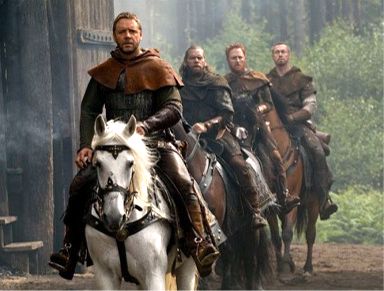
These
men are not merry! |
Gilliam’s John Cleese cameo in “Time Bandits” (1981)
could only cause some laughs at the legend’s expense. Rather than revisit the tried and true story,
Scott refers to historical facts to enhance the fabric of the story. He
takes us to the trek with the Crusaders back from defeat in the Holy Land.
While crossing France, and fighting for wealth and food to get them back
to terra England, Robert Longstride steals the identity and armor of a
fallen knight, Richard of Loxley, and brings back to England the crown
of dead King Richard. Yes, in this version, Robin is actually an identity
thief, and his formerly dead father, Sir Walter Loxley is alive and welcoming.
I admit, my head is swimming. Actually, Richard did die in France on the
way back from the Crusades, but if Richard is dead, what hope do we have
for England and Robin against the evil King John?
If you take a look at “Lion in Winter”
(1968), which recounts the life of Henry II, his wife Eleanor of Aquitaine,
and their four sons, you will meet Richard and John, plus their other
two brothers bickering over who is to receive the thrown upon Henry’s
death. This is a preview of “Robin Hood”’s royal brothers.
In “Robin Hood,” Eleanor is now an old woman stuck with her
not too bright
son whom neither she nor Henry
wanted to succeed to the thrown. Shadowing his father in “Lion,”
he ignores is wife for a young French lover. Another historical reference
is Robin being instrumental in getting John to sign a paper giving rights
to the common man. It is an obvious reference to the Magna Carta. Okay,
Scott is using to historical fact, but only for dramatic effect. This
film should not be confused with an historical drama. But I did enjoy
the invasion of England by the French sea forces. It looked like a Medieval
take on “Saving Private Ryan”’s invasion of Normandy
right down to the landing craft that opened for easy exit of troops onto
the beach, the wide vista of countless ships merging on the coast, and
the close ups of blood stained water.This
film has gone from a small group of guerilla fighters fending off foot
soldiers collecting taxes from overburdened peasants, to a full fledged
epic war drama, from a grass roots efforts at individual freedom to a
clash of mighty nations. And I loose all sight of the Robin I knew and
loved as a child.
But
what disappointed me more than changing the details and size of the story,
was changing the character of our hero. Where was Robin’s sense
of humor? Dare I say his countenance was lachrymose? Nay, even dour? No
more broad smile, nor biting sarcasm aimed at the Sheriff. No wit, no
one liners nor limerick. Like I always say, if you hire a gladiator for
a tree hugging purse snatcher, you’ll get a gladiator. Crowe couldn’t
lighten up for the role, and a heavy handed Robin Hood is no Hood at all.
The
53rd San Francisco International Film Festival - (2010) some
of my selections
Micmacs
Director: Jean-Pierre Jeunet
Cast: Dany Boon, Andre Dussollier, Omar Sy, Dominuique Pinon, Julie Ferrier,
Nicolas Marie, Marie-Julie Baup, Michel Cremades, Yolande Moreau, Jean-Pierre
Marielle
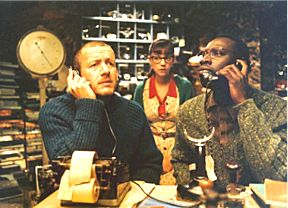
Jeunet’s
love of fringe dwellers (sewers - Delicatessen, submerged section
of an oil rig - The City of Lost Children, a ship in the depths of
space - Alien: Resurrection), now takes us to a hollowed out hill
of scrap metal in a junkyard which is reminiscent of a beaver dam
made of toasters, baby carriages and other metal flotsam. Our hero,
Bazil, has had a difficult life. His father was killed by a landmine,
and he was an innocent bystander victim of a shoot out on the street.
He blames the arms and ammunition manufacturers for these misfortunes
as well as a world of suffering and pain for others. He vows to shut
down the two local manufacturers. His being jobless, homeless and,
due to the bullet still lodged in his brain, constantly on the brink
of death, the denizens of the scrap heap take him in and support him
in his convoluted plan of revenge. This film is frenetic, inventive,
imaginative and a heap of fun.
Please go to my I, Interviewer page and click on my interview with director Jean-Pierre Jeunet.
Joan
Rivers: A Piece of Work
Filmmakers: Ricki Stern and Annie Sundberg
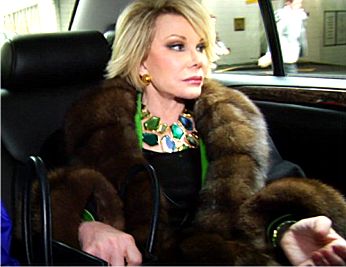
Joan Rivers' agent states very early in this
documentary that spans a year in the life of this celebrated comic
that all careers have hot and cold periods. Joan is in a slump now
and needs something to make her hot again. It doesn't take much
of a leap to realize this film is intended to give her heat. Wonder
if her team tried to start a reality show, but the career of fellow
D lister Kathy Griffin seems to have sated the market. Fine, let's
revive Rivers' career. As her calendar fills during the filming of this doc, we
follow Joan on her appointed rounds from a stand up date in Wisconsin
to rehearsals of her self-penned play in Edinburgh, Scotland, to
book signings, to a QVC appearance to hawk her trinkets. I feel
dizzy and exhausted just trying to keep up viewing this septuagenarian.
Of course, her skin sports nary a wrinkle and she refers to her
use of (addiction to) plastic surgery -- talking openly about it,
being the brunt of constant attacks and jokes -- she certainly still
has the energy of a young woman .I have to admit, I did not appreciate her old culture attachment
to wearing mountains of slaughtered animals to prove her wealth
-- it only proves her callous disregard of life. And while another
documentary about a comedienne, "Yoo, Hoo, Mrs. Goldberg,"
about Gertrude Berg, showed a more groundbreaking career as well
as her commitment to fighting social causes, it's still interesting
to see another view of just how difficult and thankless a career
in comedy is -- especially for a woman.
Please go to my I, Interviewer page and click on my interview with directors Ricki Stern and Annie Sandberg.
A
Brand New Life
Director: Ounie Lecomte
Cast: Kim Saeron, Park, Doyeon, Ko A-Sung, Park Myungshin, Oh Mansuk,
Sol Kyunggu, Moon Sungkeun
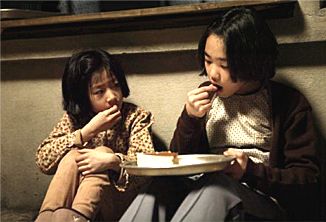
Nine year old Jinhee is brought by her father
to a Catholic orphanage just outside Seoul, Korea. She had no idea
their trip together would end there, why he left her there, or when
he would come back. Here's what bugs me: her father has a family
including his mother, his new wife and their baby; why throw away
this precious little girl? Is money too tight for one more little
mouth to feet? Does the stepmother want her out of the way? Do they
fear for their baby's safety around her? We never know, but it was
a time (1975) and a culture in which people often gave up children
for adoption into wealthier, safer countries.
Fortunately, this orphanage, and I assume Korean orphanages
in general, is run by caring, patient caregivers and administrators.
She is well looked after and the staff allows little Jinhee to work
through her fears and loss in an understanding, supportive way.
But there is much for her to go through: her deep loss and feelings
of abandonment, her fears of this new place, her new friendships
among the other orphans, her acceptance of the need to be adopted.
Based on director/writer Lecomte's own experiences, the compassion
and delicate rendering of this film is apparent in every frame.
Air
Doll
Director: Kore-Eda Hirokazu
Cast: Bae Doona, Arata, Itao Itsuji, Odagiri Joe, Takahashi Masaya, Yo
Kimiko, Iwamatsu Ryo, Hoshino Mari, Terajima Susumu

There are now enough films about inflatable
sex dolls that it can be called a genre. Soon awards will be given
out to best inflatable actress each year. Well, it's still early
enough in the genre's career for there to be many variations on
the theme with interesting storylines. In this story, after yet another night of listening to
her master over a dinner she doesn't eat, being bathed, looking
at projected stars and learning the constellations, and being screwed,
she wakes up the next morning to find she can move. She is alive
and wonders outside to experience everything. I love the juxtaposition
of being innocent of everything but sex. She learns much that is
painful and joyous. She experiences the happiness of going to the
beach, seeing a movie, celebrating a birthday, riding a moped. She
feels the pain of a broken heart. We learn through her to appreciate
the smallest things, like the feel of the sun on our hand, and accept
ending up either burnable or non-burnable trash. Hmm, is that Japanese
recycling?
Please go to my I, Interviewer page and click on my interview with director Kore-Eda Hirokaza.
Around
a Small Mountain
Director: Jacques Rivette
Cast: Jane Birkin, Sergio Castellitto, Andre Marcon, Jacques Bonnaffe,
Julie-Marie Parmentier, Helene de Villambreuse, Tintin Orsoni
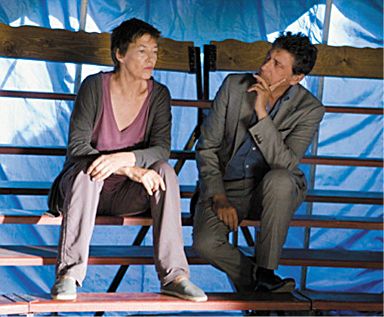
This film played out like "Waiting for
.... the Circus," as opposed to Godot. Pairs of characters
stand or sit and talk -- dead pan, sprinkled with nonreacturs,
cryptic and giving only the smallest clue as their their individual
background or intentions. You have to be a lover of Brecht to relish
this seldom used technique.
A man in a sports car traveling from Italy to Barcelona
meets up with a small traveling circus. Fascinated by the circus
lifestyle and since he has nowhere else to be, he follows the circus
from town to town, learning their acts, prying out their secrets,
just hanging out. Example of the absurdity: A clown tells another
performer to hold a plate under his chin. The clown draws a gun
and aims it at the performer's mouth, saying, "I shoot you
in the mouth, you catch the bullet between your teeth and then spit
it into the plate." We hear the act repeatedly, each time with
small changes. Eventually, we learn a bit of the dynamics of this
troupe of sullen performers, only to say goodbye at the end of their
touring season.
Cracks
Director: Jordan Scott
Cast: Maria Valderde, Juno Temple, Eva Green, Imogen Poots, Ellie Nunn,
Adele McCann, Zoe Carroll, Clemmie Dugdale, Sinéad Cusack

While watching Cracks, I kept drifting back to classics
that echoed many of the same themes. Early on, I couldn't help making
comparisons with The Prime of Miss Jean Brody -- an outspoken and
inspiring instructor at a girls' school influencing young minds.
Both films even takes place at the same time (1934) in the same
country -- England, a safe distance from the Spanish Civil War which
effects characters in both films. Then my thoughts strayed to The
Children's Hour -- similarities even included a young girl spying
her teacher through a door slightly ajar. Then I was transported
to the wild, shipwrecked boys in Lord of the Flies chasing down
pray. A girls' school is a breeding ground of lifetime bonds as
well as jealousies and adolescent yearnings, though it didn't seem
to include much learning. There was a lot of lounging about and
looking as lovely as the waifs in Picnic At Hanging Rock.
This is director Jordan Scott's first feature length film.
The nuances of the various relationships are subtle, yet potent.
The grounds of the school and the countryside are as inspiring as
any neoclassical English garden. The nude swimming by moonlight
are a treat for any Maxfield Parish enthusiast or pedophile.
Littlerock
Director: Mike Ott
Cast: Atsuko Okatsuka, Cory Zacharia, Rintaro Sawamoto, Brett L. Tinnes,
Roberto Sanchez, Mathew Fling, Ryan Dillon, Sean Neff
A
Japanese brother and sister suffer a car breakdown and have to stay
a couple of days in Littlerock, California, while awaiting a replacement
car. They meet some local boys who look quite shiftless, dubious and
maybe even a little dangerous. When the new care arrives the sister
decides to stay in Littlerock and continue to enjoy its backwater
lifestyle while her brother visits San Francisco -- and he lets her
stay! This is insane. My inner voice screams to her, "Go to San
Francisco. A wonderful film festival is going on there. Don't stay
with these dead end losers." I fear the worst. But not to worry.
It's just a real dull few days in a dusty, boring, whistle stop where
she is unchaperoned, and I guess that's the major attraction.
The Loved Ones
Director: Sean Byrne
Cast: Xavoer Samuel, Robin McLeavy, John Brumpton, Richard Wilson, Victoria
Thaine, Jesica McNamee
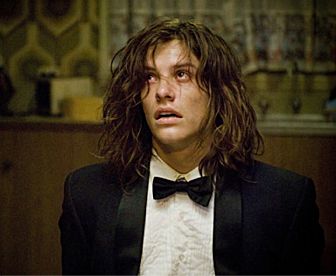
I cringed, I peeked between my fingers as
I covered my eyes with my hands, I squirmed, a even pleaded to the
screen, "Not this!" It went too far, and I loved it.When asked to go to the school dance by Princess, Brent
very politely says, "Sorry, I'm going with Holly," his
well-established girlfriend. But some girls won't take no for an
answer. Brent was already facing his own demons since the car crash
six months earlier which killed his father. And who was that guy
standing in the middle of the road, anyway? Brent didn't need any
more demons, but he got them, and how.
His nerdy buddy, Jamie, asks the hot Goth girl, Mia, to
go to the dance with him and amazingly she agrees. So, we watch
the progression of the evening for both boys. One might want to
stay clear of strange girls after seeing this film. I'm just glad
I got out of high school in one piece -- I'm sure partly due to
my never dating high school boys. This is a well-made, cut-above
thriller which should keep you close to home during the next sock
hop.
Morning
Director/Writer: Leland Orser
Cast: Leland Orser, Jean Tripplehorn, Laura Linney, Elliot Gould, Jason
Ritter, Kyle Chandler, Charlie McDermott
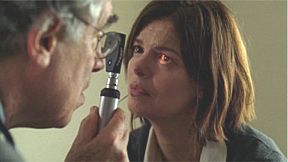
Husband
and wife in real life, Leland Orser and Jean Tripplehorn play fictional
spouses dealing with the accidental death of their son in this Orser
written and directed exploration of grief. This particular couple
can't deal with each other during this crisis and go their separate
ways to plumb the depths of their sorrow, guilt, and loss. It's not
easy following them during these most difficult first five days. He
is alone in the house and, therefore, silent. We only recognize his
pain by his behavior which is, in turn, destructive and self-destructive.
She tries to find help -- from moving in with a friend to the kindness
of a stranger found in a hotel bar to a medical doctor to a grief
therapist. Both their recoveries are so subtle that it's difficult
to tell if either of them will ever be functional again. Not an easy
film to watch and doubtful if it would help grieving viewers.
Presumed
Guilty
Director: Roberto Hernandez and Geoffrey Smith

Flawed as it is, we really do take our justice
system for granted. But this film will renew our appreciation of the
United States' constitutional right of "innocent until proven
guilty." It seems that in Mexico, the police can take anyone
off the streets, put him in jail without telling him what the crime
he is supposed to have committed is; he can be held for over 80 days
without seeing a lawyer. I could go on. This film follows Tono, an
innocent young man who was convicted of a murder even though he had
many witness alibis and a briefcase full of evidence that was not
allowed at his trial. Two lawyers decided to video document his case
in appeal. They were allowed to bring cameras into the court (more
like a corner of a busy office) and expose the system for what it
really is. Too many innocent men are withering away in overcrowded,
infested jails, only staying alive because their families bring them
food and money. Get the whole story at a screening of this very important
film.
Seducing
Charlie Barker
Director: Amy Glazer
Cast: Stephen Barker Turner, Daphne Zuniga, Pamela Gaye Walker, David
Wilson Barnes, Steve Cell
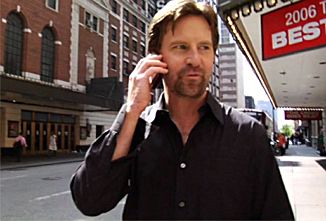
Charlie Barker is an out-of-work actor who blames
everyone but himself for his situation and general unhappiness, even
his wife who supports him both financially and emotionally. Charlie
can destroy everything he has, ruin all opportunities that come his
way, and still attack and insult everyone who would otherwise help
him. Add to that, his glands get the better of him and he starts an
affair with a gorgeous, but soulless, vapid, dull witted woman. It's
kind of hard for me to muster any sympathy for this narcissistic thespian
and I really don't want a happy ending for him. The film starts with
him scavenging food out of a garbage can; I had hoped the film would end that
way till he finds some humility and respect for others.
Date
Night (2010)
Director: Shawn Levy
Writer: Josh Klausner
Cast: Tina Fey, Steve Carell, Mark Wahlberg, Taraji P. Henson, Ray Liotta,
Jimmi Simpson, Common, William Fichtner, Kristen Wiig, Mark Ruffalo, Leighton
Meester, James Franco, Mila Kunis
Rated: PG-13
Time: 88 min.
I hear people say they like to go to the movies
for some mindless entertainment. You might say Date Night was mindless
entertainment. You don’t have to figure anything out. You won’t
think about it afterwards. There are no messages, no social relevance.
I hate mindless entertainment, usually. I feel my time was robbed from
me. But not with Date Night. I wondered why I didn’t feel cheated |
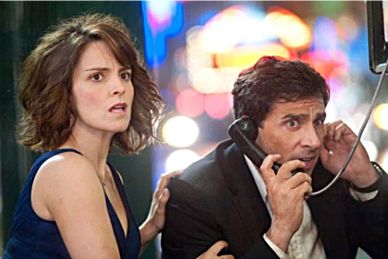
Fey and Carell adjusting to
a constant state of panic. |
and
I figured it was because I really like the people, Phil and Claire Foster
(Steve Carell and Tina Fey). They have a stable marriage based on
mutual respect and the ability to talk to each
other. They are not stupid or unlikable in any way. That one date night,
they just got over their heads. Way over their heads.It all started with Phil responded to a high end
restaurant hostess repeatedly calling out the name of the next party for
a table. Phil didn’t even have a reservation, but just wanted to
treat his wife to a very special evening in the city, not the regular
potato peels and salmon place in New Jersey they usually go to. So, Phil
responds to the call for the Tripplehorns and he and Claire enjoy some
very overpriced, but delicious food. Unfortunately, the Tripplehorns are
being hunted because ... Well, they’re being hunted and now the
Fosters have to deal with some very dangerous characters who put them
in some hilarious and threatening situations. How they maneuver through
this labyrinth is as much luck as quick thinking. Included is one of the
most inventive and scary car chases I’ve ever seen. Bullet and
French Connection have nothing on this.
Also, the dialogue was fast, witty and often hysterically
funny. Much of this is due to Fey and Carell improvising many of their
lines. The out takes at the end of the film are some of the funniest lines
– probably not used because they were out of character for the Fosters,
but too funny to leave out. Hopefully, the Fosters will come back for
more thrills and misadventures. Their chemistry was endearing, their travails
tightly scripted, their banter priceless.
The
Secret of Kell (2009)
Directors: Tomm Moore, Nora Twomey
Writers: Tomm Moore (story), Fabrice Ziolkowski (screenplay)
Cast: Evan McGuire, Brendan Gleesan, Christen Mooney, Liam Hourican, Michael
McGrath, Paul Tylack, Paul Young.
Time: 75 min.
Rate: PG
How
to Train Your Dragon (2010)
Directors: Dean DeBlois, Chris Sanders
Writer: Cressida Cowell ( story), Adam F. Goldberg (writer), Peter Tolan
(writer), Dean DeBlois (screenplay), Chris Sanders (screenplay)
Cast: Jay Baruchel, Gerard Butler, Craig Ferguson, America Ferrera, Jonah
Hill, Christopher Mintz-Plasse
Producer: Bonnie Arnold
Time: 98 min.
Rated: PG |

Dragon's Hiccup
up a tree with Astrid... and Dragon.

Kells' Brendon
up a tree with Aisling. |
I’ve been spoiled, as we all have. Since the first Toy Story, well,
even since The Adventures of Jimmy Neutron, Boy Genius, I find it difficult
to settle for flat cartoons. The only ones that I suffer now are The Simpsons,
Spongebob Squarepants and Futurama. And now that 3D has been perfected
and gone really deep – from just molded, shaped and shaded, to actual
depth via glasses – I find myself squirming in my seat with impatience
and boredom if I can’t reach out and try to grab something coming
at me or wafting past me, as I felt when I viewed The Secret of Kells.
And Kells’ animation is rather simplistic with few frames per second.
What makes it even more difficult to watch is that its major competition
is How to Train Your Dragon, with too many similarities
to avoid comparison.
Both have young boys as their protagonists. Brendan, in Kells,
lives in a monastery about to be invaded by Vikings; coincidentally, Hiccup,
in Dragon, is a Viking youth whose village is regularly invaded by dragons.
So, do I hate the Vikings due to Kells, or empathize with them a la Dragon?
Monasteries, such as the one in Kells, are dull with the only activity
of building a wall to protect it from invasion breaking the silent, stern,
foreboding atmosphere, oh, and the chase after a goose to pluck quills
for writing and illuminating bibles. In Dragon, the viking village is
constantly either under attack or is buzzing with rebuilding its burned
houses or the youth are being trained to be the next generation to fight
off dragons or Hiccup is in his workshop building new gadgets.
The stories go: Kells: Brendan (Evan McGuire) lives in the monastery
with his uncle, Abbot Cellach (Brendan Gleeson). While the Abbot is busy
getting a wall built around the monastery, Brendan is secretly learning
the art of illumination from the newly arrived Brother Tang (Liam Hourican).
It is necessary for Brendan to leave the security of the monastery to
find a tool to help paint a blank page in the book. In the forest, Brendan
meets Aisling (Christen Mooney), a forest nymph, who helps him reach his
goal. So, Brendan regularly slips away from his uncle to go to the writing
room. Dragon: Hiccup (Jay Baruchel) is the littlest nerd in the village,
a real disappointment to his father (Gerard Butler), and scoffed at by
all his peers, including the beautiful Astrid (America Ferrara). Hiccup
secretly builds gadgets in his workshop. One of his inventions, a catapult,
wounds a dragon, which Hiccup finds, trains, and enlists in his quest
to liberate all dragons from their ritual which includes pillaging the
village. So, Hiccup regularly slips away from his father to train a dragon.,
eventually taking Astrid into his confidence.And don’t forget – Brendan is flat and Hiccup is
taking us flying breathlessly along the rocky Scandinavian coast with
even more exuberance and realism than Jake Sully did in Avatar. What a
roller coaster ride without the coaster! But most significant was the
infectious humor, joy, and excitement of Dragons. The script is smart
and humorous. Hiccup is a dragon whisperer who attempts to save both his
town and the dragons from extinction. He is funny, witty, and ingenious.
I really enjoyed myself watching Hiccup solve the world’s problems
and get the girl. I feel conflicted about Kells’ Brendan devoting
his life to illuminating a page in a book that is supposed to light the
world through the Dark Ages, knowing that in actuality, the Catholic texts
and the bible were tools for keeping the Dark Ages dark, and all science
and literature at a standstill through the Inquisition and other horrible
tactics for 500 years. Yes, the Vikings and other barbarian hordes really
did scourge much of Europe, raping, pillaging and causing
mayhem. But they’re so
much more fun in Dragons. After all, don’t we go to see
animated films for pleasure? On all counts, Dragons is a much more pleasurable
experience than Kells. Except for one thing – Vikings don’t
actually speak with a Scottish accent or the strange Christian Slater
intonations Hiccup used. Dragons’ voices were annoying for me; were
there no Swedish, Norwegian, Icelandic or Danish actors who could do the
job? I did enjoy the accurate Irish lilts in Kells.
As for violence, I felt the Kells invasion scene was too dark
and violent for young children. Okay, there was violence in Dragon, too,
but it just seems more beautiful and fun in 3D. Both are rated PG and
that’s okay. Parents, aunts, uncles and all extended family should
go with the kids to see How to Train Your Dragon.
The
Runaways (2010)
Director/Writer: Floria Sigismundi
Kristen Stewart, Dakota Fanning, Scout Taylor-Compton, Alia Shawkat, Michael
Shannon, Tatum O'Neal, Brett Cullen, Riley Keough, Johnny Lewis, Stella
Maeve
Executive Producer: Joan Jett
Rated: R
Time: 105 min. |

Rocker
in a bustier? |
Rock and Roll, drugs, sex – in that order
is what the film, The Runaways, is about. We go back to the mid-1970's
and relive the times, the music, the forming of the first all girl rock
and roll band, the Runaways, featuring Joan Jett, Cherie Currie, and Lita
Ford. There has to be a genetic link between musical talent, or at least
the strong desire to be in a band, and the predisposition to drug abuse.
The Runaways confirms this theory, as do all rock music films, as do all
actual accounts. Or maybe it goes to early childhood situations –
absent parents (either actual or emotional) causing unsupervised children
to rebel and act out – becoming rock musicians and drug heads. Oh,
I’m getting too sociologically analytical. It’s just a movie
– your typical kids yearning to be free, famous, rich, sexually
active and rolling in pills and booze. It is also a true story. Joan Jett
executive produces this story about the formation and demise of her first
band, the Runaways. Coincidentally, none of the members were runaways.
They just said goodbye to whatever family was still at home and went on
the road. I love rock and roll, but I never loved girl bands.
In this case, it’s not because they aren’t as good musicians
(they are), it’s not because they aren’t as tough or as cool
(they are), it’s not because their songs aren’t as well written
or played (they are). But the voices are just too little. Except for Grace
Slick and Janis Joplin, there have been far too few voices big enough
and gritty enough while still in tune to keep up with the heavy metal
and pounding drums of good ole rock and roll. In The Runaways, the intro
on guitars and drums rises to a fever pitch, then the voices join in and
it sounds to me like the engineer speeded up the voices a la the Chipmunks
while leaving the instrumentals at normal rate. Hate me if you like, that’s
what I hear.
And band manger, Kim Fowley (Michael Shannon)
tried everything he could to get front woman Cherie Currie (Dakota Fanning)
to belt out those tunes with a vengeance comparable to a hard core, well
heeled biker with a sordid past. But he was asking
too much of the
girl
he selected based on her looking like a pubescent Bridget Bardot who had
only lip synched to Bowie even in the privacy of her own home. She couldn’t
even sing out loud in the privacy of her own bedroom or shower –
how could she rock? As a matter of fact, I consider Shannon’s performance
of attempting to squeeze adult male, testosterone, passion out of a girl
child the centerpiece of the film; he was certainly not the Brian Epstein-like
gentleman from whom the Beatles learned the art of rock.
Not
to diminish the acting performances of Kristen Stewart as Joan Jett or
Dakota Fanning as Cherie Currie. As the rock stars on the road, alone,
isolated, drugged, unhappy, angry – both actresses were up to the
task and were spellbinding. They played very different characters dealing
with pressures in their own ways convincingly and sympathetically. They
make such a good team in this film, they will be seen together again in
Eclipse, that soggy, effete vampire sequel for which I can’t understand
the ruckus. Enjoy Kristen displaying a passionate range of emotions in
The Runaways; you will only see a more-vamp-than-alive Kristen being fought
over for no apparent reason as the bloodless saga continues. And Dakota
has certainly made a smooth transition from child star to ingenue. I’m
sure she won’t disappear from the film industry only to end up in
criminal court or overdosed as so many child stars before her have.
As
for recounting the wild rocken’ days of the music world of the 80's,
Floria Sigismundi was certainly a good choice. Though this was her first
feature, her many rock videos and background in art and photography make
her highly qualified for the job.
Greenberg (2010)
Director: Noah Baumbach
Cast: Ben Stiller, Greta Gerwig, Jennifer Jason Leigh, Rhys Ifans, Juno
Temple, Chris Messina, Dave Franco, Brie Larson, Merritt Wever
Writers: Noah Baumbach (screenplay) from a story by Jennifer Jason Leigh
and Noah Baumbach
Producers: Jennifer Jason Leigh, Scott Rudin
Time: 107 min.
Rated: R
Looks like Ben Stiller is going the way of Adam
Sandler in Funny People (2009). Take a serious story with room for humor
to showcase the star’s acting skills so he can be taken more seriously
– Hollywood style. I say Hollywood style since Greenberg is far
from a serious drama, but more serious than previous Stiller vehicles. |
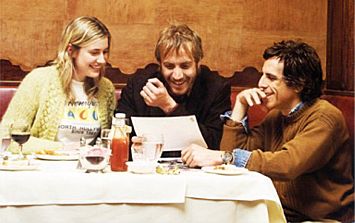
Greta Gerwig, Rhys
Ifans and Ben Stiller
peruse Musso & Frank's menu. |
Stiller plays, not a near do well, but a not interested
in doing well who just wants to do nothing, at least for a while. Roger
Greenberg is just chilling out after recently being released from a mental
institution for a breakdown. His brother, who is taking his family on
a vacation
to Viet Nam, has offered
his home in Los Angeles for some rest
and recovery.
And Roger’s brother’s assistant, Florence (Greta Gerwig),
is available to help with any errands or other help Roger may
need. Having been
raised in L.A., but living in New York for many years, Roger sees this
as an opportunity to catch up with his old friends. But his psychological
problems, past and present, make revisiting the good old times difficult.
Being insecure and self-deluded, having a touch of obsessive compulsive
disorder, and having experienced a painful breakup with his old band mates
from back in the day, all add up to some very uncomfortable encounters.
Seems Roger Greenberg was always obnoxious and inadvertently hurt people
often and deeply. I was uncomfortable to be around this Greenberg
character, and with his being present in every scene, I was pretty much
uncomfortable the whole 107 minutes. If Ben Stiller doesn’t share
these characteristic with Greenberg, he really is a consummate actor.
I disliked him and didn’t want to be around him even though I knew
the purpose of the film is to expose Greenberg to life’s lessons
and help him become a better man. He just wasn’t good enough for
my company the whole way through the film. I had to question the motivations
of Florence, the assistant, who was always ready to try again to have
a relationship with Greenberg. He gave her lots of mixed messages, but
the last message of every encounter was insulting and final. A bad relationship
with her father was suggested as the root cause of her psychology. But
still, I would have kicked her in the head and forced her to keep away
from Greenberg. Anybody is too good for him. There were a lot of insightful remarks put in
Greenberg’s mouth by writers, director Noah Baumbach and co-producer/actor
Jennifer Jason Leigh, especially about the youth of today. I couldn’t
help wondering if Baumbach and Leigh had Stiller in mind when they were
writing the story. He is such a perfect fit for the role – not to
say he’s obnoxious, but... he fits. I found it interesting that
Leigh was so adept at exposing the mind of misanthropic Greenberg. She
also gave herself a small part in the film. Even though she was on screen
for only two short scenes, it was refreshing to see her again. It was
also enjoyable seeing her calmly deal with Greenberg. “Want to go
out and have dinner some time?” “No.” She smiles and
follows the waiter off camera to get the check for the coffee they shared
during this brief meeting. I am so with her.
Maybe I’m too short on sympathy for Greenberg.
Maybe I should just hope he’s swayed by the good people around him
into seeing the error of his ways, open up, and allow love to enter his
heart. Maybe I should just let you try instead.
The
Wolfman (2010)
Director: Joe Johnston
Writers: Andrew Kevin Walker and David Self from the 1941 screenplay by
Curt Siodmak
Cast: Benecio Del Torro, Anthony Hopkins, Emily Blunt, Hugo Weaving, Geraldine
Chaplin, Art Malik
Rated: R
Time: 125 min. |
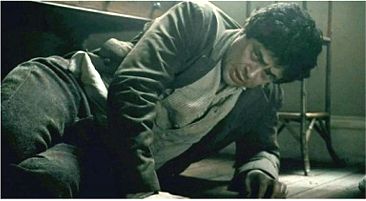 Benecio Del
Torro redefining the term 'the morning after.'
Benecio Del
Torro redefining the term 'the morning after.' |
The Wolfman seems to be trying to stay true to the classic gothic monster
movies from Universal Studios of the 1930's – even though The Wolf
Man was a late comer, being produced in 1941. Far from being the first
Wolf Man film, the 1941 version is the iconic version. The story, the
characters, the dark and foreboding tone, the fear of monsters all hark
back to the 1941 version. Credit is even given to the 1941 screen writer,
Curt Siodmak. So, take a good idea
and improve upon it. One difference is the early Wolf Man takes place
in its present day of 1941, but today’s Wolfman is set in Victorian
England, which makes it even more romantic and moody. Instead of Lon Chaney,
Jr. -- son of one of the acting world’s greatest, but himself certainly
disappointing in the titular role and in his career as a whole (so sorry,
but true) – we now have Benecio Del Toro. Del Toro has been far
too under appreciated and underutilized by Hollywood, so I’m glad
he secured this very high profile role. Even though he might be an unorthodox
choice to play British (though having spent many years in America) Lawrence
Talbot, son of Sir John Talbot, played by Sir Anthony Hopkins (rather
short on family resemblance), we need very little suspension of disbelief
to be convinced of the character’s authenticity in the face of De
Toro’s talent. It was exciting and enthralling to watch Del Torro’s
James-Dean-like brooding, aching portrayal of the smitten and bitten Talbot.
And Anthony Hopkins adds ferocious dimensions to the father figure, with
some secrets of his own, a role originally played by controlled and conservative
Claude Rains. Even Emily Blunt’s characterization and motivations
as the love interest, Gwen, are worth ample discussion time after viewing
by movie club participants.
The cob web strewn,
shadowy, high gothic estate; the village; the surrounding woods; and London
itself are all very reminiscent of the rather cardboard sets in the original
film. Nice to get out of the sound stage and into the countryside for
the outdoor scenes. But the cutting edge technology which brings life,
and grisly deaths, to the deeds of the lycanthrope make the remake worthwhile
all on its own. The all-important transformation from man to monster is
fresh, new, anatomically correct
and appropriately gross enough for the audience’s 21st century sensibilities.
And oh, the Moon – a character unto itself. How the moon spied from
above upon all the most violent and the most poignant of scenes, how the
moon followed our protagonists doggedly, exceeding astronomic limits and
the normal passage of time. In all its phases, the moon measured its cycle
against the desperate actions of our hero/demon. Makes me wax poetic. I have
noticed another improvement in storylines used for remakes, from Willie
Wonka and the Chocolate Factory to The Wolf Man – the exploration
of back stories, family histories, and psychological factors that inform
the characters’ present states. One wonders how the original Wolf
Man could have run even a mere 70 minutes with so little plot. Young Talbot
comes home, he gets bitten by a werewolf and is infected,
he runs amok. We have a lot more grist to chew in this latest version,
including a bit of social commentary on how insane asylums were run back
in the day – that alone would be cause enough to split one’s
bindings and go for the blood of all “doctors.” This plot
is textured, cohesive, and brings natural emotional motivations to the
characters who were previously formal and superficial.
Sure, there’s
a lot of high tech gore, high speed claw slashings, decapitations and
brute against brute to the death fights. The populations of the village
and London, as well as the migratory gypsies, were dramatically diminished.
So, expect a bunch of scared hugs and grapplings from your film-going
partner. For the more sophisticated and strong of heart among you, expect
a few laughs in response to the bloodbath.
Leap
Year (2010)
Director: Anand Tucker
Writers: Deborah Kaplan, Harry Elphont
Cast: Amy Adams, Matthew Goode, Adam Scott, John Lithgow, Kaitlin Olson
Rated: PG
A good story can be told again and again. And
to make it more interesting, the characters can be changed a bit, maybe
the locales, maybe little incidental plot devices. So, here again is the
story of a woman on a quest to marry the man she loves, who has to travel
a great distance, experience new things in a different culture and re-evaluate
her life choices. And along the way, she has adventures that disrupt her
equilibrium, test her flexibility and force her to see the mistakes she’s
been making, as well as see the right alternative. |
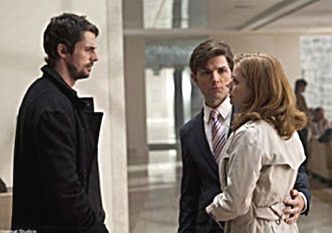
Matthew Goode, Adam
Scott and Amy Adams.
See what I mean? |
Wasn’t this the plot to “It Happened
One Night” (1934)? A rich girl (Claudette Colbert) who wants to
get to her betrothed while avoiding the paparazzi\ is helped on the road
by reporter Clark Gable who is critical of her lifestyle and ethics, and
while on the road, they fall in love. Oh, how romantic.
Here,
it’s a real estate stager, Anna (Amy Adams), who wants to surprise
her boyfriend, Jeremy (Adam Scott), while he’s at a medical convention
in Ireland over Leap Day, which entitles her to propose marriage to him.
A series of unfortunate events leads her to seek the help of a local bar
owner, Declan (Matthew Goode) who is in a deep financial crisis, and off
they go cross country to deliver her to the man she wants to marry.
Need
I say more? Declan is cuter, taller, and has great eyes. Jeremy, though
a doctor and a relatively nice guy, doesn’t stand a chance. We
know that going in, but we take extreme pleasure watching the story
unfold. It’s passably good and I passably liked it. And the countryside
was gorgeous. And who wants to be rich and successful, with a doctor
husband, in a great co-op, surrounded by good friends and relatives
when one can be with Declan in a quaint bar in some lovely Irish (or
is it Welsh) countryside? A nice 1 ½ hour romance. Now, back
to reality.
Youth
in Revolt (2009)
Director: Miguel Arteta
Writers: Gustin Nash (screenplay), C.D. Payne (novel)
Cast: Michael Cera, Portia Doubleday, Jean Smart, Steve Buscemi, Fred
Willard, Ray Liotta, M. Emmet Walsh
Rated: R
Time:
90 min. |
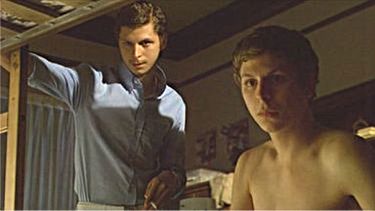
The moustached and
the innocent Michael Cera |
I
love seeing a perfectly good kid -- bright, moral, well educated, respectful
-- throw it all away for the possibility of getting laid for the first
time. Maybe all girls are evil and want ridiculous proofs of love or desire
before they give out or maybe they just can’t help but take advantage
of nerds who cross their
paths. Thanks to Nick Twisp’s (Michael Cera) unscratchable itch
for two person sex, we get to see some pretty extreme acts to satisfy
the whims of Sheeni Saunders (Portia Doubleday). One might suggest he
pay a prostitute, but Sheeni promises a steady relationship, meaning regular
sex; and a situation like that can’t be lightly set aside. So, off
goes Nick to the deep end from a high cliff, even recruiting his doppelganger,
Francois Dillinger, to help bolster his courage and give him advice on
how to go about ruining the rest of his life.
I
hate to love a movie like this. It’s crass, wholly directed towards
teens, and tragic. I hate that I enjoyed watching Nick throw himself into
the dark side with the help of his evil, yet oh so cool, alter ego just
to satisfy his visceral needs. I hate myself for enjoying the tragic fall
and the end of a limitless future for this kid.
The
Joneses (2009)
Director: Derrick Borte
Writer: Derrick Borte (story), Randy T. Dinzler (screenplay)
Cast: David Duchovney, Dimi Moore, Amber Heard, Ben Hollingsworth, Gary
Cole, Glenne Headley, Lauren Hutton, Catherine Dyer, Chris Williams, Christine
Evangelista
Rating: R
Time: 96 min. |
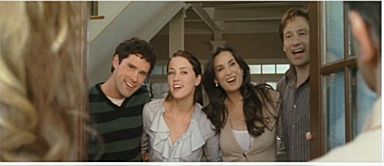
Hollingsworth, Heard,
Moore and Duchovney greeting their new neighbors |
I knew something was fishy in the opening scene
– moving vans deliver a household full of expensive and beautiful
furnishings, and even clothes on racks, to an empty house and no on is
there to greet the movers. These movers place every article as if staging
the house. Hmmmm. And when the Joneses arrive, they are all excited and
happy to see how majestic and large the outside of the home is, never
having seen it before. So, are they spies, terrorists, undercover FBI
agents? It turns out they are representatives of four age and genders
groups whose goal is to market expensive goods to a new neighborhood through
their lifestyle – they live the products, from furniture to cell
phones, golf clubs to big screen TVS and Wii video games, perfume and
jewelry to clothes and sneakers. They are aptly named the Joneses because
through the use of careful placement, amiable parties, charm and class,
everybody wants to keep up with them. High school girls want to wear that
cool new lipstick, men want their wives to have sex with them again because
of the beautiful gifts they give them, women want to look beautiful and
stylish, boys want the latest electronic and sports toys.
Of course, the problem is our perfect family is
made up of marketers, not a real family, and they are individuals with
their own idiosyncrasies which often get in the way of performing their
jobs. So, there may be trouble in consumer paradise.
One
can’t help but reflect on the cable TV show, “The Riches.”
This family of modern gypsies take over the lives of a couple who died
on the road – live in their house, take the husband’s job,
live the middle-class life of the wife. The kids, for the first time,
attend school. But it’s not easy to keep up the pretext –
either externally being found out or internally/psychologically wanting
or being able to adjust to this life. The Riches’ drama was more
intense and more interesting than the Joneses day to day marketing ploys.
The messages in The Riches were more powerful than the Joneses. And
the actors were superior and adept. Oh, I liked The Jones family, David
Duchovney and Demi Moore are so charming and beautiful. Amber Heard
and Ben Hollingsworth are good enough kids, though they look way too
old to still be in high school. But really, the Rich family was on the
edge and edgy, flying by the seat of their pants, and reached the depths
of their emotions, carrying us with them on their high stakes charade.
Okay, I’d rather rent The Riches than see The Joneses.
And
another thing – the message in The Joneses just doesn’t
fit today’s economic environment. This story had to have been
written before October 2008, when the market crashed. Since then, people
aren’t worried about keeping up with the Joneses; they’re
worried about their next mortgage payment. They aren’t buying
out-of-their-price-range Audis; they are scrimping to get an iPad. This
film harkens back to a time when people even tried to keep up with the
Joneses. Ah, fond memories.
The Greatest (2009)
Director/Writer: Shana Feste
Cast: Susan Sarandon. Carey Mulligan, Pierce Brosnan, Aaron Johnson. Johnny
Simmons, Miles Robbins, Zoë Kravitz
Producers: Lynette Howell, Beau St. Clair
Rated: R
Time: 99 min.
Every
chapter of the grief manual is covered in this film, but instead of descriptions
or anecdotes there is a story. The perfect son dies in a car crash. His
family tries unsuccessfully to
deal with the loss. It’s beyond Ordinary People (1980); the surviving
son is not resented or ignored by his parents this time. It’s closer
to “Moonlight Mile” (2002) in that a lover of the departed
child moves into the family dynamic. In “Moonlight Mile,”
Jake Gyllenhaal, fiancé of the deceased, attaches himself to Dustin
Hoffman and Susan Sarandon. Here, Carey Mulligan knocks on the door of
Pierce Brosnan and (again the grieving mother) Susan Sarandon’s
home with the news that she is pregnant with their grandchild. And off
we go. Perhaps dealing with Mulligan is a healthy distraction from the
insurmountable pain of losing their son (Aaron Johnson, recently of “Kick-Ass”),
but each of the family members, now including Mulligan, go through their
various stages of grief in their own painful way. |
|
This
film, though heartfelt and sincere, seems almost like an after school
special and will eventually wind up on Lifetime or LMN cable channel.
Sarandon has perfected the role of grieving mother in its several film
incarnations, including “In the Valley of Elah" (2007) and
“Lovely Bones” (2009), as well as the two above noted films.
In “The Greatest,” she has lost all semblance of the attractive,
empathetic woman she conjured for the other mothers. Tired, haggard, wan,
and greasy haired – this is the look actresses sacrifice their beautiful
appearance for to wins Oscars©, but “The Greatest” is
not worthy material. I expect she’ll be back to her old lovely self
in her upcoming films. Mulligan is a viable American-accented actress
and the world of opportunity is opening for her. She is the flavor of
the year, unfairly being compared to Audrey Hepburn – not even close.
But she is adorable and her presence in this film certainly brightens
the dark subject matter. Brosnan is stretching from typically “in
control’ to ‘vulnerable’ in this tear jerker which he
co-executive produced. He even adds a few tears of his own.
Happy
Tears (2009)
Director/Writer: Mitchell Lichtenstein
Cast: Parkey Posey, Demi Moore, Rip Torn, Ellen Barkin, Christian Camargo,
Billy Magnussen, Roger Rees
Producer: Joyce M. Pierpoline
Rated: R
Time: 95 min.
Happy Tears is really Parkey Posey’s
vehicle. Through the course of her travails as a woman whose husband doesn’t
want a baby while she does, whose sister upbraids her for her damned luck
of marrying rich and being irresponsible, whose father deteriorates into
dementia before her very eyes, and whose mother’s most precious
belongings disappear into the hands of her father’s crack head girlfriend,
she seems to be falling deeper
and deeper into a
breakdown. I have to admit,
I don’t have a whole lot of sympathy for Jayne (Posey); she’s
spoiled, selfish, and regularly drifts into dreams to escape the harsh
realities that demand her |
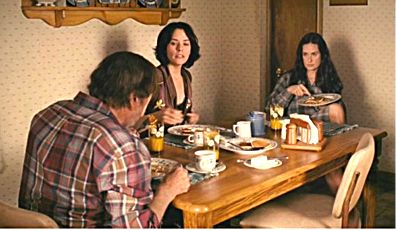
Rip Torn, Parker Posey
and Demi Moore --- watch the dribble! |
attention. Kindly, he
dreams also take us
to a prettier, mostly happier world and comparably
happier memories, and out of Dad’s (Rip Torn) cluttered, dirty home
and his physical needs of washing feces off his butt and changing his
vomit stained shirt. Laura
(Demi Moore) is the stalwart sister to deals with problems and has a history
of protecting her baby sister from life’s harsh realities. Now she
wonders if all that early protection was a mistake – seeing how
incapable Jayne is of coping
with or facing reality as an adult. There
are no climactic all out,
drag down, clear the air fights that are de rigueur for dysfunctional family
dramas and that I much appreciated. Perhaps this family is not so much
dysfunctional as just trying to get by, trying to find happiness, trying
to do what’s right. These are just two sisters with very different
personalities trying to deal as best they can with their present problem
– Dad and is future. And Dad himself, as damming as his past may
be to his character, is a cheerful fellow who just appreciates having
his “girls” with him and his treasure buried nearby in the
backyard. Well, treasure, you say? Along with the rest of her dreams,
Jayne has high hopes of finding the treasure, though how Dad could have
possibly accumulated any amount of wealth is unknown, and Jayne is certainly
not hurting for money. Please note that Ellen Barkin, as Dad’s
buzzed girlfriend who poses as a nurse because she’s got a stethoscope
draped around her neck, is absolutely brilliant and worth the price of
admission. If this stellar performance is due to her being too old to
be considered a leading lady anymore and she now feels free to really
bust her acting chops, what a pity. We could have otherwise been enjoying
her fantastic performances for the last 20 years. Taking into account
the strength of my stomach, I could watch her do her “Shelly”
schtick all day.
As for the overall theme of the film, oh, baby
boomers, this is what you have come to or will come to in the near future.
Expect more films like Happy Tears, Play the Game (2008), The Savages
(2007), Away From Her (2006), The Boynton Beach Bereavement Club (2005),
and The Notebook (2004) -– the institutionalization of your generation.
At
the Foot of a Tree (2009)
Director/Writer: Ricky Shane Reid
Producer: Kelly Jo Reid
Cast: Reece Reid, Anna Blades, Norman Reid, Neil Summerville, Nicola Borthwick
Time: 84 min
The film starts with a functional family. Everybody
loves and supports each other, and they all have a great time together.
They play together, eat together, talk, watch tv and listen to 11 year
old Alfie play his guitar and sing. I had hopes this would be a very boring,
but unique, film about a singular situation: no enemies, no neurosis,
no pain, just lots of love and mutual respect. I was half right. |
Reece Reid as Alfie contemplating his actions. |
For some undisclosed reason, dad comes home beaten up by his cousin, and
little Alfie decides to seek revenge. Actually, it took a very long time
to get to this point in the film. We are subjected to endless repetitive
scenes of Alfie riding his bike, climbing a tree, looking off into the
distance, and again riding his bike, climbing a tree, looking off into
the distance. I could go on, endlessly, repeating these scenes. This may
be why it took less than 2 weeks to shoot the whole 84 minute film. Oh,
he is hidden in his brother’s attic where he thinks about, dreams
about and forecasts riding his bike, climbing a tree and looking off into
the distance. Each repetition gives the viewer a bit more info: a longer
cut of the same shot which includes a word or sentence of dialogue, making
each repetition a few seconds longer. Possibly, writer/director Ricky
Shane Reid
thinks this technique builds up interest or tension, but it is unnecessary
because any viewer who is still awake has already figured out where the
whole film is going. It takes 84 minutes of viewing to impart about 20
minutes worth of content, while questions, if anyone is still interested,
could have been answered that may have been
more difficult to write/shoot/edit, such as why dad was beaten up; who
these violent, hateful cousins are; what happens to dad after the attack;
what in
Alfie’s past could lead him to do what he did? There could have
been a movie here, but instead of content we’re giving endless repetition
which some might call artful film making.
This is writer/director/co-producer/actor
Ricky Shane Reid’s first film, as it is his brother, Reece Reid’s
first acting gig. This film could probably make a rather haunting, eerie
short – a good place to begin a career in film making and acting.
Fish
Tank (2009)
Director / Writer: Andrea Arnold
Cast: Katie Jarvis, Michael Fassbender, Rebecca Griffiths, Sydney Mary Nash,
Harry Treadaway
Time: 122 min.
Rated: NR
What a dismal, deadening life -- at least in Essex,
east of London, as depicted in “Fish Tank,” and probably in
all the small cities throughout England. Well, maybe it’s bad all
over. I am just adjusting to the fact that things are worse all over and
that we’re all getting used to it. I was brought up in an age when
we expected things to get better and better, and they did to a point.
I can’t remember at which recession all that stopped. But let’s
not get into economics and politics now. Back in the early 1960's, England
developed a unique genre – the “Angry Young Man,” films
– such as “Loneliness of a Long |

Katie Jarvis reflecting
on suburban hopelessness. |
Distance Runner”
(1962), “Look Back in Anger” (1959), “Saturday Night
and Sunday Morning” (1960), “This Sporting Life” (1963),
and even the comedy “Billy Liar” (1963). Tom Courtney, Albert
Finney, Richard Harris, and Richard Burton were the poster boys of the
disappointed,
disenfranchised
youth of their generation. The girls were represented by Rita Tushingham
in “A Taste of Honey” (1961), “The Leather Boys”
(1964), and “Girl with the Green Eyes” (1964). Whereas, back
then the famous “gaze,” staring out into nowhere and dreaming
of a better life, was perfected by Tushingham and copied by all budding
actresses of her generation, protagonist Mia in this current film attacks
whole gaggles of girls, defies her mother, shuns her sister and aerobicizes
her demons into submission with her endless street dancing practice in an
abandoned apartment.
In
the 60's, row houses were the symbol of uniformity at the expense of hominess,
creativity and optimism. Oh, what an improvement these little attached
cottages with their quaint backyards, and often outhouses, are in comparison
to the huge, unlandscaped projects, already decaying and vandalized –
all the windows facing the next building’s windows, looking like
rows of fish tanks in a pet store, exposing the goings-on of each tank’s
captives.
If people in England’s pre-Beatles 60's
were angry, the people who inhabit cities like Essex today are downright
furious, even more alienated and hopeless. Mia (Katie Jarvis) is so angry,
so representative of her time and place, that it’s hard to empathize
with her. She is a nasty piece of work, already so hardened by her environment
that it’s hard to find the humanity in her. But through the course
of the film, we find she’s not completely deadened yet. She wants
to help a horse in a garbage strewn field who she thinks in being abused,
she wants to compete in a dancing contest with the hope of bettering her
situation, and she finds compassion and a glimmer of a better future with
her mom’s new boyfriend (Michael Fassbender).
Is she fooling herself, at 15 still to innocent
to see the inescapability of her situation? Perhaps Mia will or won’t
find a better life, but Katie Jarvis, the girl who plays her, has. Jarvis,
an unemployed drop out who had no intention of becoming an actress, was
found in a train station arguing across platforms with her boyfriend by
director Andrea Arnold’s (“Red Road,” 2006) casting
people. Since her very admirable performance in “Fish Tank,”
which earned her several acting nominations and awards, she has an agent
and has already been in another British television production. So, no
matter what happens on the screen, the film has a happy ending.
Daybreakers (2009)
Directors / Writers: Michael and Peter Spierig
Cast: Ethan Hawke, Sam Neil, Willem Dafoe, Emma Randall, Isabel Lucas,
Michael Dorman
Rated: R
Time: 98 min.
The description of “Daybreakers” starts: “In the year
2019, a plague has transformed most every human into vampires.”
And the plague is too many vampire movies and TV shows. These poor creatures
of the night have no more secrets, mystique or privacy. In “Daybreakers,”
because humans are almost as rare as the Dodo and vampires now run the
world, culture, business, politics, vampires have simply turned into humans
who are suffering a precious resource shortage: blood. The parallels to
human culture are abundantly clear. They, as we, have sucked the life
out of this planet: for us, trees, minerals, petroleum, animals, air; for them, |
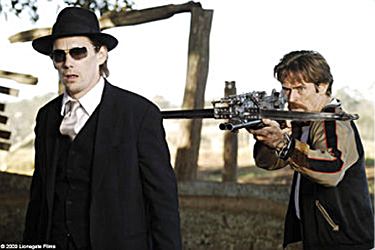
Ethan Hawke and Willem
Dafoe fighting the good fight |
it’s human blood. Otherwise, their lifestyle is identical
to ours except they have special cars for daytime driving and lots of
walking tunnels to avoid direct contact with the sun. So now the fete
is accompli. Vampires are humans, as dull, as lifeless, as monotonous.
Hopefully, this will end the present fad of vampire movies.
To
the plot – how to solve the problem of hungry vampires? Even back
in 1994, vampire Louis in “Interview with the Vampire” (and
the time tested book of the same name from which it was taken) knew he
could get by just fine on rats’ blood. That would solve two problems
at once. Angle, from the TV show of the same name, as many others with
his problem, made arrangements with butchers to get a regular supply of
pigs’ blood. We husband animals, why couldn’t “Daybreakers’” vampires in the not to distant future? Actually, their idea for the solution
is the dumbest thing I’ve heard of or read yet. I can’t write
it. It’s too stupid.
So,
enjoy the blood spurts, ripped throats, gang sucking and hopelessly confusing
and dismal end to the film. Hopefully, “Daybreakers” bodes
the end of the genre – at least till the next generation of film
viewers. Ah, but Twilight 3 is already in production. Nonetheless, this
will be the last vampire film I see. I started as a kid watching the original
“Dracula” (1931) on TV, read Stoker and Rice, lived for each
episode of “Buffy the Vampire Slayer,” and kept up though
the years as the legend got sillier, more vapid, repetitive, and pathetically
dull. You all must go on without me. For me there is nothing left of the
vampire myth but a small pile of ash in the sun.
Nine (2009)
Director: Rob Marshall
Screenplay: Michael Tolkin, Anthony Minghella, from the Broadway show
written by Arthur Kopit, Maury Yeston, from the Italian original Broadway
musical by Mario Fratti, from the original story and life of Frederico
Fellini, co-written with Ennio Flaiano
Cast: Daniel Day Lewis, Marion Cotillard, Penelope Cruz, Nicole Kidman,
Judi Dench, Kate Hudson, Sophia Loren, Fergie
Rated: PG-13
Time: 110 min.
Daniel Day Lewis doesn’t make enough movies. We have far too few
opportunities to watch this masterful and magnetic actor on the big screen
weaving his magic and entrancing us. All I can say without reservation
is watch everything he’s in, including “Nine.” Also,
there aren’t enough musicals being made in Hollywood or any place
else. I can’t understand that since they always end up in the black
on the ledger, and they’ve got to be cheaper to make than “Avatar.”
So, Daniel Day Lewis in a musical has got to be a winning combination.
One’s interest is always piqued as to whether the actors have good
singing voices.
|
Daniel Day Lewis alone on the casting couch. |
Didn’t the whole cast of “Chicago” floor
us with their singing skills? As an aside, I would really love to know
why both Rene Zellweger and Catherine Zeta Jones refused parts in “Nine.”
Could it be they didn’t want to be pigeon holed as musical stars,
and especially being cast together again. Or did they have doubts about
the script? They were probably just committed to other projects, but one
loves mysteries like this one. I think they missed out.“Nine,”
the film, was adapted from “Nine”, the stage play. But it
should not be forgotten that both “Nine”’s source material
was “8 ½,” or “Fellini’s 8 ½,”
as it was called in America in 1963 when it debuted, not only because
Fellini was the director,
but the film exposes the history, dreams, fears and very soul of Fellini.
In "Nine," the Fellini character, Guido, is suffering writer’s
block on his latest film as it is about to start production. Quietly panicked,
he tries to hide from his producer and the paparazzi (a name originally
dubbed by Fellini himself) by going to a small spa in the countryside,
only to be followed by his whole production crew, his mistress, his wife,
his memories, and his fantasies. Unfortunately,
copying a master is very much like the analog comparison of taking a photo
of a work of art – one loses clarity, detail, awe inspiring craftsmanship,
artistry and originality. I suggest one not see “8 ½”
before viewing “Nine.” See it fresh and enjoy it. “Nine”
does stand very strongly on its own. And it really isn’t fair to
make comparisons; nothing could compare to Fellini’s most powerful,
truly amazing work which even today blows minds. “Nine” reminded
me more a Fosse production, except the dancing wasn’t as sexy. The
very American flavor of the musical numbers, especially Kate Hudson’s
Italiano, are exciting and very entertaining. All the actresses happen
to have great voices. You already knew that about Kidman from “Moulin
Rouge” (2001), Cotillard from “Edith Piaf” (2007), and
Fergie, obviously. But what a surprise to see Cruz, Dench and DD Lewis
belting out their numbers. I did miss the trademark Fellini music that is
still his trademark, written by Nino Roto for most of his films. How can
any Italian themed film not include at least a few riffs in the style
of Rota? Actually, I was distracted by not hearing it.
I thought Penelope Cruz was gorgeous, Nicole Kidman
elegant, Kate Hudson adorable, Judi Dench timeless, Fergie raw, and Marion
Cotillard the true embodiment of love – until Sophia Loren appeared
on the screen. At 75, she is still the ultimate woman and overshadows
all others. I don’t mean I remember how she was, or I pay homage
to her past glory. She still is! I want to thank the Weinstein Company
for bringing her to the big screen again.
It’s
Complicated (2009)
Director / Writer / Producer: Nancy Meyers
Cast: Meryl Streep, Alec Baldwin, Steve Martin, John Krasinski, Lake Bell,
Caitlin Fitzgerald, Zoe Kazan, Hunter Parrish
I have to admit, ”It’s
Complicated” was better than I expected. It probed the situations
and feelings of a divorced woman who is in contact and “on good
terms” with her ex-husband. They meet at parties to celebrate more
fortunate couples’ anniversaries, they both go to their son's graduation
and even though the ex is at fault, having left his wife for a younger
woman, he will surely walk his daughters down the aisle when the time
comes. How one deals with
constant meetings with an ex may already be answered by the time the film
begins, but how to interpret one’s true feelings during an affair
with one’s ex is the quandary here. Jane (Meryl Streep) |
|
has a moment
of weakness while drunk and partying with her husband, and lands up in
his meaty arms again. Jake (Alec Baldwin) couldn’t be happier, having
found his young, beautiful wife (Lake Bell) too demanding and unsympathetic.
Jane was truly a Martha Stewart wife, with only the ambition to run a
bakery/restaurant, not rule the world. Jake may have taken the nurturing,
great cooking and lovely table settings for granted during his marriage,
but sorely misses them now.
Jane, being very intelligent
and aware, wants to really probe her motivations for this passionate rekindling.
She even talks with her therapist about it, if we didn’t figure
out all the alternative
Meryl Streep,
Alec Baldwin: that what-have-I-done?
Rather than let her emotions lead her, she careful thinks out why she
does what she does and relies on sanity, wisdom and common sense when
making her decisions. I love her mindfulness, while still enjoying life
and having a good time. I love writer/director Nancy Meyers’ perspective
of how a woman feels about her own body at Jane’s age. It was sad
to see Jane constantly hiding her body from her ex, even though they had
felt every inch of each others’, because since their divorce 10
years earlier, it had aged 10 years. I love his response when she finally
unveils herself. I connected with all her decisions throughout the film,
even where it concerned her children, and I don’t even have children
or an ex. It really takes great writing skill and human understanding
by the writer for an audience without shared experience to empathize and
agree with these characters.
But I couldn’t
understand why Jane wasn’t incredibly fat since she eats so much
of her own bakery goods during the film. I was also distracted by the
constantly bobbing boom mic on the top of the screen. Once, maybe, but
so many times that I kept watching the sky or ceiling in most shots for
its next appearance. I heard several groans from the audience to welcome
these appearances.
The
Missing Person (2009)
Director / Writer: Noah Buschel
Cast: Michael Shannon, Amy Ryan, Frank Wood, Linda Emond, Paul Sparks, Margaret
Colin, John Ventimiglia, Yul Vazquez, Merritt Wever
Time: 95 min.
In the first 5 minutes, I felt “The Missing Person” proved
the film noir genre was a unique thing of the past that should not be
disturbed. The genre was famous for its lighting (making the Venetian
blind a mainstay of cinematographers and gaffers foreclose to 15 years).
The opening of " The Missing Person” is just dark, without subtlety, gradation,
mood or artistry. There isn’t even a neon light outside a flophouse
room interrupting the dull blackness. Sure, it’s got a loud, high
speed subway mere feet away from the window, but is that enough? |
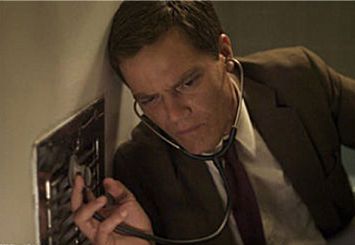
Good old fashioned
eavesdropping by Michael Shannon. |
A guy wakes up to a phone call. His typical gumshoe voice, drenched in
old martinis and bad dreams, jaded and fatigued, accepts a job entailing
following a man on a train from Chicago to L.A. $500 a day plus expenses
can’t be turned down in his economic state. But even his voice is
too flat, too monotone to involve an audience. This actor is trying to
hard to play a stereotypical private eye, and in the process, falls far
short of the greats: Humphry Bogart with his wry intonations, Robert Mitchem
with his undertone of anger and sexuality, Robert Ryan with his seething
madness just under the surface.
But I stay
and watch, not expecting the film to go anywhere. I’m already disappointed.
We ride on the train with the PI, followed man and his young boy companion.
We are stunned by Southern California’s over-exposed sun and tall
palm trees. We start meeting more characters and, to our surprise, start
getting involved. All the plot turns are there. It’s not so much
that this film takes us to new places as that we enjoy ticking off the
list of elements necessary for a noir movie to contain. “The Missing
Man” is more a low budget tribute to a past art form than an original
take on an historic genre. I’m glad I stayed till the end.
Alvin
and the Chipmunks: The Squeakquel (2009)
Director: Betty Thomas
Writer: Jon Vitti, Jonathan Aibel, Glen Berger
Cast: Alvin, Simon, Theodore, Zachary Levi, Jason Lee, David Cross, Wendie
Malick
Producers: Janice Karman, Ross Bagdasarian, Jr.
Rated: PG
Time: 88 min.
“Alvin and the Chipmunks: the Squeakquel,” is all
you’d expect it to be. The plot is safe and time worn, but the kids
probably haven’t seen it yet – if they’re very young.
The characters are sweet and amicable, with one blatant villain easy for
kids to understand and boo at. The animation is very lifelike and the whole
audience will soon forget that the creatures are not real, and will happily
suspend disbelief. But most of all, the music is hot. It was obviously
intended for an older audience, so parents bringing their children will
have a good time despite the over-acting and lack of surprises. It’s
their music –- some of the most rockin’ hits from the 70's
and 80's are brought back with the distinctive Chipmunks treatment. As
soon as I got home, I whipped out my Chipmunk Punk album and reminisced
to the beat of “My Sherona.” Yes, I have a Chipmunk album
and am proud of it. This is not children’s music, though they can
enjoy it as much as we adults do. |
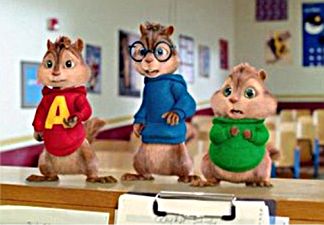
The 3 rock
stars go to high school to win a music contest
to keep the music program alive. |
The
Private Lives of Pippa Lee (2009)
Director, writer (novel and screenplay): Rebecca Miller
Producer: Brad Pitt, Lemore Syvan
Cast: Robin Wright Penn, Alan Arkin, Winona Ryder, Keanu Reeves, Shirley
Knight, Julieanne Moore, Monica Bellucci, Madaline McNulty, Blake Lively,
Mike Binder, Ryan McDonald, Zoe Kazan
Rated: R
Time: 98 min.
One nice thing about actresses getting divorced is they come back to work.
We’ve been seeing a lot more of Robin Wright since she and Sean
Penn initiated divorce proceedings. Call me selfish; I couldn’t
be happier.
I
think the script for “... Pippa Lee” was intentionally written
poorly in places, riddled with the worst cliches and banal dialogue just
so Wright could deal with bringing veracity to these over used and tired
lines. And she did gloriously. I was amazed how she could deliver a sentence
like, “I can’t take |
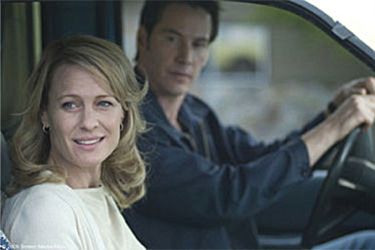
Pippi
(Robin Wright Penn) riding in car with boy (Keanu Reeves) |
it anymore,” and we believe her,
wholly empathize with her. Other parts of the script were very witty and
humorous in a dry, off-handed way. Another notable performance was by
Winona Ryder (Edward Scissorhands”) as a neurotic, unstable, and
guilt ridden friend. Pippa
herself, played by Robin Wright Penn, is not such an extraordinary character;
she is actually like a lot of us. Pippa’s life starts with an extremely
dysfunctional family colored by Pippa’s mother (Maria Bello - “History
of Violence”) who’s mood shifts, caused by prescription drugs,
make Pippa’s life unbearable. By the way, Bello did an incredible
job of relating completely random emotions. No, “What’s my
motivation?” in this part. She just did it and wrenched our hearts
in the process. Onward to Pippa’s teen years of sex, drugs and beach
parties. The next phase of her life tells the story of how she falls in
love and marries an older man (Alan Arkin - “Little Miss Sunshine”)
and becomes the perfect wife.
We all may not realize it, but upon reflection, each of our lives also
has sections so disparate in environment, lifestyle and attitude, they
could be separate books or films. What makes Pippa’s life unique
is that she decides what kind of person she would like to be and works
at it, sometimes for years, to achieve the desired effect. Yet, she is
not a false or duplicitous person. She is just taking control of her life
and making of it what she wants. You have to admire her for that and for
choosing to be kind, giving, and in the process, respected and loved.
If we all made such conscious decisions as to the life we lead, there
would be a lot less regret in the world. There is much to learn from Pippa.
Serious
Moonlight (2009)
Director: Cheryl Hines
Writer: Adrienne Shelly
Cast: Meg Ryan, Tim Hutton, Kristen Bell, Justin Long
Rated: R
Time: 84 min.
My credo has always been that if a man says he doesn’t love me,
I don’t argue with him, I don’t plead with him, I don’t
try in any way to change his mind. “So long and amen.” I don’t
believe you can change people’s feelings; maybe their actions (by
force or agreement), but not their feelings. And I don’t want a
man who doesn’t want me. It’s not just pride or dignity or
self-respect. Well, it may be, but logically, there ain’t nothin’
you can do about how other people feel about you.
Leslie (Meg Ryan), when told by her husband, Ian
(Tim Hutton), that he doesn’t love her anymore, won’t let
him go, figuratively and literally. She insists she will convince him
he still loves her as he did |
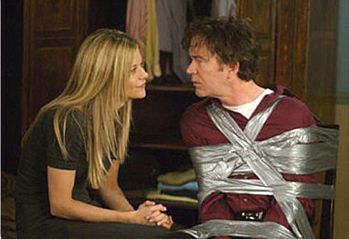
Reconciliation? |
in the past. She will change whatever made
him believe he doesn’t love her anymore, whatever is wrong with
their marriage. He even tells her he is now in love with another woman,
but she is undeterred in her dogged and relentless pursuit of his once
vital love.
Okay,
I’m not with this woman. Not only do I think the guy’s a jerk
and doesn’t deserve a real grown up woman as opposed to the typical
much younger, idealistic, naïve woman/child he will run away with
(Kristen Bell), but I can’t stand Meg’s desperation. In her
various attempts to reconcile, her behavior is so extreme, I start seeing
visions of Kathy Bates in “Misery” (1990),
forcing her captive, James Caan, to love her. I am reminded of Michael
Madsen singing and dancing in front of the captive
cop in “Reservoir Dogs” (1992), wielding a straight razor
and suddenly cutting off the cop’s ear without missing a beat of
his musical routine. I figured this film was going to turn very, very
dark and there would be blood. But Meg plays it for the laughs, though
it really is not funny. She plays
a border line sociopath, but the audience is supposed to think she’s
cute when she hugs her tape-bound husband and shows him slides from their
wedding. I am spooked and know that it could not have been the intention
of screenwriter Adrienne Shelly (“Waitress” 2007) to spook.
“Waitress” was quirky, but followed a particular philosophy
throughout that made sense. And please give a moment of silence for the
horrendous murder of Ms. Shelly in 2006, shortly before the opening of
her break out film. Was it Cheryl Hines’ miscalculation as first
time feature director, having been in many comedies previously (TV’s
“Curb Your Enthusiasm”)? I hate to cast blame, but there you
go.So I end up in limbo with a bunch of characters
I don’t like in a situation I can’t relate to. Make it a suspenseful
drama or play it like a typical Hollywood romance, much like the new Hugh
Grant, Sarah Jessica Parker reconciliation film, “Did You Hear About
The Morgans?” (2009), or really go for blood and get Meg earning
her big bucks as an actress, not just a cute Hollywood darling.
I can’t give away too much more of this
mish mash, except I did find the last third of the film really interesting
and surprising. I still won’t give it a reprieve since I find the
basic premise and execution very faulty. And I did enjoy Meg’s explanation
of why she doesn’t want to be a divorced woman. So true.
Fantastic
Mr. Fox (2009)
Director: Wes Anderson
Writer: Roald Dahl (novel), Wes Anderson and Noah Bomback (screenplay)
Cast: George Clooney, Meryl Streep, Jason Schwartzman, Bill Murray, Michael
Gambon, Wallace Wolodarsky, Eric Anderson, Willem Dafoe, Owen Wilson
Rated: PG
Time: 87min. |
The cast gather to
strike a blow for free eats. |
A tiger can't change his stripes, an elephant
never forgets, birds got to fly and fish got to swim. So, foxes must thieve
-- stealing chickens, partridges, as well as smoked hams and apple cider,
and many items still nailed to the floor. Try as he may to fulfill his
promise to his wife never to steal again, Mr. Fox just can't resist. The
plan, the execution, the danger, the fine repasts are all too much temptation,
at least for a fox with a fox's nature. The repercussions to his family,
his animal community and the whole environment wreak havoc on this pristine
environment.
I didn't think I'd enjoy "Fantastic Mr. Fox,"
but I thoroughly did. I expected the plot to be thin and tired. I expected
the 1960's type stop motion animation to bore me within minutes. After
all, I've seen "Up," the best of 3D animation -- and I'm still
mesmerized by the flow of the balloons wafting over the house. I tried
to figure it out afterwards -- why did I like this film so much? Maybe
George Clooney's rather matter-of-fact delivery, a perfect blending of
over-self-confidence and Ocean's coolness. The animation was a 21st Century
improvement of a 60's format and added subtle color and action. The dialogue
and jokes, though directed at grown ups, were still get-able to the children
in the audience. Maybe it was just the indescribable heart without schmaltz
or sentimentality.
I
spent too much time trying to recognize famous voices which pulled me
out of the film. Sorry, Meryl, couldn't recognize you, but I think it's
because the role of wife/mother is universally calm and undistinguishable.
It's a thankless job. Except for Holly Hunter's distinctive twang in
"The Incredibles" (2004), I never get the women's voices.
They are all equally modulated and calm.
Kudos
to Michael Gambon who can play as evil in this film as he can kind in
"Harry Potter"; to Willem Dafoe for his depiction of a rat
which will plummet the sale and keeping of pet rats for decades to come.
The
Maid (La Nana) (2009)
Director/Writer: Sebastian Silva
Cast: Catalina Saavedra, Claudia Celedon, Alejandro Goic, Andrea García-Huidobro,
Mariana Loyola, Agustín Silva, Darok Orellana, Sebastián
La Rivera, Mercedes Villanueva, Anita Reeves, Delfina Guzmán
Time: 95 min.
It's
a fascinating and frightening thing to watch a woman go through a nervous
breakdown. At first one might think that live-in maid with 23 years in
the same household, Raquel (Catalina Saavedra), is just embarrassed to
join the family at the dinner table to celebrate her 41st birthday (then
to be unceremoniously whisked back to the kitchen, if not to wash her
own celebratory
dishes,
then to at least find her usual place behind the scenes of the household).
Perhaps her birthday sets off an avalanche of emotions -- middle aged
reflections of lifetime accomplishments (the only one being her belief
that this family's children love her since she recognizes no other family
in her life). Does the paranoia kick in full throttle when her very beneficent
and compassionate boss brings in another maid to help her in her chores? |
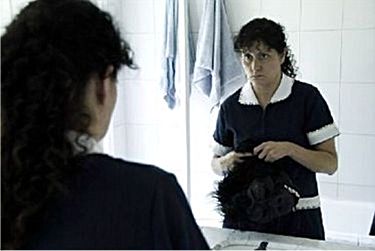
Catalina
Saavedra as Raquel the Maid in a reflective moment. |
The
constant headaches, her vicious acts against members of the family and
new maids hired only to easy her workload, her day off in which Raquel
has nothing to do but wander through streets and buy a sweater that reminds
her of her mistress -- all symptoms of a mind fractured and crumbling
under the decades-long pressure of being an outsider, a lower class citizen
in the only household she knows? I
love watching foreign films -- in this case, Chilean. People really look
like people. For instance, in "The Box," one of the most beautiful
woman in Hollywood today plays the part of a wife with financial problems
who is offered a million dollars to press a button which will not only
earn her one million dollars, but kill someone somewhere on this planet.
Was she chosen because she is so drop-dead gorgeous? After a while, I
get tired of the .0001% of the population (young and gorgeous and talented
and did I say gorgeous) representing me and everyone else who pay the
big bucks to see movies. I just stop relating, and don't even realize
it till I happen upon a film like "The Maid," and get reconnected
with humanity. These are real people with real day-to-day problems, and
their maid is going through a crisis.Now,
honestly, I don't exactly relate to the problems Raquel is experiencing
or empathize with her. She is so stoic, internalized, stiff, and tense
to the breaking point which she does cross. And at first I truly believe
that actress Catalina Saavedra must actually be a maid possibly found
by the director or casting director to do this part. But as the film progresses
and we watch her mental deterioration, my jaw ever so slowly drops as
I watch this masterful craftswoman portray this fictional character crossing
the brink. Muchos kudos to Ms. Saavedra. "The Maid" is a subtle,
realistic and engrossing study of a have-not living among the haves. As
cold and nasty as she is, we are won over, we care, we root for her and
hope she finds some equanimity in her life. We hope she comes into her
own. We hope she heals.
P.S.
The many shower scenes of the maids could only be described as gratuitous,
jarring in their unnecessary and repetitious intrusion. It seemed not
so much an intimate look at the life of a maid as a casting session by
a dirty old man producer.
Gentlemen
Broncos (2009)
Director:
Jared Hess
Writers: Jared Hess and Jerusha Hess
Cast: Michael Angarano, Jennifer Coolidge, Jermaine Clement, Halley Feiffer,
Sam Rockwell, Edgar Oliver, Hector Jimenez, Johnny Hoops.
Rated: PG13
Time: 90 min
This film was sooooo bad, it was.... fun. Not
good, but good fun. It is a devastating criticism of science fiction books,
their writers, the hopefuls and all sci fi enthusiasts. You may say they
are all easy targets and have been the brunt of insults in film and television
many times before, but this film is by far the most insulting in its tackiness,
raw stupidity, and underlying genius in exposing those at the top of this
particular heap. |
Bronco (Sam Rockwell)
mounted on military buck |
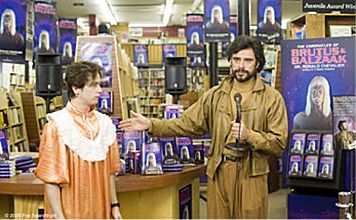
Ben (Michael Angarano),
dressed in one of his mother's creations,
being publicly humiliated by renown author
Chevalier (Jermaine Clement) |
Woeful, young Ben (Michael Angarano, “Man
in the Chair” 2007) writes sci-fi fantasy novels not only to escape
his odd, lonely life in a very cozy geodesic dome with his loving, home-schooling
mom Judith (Jennifer Coolidge again playing an off kilter lady, this time
mom and nightgown fashion designer [once the standard poodle owner in
“Best in Show” 2000]), but also in remembrance of his father.
The main character of his novel is Bronco, an incarnation of his dad,
who fights evil, Cyclops, yeast miners who want to create a superior army
based on his excised scrotum’s valuable genes. The constant references
to laser blasting teats, testicles, projectile vomit, character names
that sound like anus and references to other sundry human parts is not
so much reflective of the authors’ adolescent intelligence, but
well chosen examples of the sci-fi fan mentality. Marrieds Jared and Jerusha
Hess co-wrote “Nacho Libre” (2006) and “Napoleon Dynamite”
(2004) as well as “Gentlemen Broncos”, so they seem to have
a direct
line into the mind set of the off kilter
youth of America. Well, somebody’s got to do it, or at least profit
from it. No, really, I loved “Napoleon D.” for the psychological
complexity hidden under the seemingly dead faces and monotone voices of
its American heartland characters. It really spoke volumes about the stoic,
yet troubled characters that populate that film and possibly our country. |
Back to “Gentlemen Broncos” (even
though there is only one multi-faceted character called Bronco in the
film). Ben goes to a sci-fi symposium, meets fellow home-school students
Tabatha (Halley Feiffer in her first major role) and her filmmaking buddy
(Hector Jimenez, “Sin Nombre” 2009), and listens in awe to
recognized giant among sci-fi authors, Chevalier (Jermaine Clement, “Diagnosis
Death” 2009). From hopeful writing contestant, to plagiarized failure,
to a writer whose work has been bastardized in film, Ben’s life
seems to always find a way to get worse. Leaps in logic; hysterically
pathetically drawn characters; adolescent plots and absurd special effects
(the sound is always good) in both Ben’s real life and the various
versions of his book, all keep the audience jaw-dropped while laughing
-- no easy feat. Of course, Sam Rockwell (“Moon” 2009) as
both incarnations of Bronco was a blast (literally) to watch even though
he was unrecognizable.
I,
myself, refused to laugh at the many insulting gay stereotypes which hearken
back to the time of homophobia in America. Not to be too politically correct,
but it’s just too easy to get a laugh from these pinky-up, lisping,
swishes. Still there was more than enough to keep me absorbed in the sci-fi
antics and poor Ben’s misadventures. Actually, I’d like to
see it again.
Motherhood (2009)
Director / Writer: Katherine Dieckmann
Cast: Uma Thurman, Minnie Driver, Anthony Edwards, Daisy Tahan, Matthew
and David Shallipp, Alice Drummond
Rated: PG13
Time: 90 min.
Is Eliza (Uma Thurman)
a modern day Sylvia Plath, driven to the edge by motherhood, caring for
two perfect children at the expense of her artistic writing pursuits?
Or is she just another blogging complainer who can't afford therapy, a
nanny or a housekeeper, unable to find the time to write sentiments most
appropriate for Hallmark greeting cards? I have to admit, I found it difficult
to sympathize with her. She leaves to the last day all preparations for
her daughter's birthday party, which include going to a party |
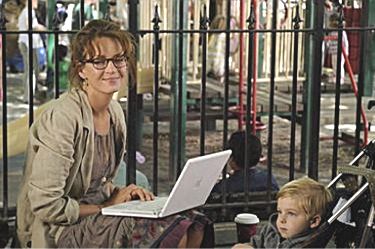 Uma Thurman
and either Matthew or David Shallipp
Uma Thurman
and either Matthew or David Shallipp
Another peaceful day spent in the park writing. |
store and
a bakery to pick up everything she needs and then hanging some crape paper
and a Happy Birthday banner. She doesn't pick up her dog's poop on the
street, she doesn't buckle her son into the car seat (shades of Brittney
Spear), she leaves him alone in the car while she yells at another driver,
she smokes even though her daughter pleads with her not to, she rats on
a friend in her blog. I could go on. Mostly, she complains that she doesn't
have time for herself. She even suggests to her friend that she would
warn other women not to do it, meaning have children. Yet, she finds time
to go clothes shopping for herself, entertain the messenger, write countless
entries in a blog (don't ask me how I feel about blogs), and write an
essay -- all these responsibilities and personal activities take place
in one day. I'd say all she needs is a one day seminar in time management
and getting over it. Instead of wishing your life were better, donate
$25 to a non-profit like Kiva.org or ODCF.org which give small
loans to women in third world countries to get them out of poverty and
become self-sufficient. Uma was adorable in
her distraught mode. Minnie Driver as her best friend, Sheila, is always
a pleasure to watch. And though Eliza (Uma) has a husband and a steady
income, Sheila (Minnie) is pregnant with her second child and alone, but
seems more in control. This only proves it's not your situation that makes
you desperate, it's how you deal with it.
Okay, maybe I'm being
a bit too harsh. It's tough having Anthony Edwards as a caring husband
with a few charming eccentricities, it's tough living in the West Village
of Manhattan where the worst problem is parking and dealing with all the
production companies that shoot movies on your block,
it's tough having
two healthy, adorable, quiet, good natured, loving children. (Oops, sarcasm.)
My point is if a woman wants a family and the ability to pursue her creative
goals, she would be in a pretty good situation if she traded places with
Eliza. I bet even Kate Winslett's April Wheeler of "Revolutionary
Road" (2008) would find it palpable.Now, to really get
a wonderful, poignant and empathetic view of a family woman's life, I
highly recommend "A Special Day" (1977), with a very unglamorous
Sophia Loren and an old, gay, lonely Marcello Mastroianni. It's early
1930's Rome, and she has a quiet day in her apartment because her husband
and family are off to see the momentous meeting of Mussolini and Hitler.
She spends a little time with her next door neighbor and the inner frustration
of their lives is revealed. It is available on disc and at Netflix. There's
a movie about a wife/mother's day. Please don't think I only appreciate
foreign drama. I'm not a cineaste. I even appreciated the Hollywood comedy,
"One Fine Day" (1996) with Michelle Pfeiffer and George Clooney
as two divorced parents just trying to take care of business. I believed
the exigency of their situation if not their emotional lives.
My philosophy is if
you want to write, write. If you want to have children, breed. If you
want both, figure it out; don't stick your head in the oven, don't blow
your brains out, don't go to New Jersey.
Big
Fan (2009)
Director / Writer: Robert D. Siegel
Producer: Jean Kouremetis. Elan Bogarin
Casting: Robert D. Siegel
Cast: Patton Oswalt, Kevin Corrigan, Michael Rapaport, Marcia Jean Kurtz,
Matt Servitto, Serafina Fiore, Gino Cafarelli, Jonathan Hamm, Polly Humphreys,
Scott Ferrall
Rated: R
Time: 85 min. |

Patton Oswalt as Paul
from Staten Island in an intense state of mind. |
They
say all stand up comics are deeply emotional, depressed, angst ridden
– not fun at all outside of the comedy club forum. This must be
true based on films like “Lenny" (1974), starring Dustin Hoffman
as the most tragic of comics, Lenny Bruce, “Punchline” (1988),
starring Tom Hanks, “Man on the Moon” (1991) with Jim Carrey
playing disturbed comic Andy Kaufman, and the recent, “Funny People,”
starring Adam Sandler. Since everything I know is from the movies, I have
learned this lesson repeatedly.
And many comics have
utilized their dramatic skills to become very successful actors: for instance
Robin Williams, Steve Martin, Denis Leary..Stay with me here.
It makes perfect sense that Robert D. Siegel would prefer a little-recognized
comic to an established dramatic actor to play his first directing/writing
project, “Big Fan.” After his Oscar nominated and multi award
winning, “The Wrestler,” we could assume his next film would
also be a dramatic, character study and not, as the name of the film might
imply, a sports movie.
Patton Oswalt, most
recognized as the voice of Remy in the animated “Ratatouille”
(2007), has us believe and feel his every moment of euphoria, frustration
and desperation as Paul Aufiero, the New York Giant’s biggest fan.
Paul lives only for his team. At work as a parking garage cashier, he
has time to compose his latest Giants-related criticism for his favorite,
late night, call-in, sports talk radio show. He is jubilant
going to the local games, happy to sit in the stadium parking lot watching
the game on his car battery driven TV. I don’t know why he doesn’t
buy tickets since he does have a regular income with no expenses since
he lives with his mother. He has found his perfect niche, and the complaints
of his family about his lack of career, marriage, family, a life of any
kind other than his obsession with a football team fall on deaf ears. And this is not just
empty sports fan enthusiasm, based on lack of ambition, fear of women,
ennui or anything else. Paul really doesn’t want the trappings of
any other kind of life. He is truly happy making comments on the radio,
watching the games on TV, catching a glimpse of a quarterback hero out
on the town. That really is all he wants out of life. When put to the
test, Paul Aufiero puts his loyalty to his team above personal welfare,
health, offers of a huge monetary reward. To him, nothing and no one is
more important than the New York Giants. He’ll even go into the
very heart of darkness itself, the enemy camp, to seek justice at the
risk of his own life and freedom -- all for the New York Giants. I found the character
frustratingly disturbing in his complaisance and Zen like satisfaction
with his life. We as Americans have a birthright and obligation to living
a life at least a step better than our parents'. We are breast fed ambition
-- the American Dream, the land of opportunity, the place where if you
work hard, anything is possible. And here is Paul Aufiero who loves his
dead-end life spent in his mother’s spare bedroom, the parking garage
ticket booth and his car in the stadium parking lot. That is really all
he wants; and he’s not settling for anything anyone else would consider
better. He is happy. I also found this
character fascinating and mesmerizing. Patton Oswalt, though he has appeared
in many film and television shows in recent years, is now a leading dramatic
actor to be reckoned with. Let me repeat – this is not a sports
movie. This is a profile of a guy from Staten Island who’s only
hope in life is that the Giants win the pennant. Good luck to him and
them.
p.s. I must state
here my frustration with New Yorkers’ attitude towards the Verrazano-Narrows
Bridge. When a film takes place in San Francisco, it is awash in beauty
shots of the Golden Gate Bridge (it even has a talent agent), and sometimes
the equally beautiful western span of the Bay Bridge. But New Yorkers
have consistently refused to recognize the majesty, nay, magnificence
of the Verrazano Bridge. What’s that about? In the whole of “Big
Fan,” the bridge appears less them a moment in a reflection of the
windshield of a car. Lot’s of ferry boats, lots of driving on roads
in and out of Staten Island, yet no establishing shot of the Verrazano
Bridge. Hey, New Yorkers, get over it. Maybe it only goes from Brooklyn
to Staten Island, but it is the gateway to New York Harbor, seen long
before the Statue of Liberty. Give the bridge a break.
New
York, I Love You (2009)
Directors: Wen Jian, Mira Nair, Shunji Iwai, Brett
Ratner, Allen Hughes, Shekhar Khapur, Natalie Portman, Fatih Akin, Joshua
Marston and Randy Balsmyer.
Writers: Emmanuel Benbihy, Tristan Carne, Hall
Powell, Israel Horovitz, James C. Strouse, Shunji Iwai, Hu Hong, Yao Meng,
Joshua Marston, Alexandra Cassavetes, Stephen Winter, Jeff Nathanson,
Anthony Minghella, Natalie Portman, Fatih Akin, Yvan Attal, Olivier Lecot,
Suketu Mehta
Cast: Bradley Cooper, Andy Garcia, Hayden Christensen,
Rachel Bilson, Natalie Portman, Irrfan Khan, Abe Karpen, Emilie Ohana,
Orlando Bloom, Christina Ricci, Maggie Q, Ethan Hawke, James Caan, Blake
Lively, Drea de Matteo, John Hurt, Shia LaBeouf, Julie Christie, John
Hurt, Drea de Matteo, Burt Young, Chris Cooper, Robin Wright Penn, Ethan
Hawke, Eli Wallach and Cloris Leachman, Anton Yelchin
Time: 1:52
Rated: R |
James Caan as a pharmacist,
Director Brett Ratner,
and prom boy,
Anton Yelchin. surrounded by unmistakable
New York brownstones |
I can imagine a round table production meeting
of all the writers and directors of “New York, I Love You,”
a table that dwarfs King Arthur’s, where somehow everyone agrees
on how all the stories intersect, how the tone, color, and overall feel
of the film develops into a beautiful mosaic from a pile of multicolored
shards. Actually, I can’t imagine it. Really, how did they do that—meld
12 five minute short films into one flowing fugue in homage to New York?
Unlike,
“Paris, Je t’aime” (by the same producers), with it’s
collection of insular, separately produced shorts, “New York, I Love
You” is truly one film containing disparate stories that give the
unique flavor to a city. To mention one story without mentioning all would
be unfair, to mention all would be to give the movie away. But one of the
things that makes New York truly unique is that “everyone comes from
someplace else.” Though the pot called New York started melting over
a hundred years ago, distinct cultures, classes and attitudes are not only
still prevalent, but they all accept living in the same pot -- more comfortably
than rival gang members of the same ethnicity in the same neighborhood with
only different colored shoes. Another example: in San Francisco, I meet
“natives” disproportionate to the size of the population and
influx of residents or often transplanted New Yorkers. But in New York,
no matter how many generations removed one is from Ellis Island, one states,
“I’m Irish,” “I’m Eastern European,”
or “I’m Italian”.
Don’t
let me lead you astray. “New York....” is not a sociological
study, but a bunch of little moments among people -- some sharing a cab,
some sharing a smoke on the sidewalk outside a restaurant, some in a little
pawn shop or pharmacy. Their moments are precious -- truly reflecting
universal emotions and situations that happen more frequently in New York
than anyplace else in the world. It’s as true today as it was back
in 1958 when the shot-on-location crime drama opened with, “There
are eight million stories in the Naked City.” Cities with larger
populations never boasted more stories. There is an individuality among
New Yorkers which makes their stories, even if they just got off the boat
or landed at Kennedy, uniquely human, endearing, heart rendering, and
often funny That’s what “New York…” shows is through
the myriad talents of its writers, directors and actors. Obviously, everyone
poured his/her heart into this project. The cast members alone are worth
the price of admission. Whereas
Paris was overwhelmingly beautiful, New York is sometimes gritty and unattractive,
sometimes a wonderland of fog rising from manholes and starry restaurant
signs lighting up a black amorphous nothingness. All the stories resonate
with a truth, an intelligent sensibility, a touch of neurosis. All are
unmistakably New York.
By
the way, I’m a New Yorker of Russian, Czech heritage.
Five
Minutes of Heaven (2009)
Director: Oliver Hirschbiegel
Cast: Liam Neeson, James Nesbitt, Anamaria Marinea
Time: 90 minutes
Reconciliation is definitely the high road, one
not often enough taken. Both sides in the "troubles" in Ireland
believed God was on their side and they felt they had to do something.
Lives were lost, yet your neighbor may have been your son's killer 30
years earlier. Understandably, it may take more than time and even prison
sentences to heal these wounds.In "Five Minutes of Heaven," for those
who have not found closure, a popular reality TV show brings the opposing
parties together for a meeting, forgiveness and an resolution to that
episode of their lives. People who were hurt during those times can finally
confront the perpetrators. The producers and staff of this show are sensitive
to the emotions surging under the skins of their guests and do their best
to calm them and get both sides into the same room for civilized discussion.
One guest, Alistair Little (played by Liam Neeson, "Batman Begins"),
at the age of 17, put on a ski mask and went to the home of his target,
saw a young boy playing ball outside the house, walked past him and up
to the window of the house, and killed the target -- who happened to be
the young boy's brother. The other guest, Joe Griffin (played by James
Nesbitt, "Match Point"), is the same brother who witnessed the
murder.
Now, it's bad enough to witness one's brother's
death, but even though the culprit was brought to justice and served a
prison term, there seems to be no end to the nightmare. Obviously unfairly,
Nesbitt's mother blamed him, at the time a child of no more than 12, for
not stopping the man with the gun from killing her son. So, besides grief,
there is shame, loss of one's mother's love, feelings of cowardice and
a strong need for revenge. |
|
|This film
tackles the very difficult subject of life after violence. The damage left
behind effects families and children not yet born. Both killer and people
close to the victim suffer the repercussions for years, if
not the rest of their lives. And "Five Minutes of Heaven" explores
this damage from all angles and aspects.
Both Neeson
and Nesbitt are powerful and precise in expressing the feelings of their
characters. Both are sympathetic and believable. The film only starts
in the reality show location. We are not stuck for 90 minutes in a room
with two chairs. This is not an intellectual or psychological confrontation
a la Satre as a story of two men coping with the past and their parts
in it.
Whip
It! (2009)
Director: Drew Barrymore
Writer (novel and screenplay): Shauna Cross
Cast: Ellen Page, Alia Shawkat, Marcia Gay Harden, Daniel
Stern, Landon Pigg, Juliette Lewis, Drew Barrymore, Kristen Wiig,
Jimmy Fallon, Rosa Sparks, Zoe Bell, Eve, Andrew Wilson
Executive Producer: Drew Barrymore, et al.
Rated: PG13
Time: 111 min.
Girls always have a hard time getting permission
to partake in sports. Remember "Bend it Like Beckham" (2002)
and "Ice Princess" (2005), among others? Well, maybe it's not
so easy to remember "Ice Princess." Nonetheless, parents would
still rather see their daughters pursuing academic careers or family life
rather than competitive sports, be the sport as culturally accepted as
soccer or as pristine and elegant as figure skating. |
Little Ellen Page in
the center. |
Certainly roller derby, the grittiest, most violent,
lowest common denominator sport, played in abandoned warehouses by women
of dubious pasts and social habits, ensconced in ripped fishnet hose,
tattoos and far too much makeup, is simply not acceptable. This milieu
is certainly not accepted for Jenny (Ellen Page - "Juno") who
at the age of 17 is still being dragged by her mother (Marcia Gay Harden
- "Miller's Crossing") to beauty competitions and is being groomed
for college.
Jenny
encounters roller derby and is snagged by its sisterhood of skaters, wild
parties, outsider lifestyle and cute boy hangers-on. She sneaks out to
see the derby, try out, practice and compete. This lithe, frail, teeny
girl becomes the Harry Potter of the game; she's the youngest player in
the scoring position. She even becomes the photographic representation
of the game. At the same time, she learns many of life's lessons .Nonetheless,
after having now seen roller derby, possibly at its most sanitized, I
still wouldn't want my daughter involved. These girls compare their huge,
purple bruises against each other's. They take bone breaking hits, smashes
and falls. They still have to maintain their day jobs, as Johnny Rocket,
the announcer at bouts (Jimmy Fallon, "Saturday Night Live")
humorously comments on the microphone during a match, waitressing all
day so they can compete at night. And the men they find in the bleachers
can do little better to support a family. Call me old fashioned, but a
gold medal, with its concomitant endorsements, goes a lot further than,
"Yah hoo, we're second!" Yes, viewing this film was a lot of
fun. I had a great time watching the team, which included Drew Barrymore
(also director and executive producer, "ET") at her absolutely
most adorable, and the competitor-villainous nemesis Juliette Lewis doing
her best nasty. I wanted to be at those parties where almost nobody got
drunk and nobody took drugs, where there was only good natured camaraderie
and lots of laughs, where losing was as much fun as winning. I just hope
no young girls in the audience catch roller derby fever and take one of
those business cards that were handed out after the film advertising the
Bay Area Derby Girls. Stay in school, stay off drugs, seriously consider,
if not obey, your parents. There, I've said it.
P.S.
The lipstick used in this film was gorgeous. I'm not particularly a lipstick
whore, but it was so fine, it could not be ignored. Came in many natural
tan, orange and brown muted colors with the perfect hint of gloss. I just
couldn't stop gazing it all those lips perfectly coutured. Watch for
it.
Love
Happens (2009)
Director: Brandon Camp
Writers: Brandon Camp, Mike Thompson
Cast: Aaron Eckhart, Jennifer Anniston, Dan Fogler, John Carroll Lynch,
Martin Sheen, Judy Greer, Frances Conroy, Joe Anderson
Rated: PG13
Time: 109 min.
So, Burke (Aaron Eckhart) lost his wife three
years ago. This devastating experience led him to write a book on dealing
with grief, which led to his giving seminars, and attracting the attention
of media moguls who want to turn him into a virtual grief guru with TV
show and a line of lucrative products including diet powder since surveys
have shown that grieving people gain weight. Aaron meets a lot of people in his travels, including
lots and lots of women, from seminar participants to talk show and magazine
interviewers to photographers. But one day he turns a hotel hallway corner
and bumps into Jennifer Anniston. Ah, she's the one! This is where the
film looses me. Couldn't come up with a better plot device to pierce his
long standing grief/guilt/isolation than a bump into Jennifer? Romantic
to some, damned Hollywood lack of attention, lack of imagination, lack
of experience among the film's writers to me. In any case, I go ho hum
in my seat and from that point on watch with my head instead of my heart
and wish I had more popcorn to munch on. But it doesn't stop there. The
pat Hollywood romantic |

Eckhard and Anniston
find true happiness again. |
pap continues through the predictable plot. Jennifer
plays hard to get then relents, Jennifer comes up with really cute ideas
to make a date more fun than imaginable, Aaron screws it up so they break
up and then can get back together again. Lordy, lordy, have I been there
before? Well, yes, but never in so much rain as in this Seattle-based
film. Humor me -- watch one commercial for "Love Happens," then
explain the whole plot to whomever you are around at the time. Don't forget
to include the public confession that is de rigueur in such films. You
will not be far off. Ever think of becoming a Hollywood writer? This seems
to be a year for dishonest self-help gurus. In "Arlen Farber,"
Jeff Daniels writes a book about his conversations with god and how now
the enlightened Arlen can answer all life's questions. Of course, everyone
believes him on face value and craves answers. Actually, his answers are
very good; he just doesn't take his own advice. You'll cringe at this
public apology as well. But I found his meeting with his love interest
more imaginative.
"Love Happens" hasn't proven to me that
grief is a good source of romantic comedy. The TV detective comedy "Monk"
has -- underlying every moment of his daily life, Monk is aware of how
much of him died with his wife. I find Eckhart's fluctuations between
dating game maneuverings and dealing with his festering wounds of grief
and sorrow unconvincing. And I had to laugh at his first meeting with
Jennifer where she pretended to be deaf to cut short a conversation with
him. In his almost first film, "In the Company of Men" (1997),
Eckhart plays a misogynist who plots to manipulate and ruin the life of
a hearing impaired woman who works in his office. I had to chuckle.
And I have to admit, I have always thought there
was more to Jennifer Anniston than being just perky and cute and needing
to get a man in her life. She showed such great promise as an actress
in "The Good Girl" (2002), tackling much more interesting material.
This was a film that explored real human feelings of quiet desperation,
not one that dazzles its audience with 20 different beauty shots of the
Seattle needle. That's an example of content versus style. "Love
Happens" is one step less unsettling for me than her last foray in
acting, "Management" (2008), a romantic comedy about a stalker
who wins over a cute, yet serious girl. Okay, she was much more somber
in this one.
The point is, if I'm comparing "Love Happens"
to so many other films, it's because my mind was drifting to better places
while I watched this one. Show me something new, not necessarily a whole
original film, but one thought, one scene, one something that hasn't been
beaten to death, often better, in a plethora of other films. If you've
never seen a Hollywood romance before, this might be very fresh and charming.
There are new audiences going to films for the first time all the time.
"Love Happens" has all the elements you like and will learn
to expect in romances. Eckhart and Anniston make a lovely couple who are
very sweet. There are no bad guys in this film and I like that. Nice date
movie for young people who haven't seen it before.
My
One and Only (2009)
Director: Richard Loncraine
Writer: Charlie Peters
Cast: Réne Zellweger, Logan Lerman, Mark Rendall, Kevin Bacon, Chris
Noth, Steven Weber, Eric McCormack, Nick Stahl, David Koechner
Rated: PG-13
Time: 108 min.
If "My One and Only" is a comedy, it
is a human comedy, based on human situations, not jokes, pratfalls, unrealistic
situations. The opening credits of the film make it clear that this is
a story that takes place at a certain time, the 1950's, with an image
and music filled montage, the age of the blossoming American family, a
time from which much of America has never recovered or at least changed,
a time of the housewife, either middle class and a good mother, or upper
class and a Manhattan socialite. Women were wives or not talked about
at all.In this environment, we find Ann Devereaux (Réne
Zellweger), wife of successful bandleader, Dan (Kevin Bacon), catching
said |
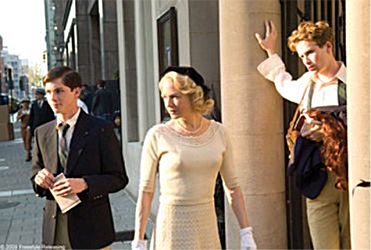
Logan Lerman as George,
Renee Zellweger as Ann and
Mark Rendall as Robbie -- on the prowl. |
husband in flagranto delicto with another woman. With class that
I immediately admire in her, she helps zips the other woman's dress, packs
her own bags, and leaves. No fighting, no displays of emotion. What's
the point? He's ruined their marriage and she's gone. Oh, yes. She takes
her two teenage sons with her. She can't leave them with him. Now, where
to they go to school? Okay, she finds them, packs them into a new Cadillac,
and starts a journey she believes will be short and successful -- to find
a new husband.
Back in 1974, in "Alice Doesn't Live Here
Anymore," Ellen Burstyn (the housewife) and her son start fresh.
She faces her own disappointments and inner growth while dealing with
the real world. "Alice" is a more gritty film than "My
One and Only" that rings very true in a time when women were struggling
for independence and the ability to fulfill their dreams. "Auntie
Mame" (1958) depicts Mame (Rosalind Russell), not only a socialite,
by a very eccentric one, raising her nephew while hunting for a rich husband.
Now, that fantasy really was fun, sumptuous, lighthearted. There's no
reality in "Mame," though it reflects the type of women who
never wants the party to end and would marry when funds got low (think
Gabors). Surprisingly, and I really was surprised at the end of the film,
"My One and Only" is a biopic. There was such a woman who in
the early 1950's believed
that
she could rely on her charm and beauty, though already fading, to secure
all she needed in life -- a rich husband. Perhaps she saw no other options
at her age, with her upbringing, or maybe it was just her character.
But we ride in the back seat of that 1953 Cadillac convertible and cross
the country, one disappointment and revelation after another till we
reach our destination -- self-understanding and independence, and California.
I'd like to believe neither are dependent upon the other, though California
is always a good place to end up.
The
story is told by narrator, younger son, George (Logan Lerman), who has
a critical eye towards his mother, disagrees with her decisions and
is distrustful of her ability to lead herself and her sons to some semblance
of security and equanimity. This boy has a bright future. Though I don't
like to call this film a comedy, it was, in turn, funny, sad, subtle
and always engaging. I loved all the performances, especially Zellweger's.
I wanted her to find her man, though, personally, I'm fiercely independent.
She did win me over even though she was flawed, often oblivious, and
wanted to be dependent. There may still be women like Ann Devereaux
out there, and there are certainly men who still want them at their
prime. Nice to know there are choices now, though, and even were back
then.
Extract (2009)
Writer/Director: Mike Judge
Cast: Jason Bateman, Ben Affleck, Mila Kunis, Kristen Wiig,
J. K. Simmons, David Koechner, Clifton Collins, Jr., Gene Simmons
Extract is a pleasant enough comedy.
I laughed several times, I empathized with our frustrated protagonist,
I stayed awake. But the pathos of "Funny People," or the biting,
satirical, political commentary of "In the Loop," or the extreme
shock and daring of "Bruno" just weren't there. So, it seemed
to me I was watching a TV movie, pleasant, safe, predictable, comfortable.
Oddly, writer/director Mike Judge is the TV co-creator of such programs
as "King of the Hill" and "Beavis and Butt-Head,"
as well as contributing to "Saturday Night Live," all of which
take more chances in their themes and stories. Is Judge mellowing out
with age? |
Ben Affleck with beard dispenses advice as well as booze.
Jason Bateman as frustrated husband unfortunately follows it. |
In
"Extract," Jason Bateman plays Joel, the owner of a flavor extract
company, who is sexually frustrated because his wife avoids having sex
with him. His "wacky" scheme, inspired by his friend/bartender
Dean (Ben Affleck), is to hire a gigolo to have sex with
his wife, Suzie (Kristen Wiig), so he doesn't have to feel guilty about
having sex with new temp factory worker Cindy (Mila Kunis) who has schemes
of her own. The mild mayhem follows. Joel
and his wife are very nice people. I distrust "nice" people.
They go unnoticed. Nothing stands out about them, no clear personality
or character traits; they're just "nice." And unfortunately,
I have learned through life experience that "nice" people can
do really thoughtless, mean, damaging things to other people while looking
absolutely harmless. Nice people are not harmless; they just seem that
way because they are outwardly so namby pamby. Joel's factory is run like
a dangerous clown show; he plans on cheating on his wife; both he and
his wife would rather be celibate and cause each other distress than talk
to each other; and she would rather cheat than solve relationship problems.
They're a "nice" couple.Ben
Affleck as Joel's friend was the light and color in this gray film. He
constantly spews advice to his friend, all having to do with an endless
supply of pills he keeps behind the bar, weed to calm the nerves, and
friends so stupid they can barely talk who will act as pool boy/seducer.
I always brightened up for the Ben scenes. And Gene Simmons' portrayal
of the sleazy lawyer was just so .... him. He's been wasting his career
playing music instead of practicing law, selling used cars (a compassionate
profession in comparison), or acting.
Also
of note: extract production seems to be a lucrative business. Joel's home's
driveway seemed endless, his house vast, and his swimming pool so large
we only got to see a small portion of it even in a long shot. Please get
that pool cleaned, finally. It's too beautiful to waste.
World's
Greatest Dad (2009)
Director/Writer: Bobcat Goldthwaite
Cast: Robin Williams, Alexie Gilmore, Daryl Sabara, Evan Martin, Henry Simmons,
Lorraine Nicholson, Zach Sanchez, Geoffrey Pierson, Tony V.
Executive Producers: Sarah de Sa Rego, Jennifer Roth
Rated: R
Time: 98 minutes |
|
It's not easy making a comedy about teen suicide. I'm not even
sure it's commendable that Bobcat Goldthwaite attempted it. I am sure
just the publicity, advertisements, trailers, and talk about this film
will cause tremendous pain and outrage among the growing population of
parents who have lost children to suicide. But all the most serious comics
will tell you that no subject should be taboo or the socially redeeming,
cathartic and valuable criticism attached to comedic social commentary
will be drowned in conservatism and overly energetic political correctness.
We need to exercise our artistic and creative juices, commenting on any
subject, or what's the First Amendment and the funny bone for? Having said that, Goldthwaite sets us up to want to kill off
this kid, Kyle, too convincing played by Daryl Sabara (all the "Spy
Kids"). He's not just obnoxious, stupid, ugly, overweight, and slovenly,
but he hates his father, loving, patient Lance Clayton (played by Robin
Williams). How can you hate Robin Williams? Kyle is also literally perverted,
fantasizing about feces covered bodies while asphyxiating himself during
orgasm. Really, his kid should not live. One wonders how he keeps his
one friend, a quite, respectful, pensive boy, Andrew (played by Evan Martin
in his first film). He might rather be friendless, except he appreciates
spending time in Kyle's house, away from his alcoholic mother.As if this situation weren't dismal enough, Lance himself feels
he is a dismal failure as a writer, having written 5 novels among other
works, none published, and he's about to lose his poetry teaching job
due to a tightening budget.
Things happen I'd rather not give away. Suffice it to say, Williams
manipulates a few facts following an accident; the outcome is he tastes
success, but eventually it leaves a bitter taste in his mouth. I like
that, under the circumstances, we all might have done what he did.
That's not to say this film mirrors reality in any way, but the choices
made under these odd circumstances are believable. Interesting note: I pondered after the film about Williams' character's
wonderful writing ability, yet his failure to be published. During the
film, anyone who had read anything he had written honestly and sincerely
felt the work was very good. This is a sad commentary about the possibly
many unpublished, wonderful writers out there who, for one reason or another,
never made it. How come?Unfulfilled: I never got enough information to figure out why
fellow schoolteacher Claire (Alexie Gilmore of TV's "New Amsterdam")
was involved with Williams. She is sweet, warm, friendly, honest. On the
one hand, she really seemed to like him. On the other, she bounced over
to his rival as the winds blew fair or foul. Never really understood the
motivations behind her affair with Williams. I felt unfulfilled as an
observer of their relationship. Confused: The ending of the film seemed very out of context,
un-led-up-to and perplexing. Sadly, it was not very attractive either.
Sorry, Robin. I can say no more.
Moral of the story: if you kill yourself, you don't get to control
how you're remembered.
Cold
Souls (2009)
Writer/Director: Sophie Barthes
Cast: Paul Giamatti, David Strathairn, Emily Watson, Dina Korzun, Katheryn
Winnick, Lauren Ambrose
Rating: PG-13
Time: 101 min.
Paul Giamatti plays himself, the respected actor,
rehearsing "Uncle Vanya," and having a very hard time with the
actor's process and developing the character. His anguish, frustration,
psychological pain, confusion and sense of defeat are overwhelming. He
hears about a new medical process by which one's soul can be removed and
stored, leaving the patient light, angst-less and more able to function.
He does it. This certainly sounds like a deal with the devil and you know
there will be a price to pay.This is a comedy. I tell you right off since
you may not notice. It is deadpan, straight faced comedy. The actors play
for drama, but the dialogue and the absurd situations are high satire
and commentary on our society |
Paul
Giamatti prepares for the excision.
It won't hurt a bit. |
which constantly aims to rid people of the
discomforts that make them unique and human. Not to say the soul is exclusively
human, but without it, life becomes emotionally numb, empty and purposeless.The film questions what the soul actually adds
to an individual, what it's like to be soulless, what it's like to use
someone else's soul instead of one's own. Of course, I saw it all already
in an episode of "The Simpson's" in which Bart sells his soul
and then tries desperately to get it back, feeling a ghost of his former
self.
Well, Paul also feels the need to get his soul
back and finds out a group of Russian soul traffickers have taken it.
Oh, those Russians -- the new bad guys. They're white, so we can't be
accused of bigotry. They're alien, so, they're accent gives them away.
And unfortunately, they've developed a reputation, probably well earned,
for mafioso-like criminal dealings since the fall of Communism. And there's
no Russian anti defamation league yet.
Giamatti
is brilliant. We watch his "Uncle Vanya" rehearsals with/without/and
with another's soul; his mutations are subtle, exciting, and if you
have a sense of humor, you'll catch his impeccable timing as a comic
while performing drama. His mood swings, fears, frustrations and moments
of courage under these changing conditions are also completely believable.
It's always a pleasure to watch Giamatti work, even in his bad films.
I'll say no more about that. Kudos also to David Strathairn as the doctor
in the "transplant clinic." He is the ultimate professional
at playing the "professional." His comforting demeanor and
confidence while sucking one's soul is priceless. "Think of your
soul as a twisted tumor." Dina Korzun, playing a major role in
the film as the Russian mule, transporting souls between New York and
St. Petersburgh, was sympathetic and memorable. Though very accomplished
in Russia and Europe, this is her first American film. I hope to see
more of her.
Like
alleviating oneself of unhappy memories in "The Eternal Sunshine
of a Spotless Mind," "Cold Souls" is a warning about
losing another essential part of one's make up. Thanks, I'll hold onto
mine, warts and all.
Funny
People (2009)
Writer / Director / Producer: Judd Apatow
Cast: Adam Sandler Seth Rogen, Leslie Mann, Eric Bana, Jonah Hill, Jason
Schwartzman, Maude and Iris Apatow
Time: 146 minutes
Rated: R
I like stand-up comics, maybe almost as much as the next guy, so it’s
fun to watch a movie about them. But the film is more about the situation
the lead character faces than the jokes he tells. And I found I like that
even more than watching stand up comics. George Simmons (Adam Sandler)
has a 92% chance of dying and is now faced not only with his mortality,
but more importantly, with the mistakes he made in choosing wealth, fame
and adulation over love and relationships. He is alone, and all the woman
who are eager to have sex with a “name” don’t appease
his loneliness. So he hires a budding comic, Ira Wright (Seth Rogen),
to be his assistant, confident, joke writer.
|
 Adam Sandler,
Seth Rogen, writer/director/producer
Adam Sandler,
Seth Rogen, writer/director/producer
Judd Apatow, Eric Bana and Leslie Mann on the set |
There has to be a lot to say about a movie that runs two and a quarter
hours. First let me say -- it’s too long! I don’t say this
because as a typical American I have the attention span of an MTV watching,
video game playing zombie who processes images in
nanoseconds
rather than ideas in whatever time it may take. The middle of the film
(some might call it a second act) just wafts about in undirected, multiple
displays of self-pity.As for the jokes –
some are passable funny. but most are intentionally written this way:
Rogen’s jokes stink because he’s new at the stand-up game
and isn’t very funny; Sandler, coping with his impending death,
needs a platform to vent is fears and disappoints more than to make people
laugh. Sandler’s club act reminded me of Lenny Bruce shortly before
his death by overdose. Exhausted by all his arrests, trials and convictions
for blue material and heartbroken over the end of his marriage, he was
more a bitter philosopher at a pulpit than a comic. That’s not to
say Sandler’s act reached anywhere near the revelatory intensity
of Bruce. He just mostly said, “You’re going to miss me when
I’m gone.” The bulk of the humor revolved around the comics’
penises. At least it’s self deprecating humor and not insulting
to others. Why comics fixate on their dicks is hinted at – unhappy
childhood, need for acceptance by father, need to shock. Whatever. After
a while it really gets ho-hum. Even the actual, well-known comics who
drop in for cameos comment on the situation more than make laughable jokes.As to my referring
to Sandler rather than to his character’s name in this review, it’s
because the line is made very fuzzy as to whether Sandler is playing a
character at all or if this film is a tribute to his career. Throughout
the film, we sit with Sandler in front of his flat screen watching his
work from the last 20 years, as well as clips from his character’s
fictitious film career. I’m really not sure if writer/director/producer
Judd Apatow (“The 40-Year-Old Virgin,” “Knocked Up”)
dug deep into his psyche to come up with an iconic comic figure or just
let Sandler have at it. Maybe it’s a tribute to Sandler’s
growing acting skills or maybe it’s just Sandler being Sandler.
Back to the story.
Sandler decides to visit the only woman he really loved, Laura (Leslie
Mann), now married and with children. As we move into the second half
of this epic-lengthed movie, here comes one giant surprise and the best
part of the film -- Eric Bana, as Laura’s husband, is a great comic
actor. Who knew? He is not just the brooding Hulk (2003) or pensive Henry
VIII (The Other Boleyn Girl, 2008) or Hector the Greek warrior (Troy,
2004) years before the “300” blinded audiences with their
6 packs and pecs. His comic timing, his delivery, his energy literally
woke me up. Moral is – you can still be a big, handsome hunk and
do comedy.
Adam (2009)
Director: Max Meyer
Writer: Max Mayer
Cast: Hugh Dancy, Rose Byrne, Peter Gallagher, Amy Irving,
Frankie Faison, Mark Lin-Baker
Producers: Miranda de Pencier, Leslie Urdang, Dean Venich
Time: 99 min.
Rated: PG13
Asperger's Syndrome is a condition in which one
has difficultly reading people's facial expressions or subtext or irony
or sarcasm. But it is an asset in "Adam," a film written and
directed by Max Meyer, about an Asperger's victim or in this case, recipient.
Due to his innocence in social situations, he can be trusted to always
tell the truth, be gentle and slightly timid, never cheat on a girlfriend,
always try extra hard to please. And being played by adorable Hugh Dancy
is the cincher-- he's the perfect boyfriend. Rose Byrne's character, Beth
Buchwald, who just ended an unhappy |
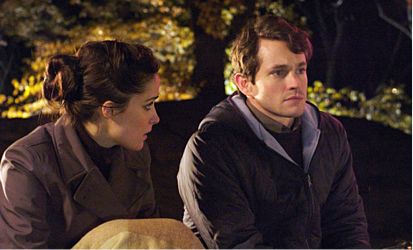
Notice her concern,
notice his unresponsive expression. Ah, love! |
relationship with a high powered stockbroker/cheater,
finds a quiet haven in Adam, an uncomplicated, yet accomplished electrical
engineer who can earn a good living once he finds a new job, and he is
seriously looking.
Asperger's has obviously knocked out Obsessive
Compulsive Disorder as the entertainment industry's new neurotic behavior
de jour. We've gone from "As Good As It Gets" (1997) to "Monk"
(now in its last season) among other films and TV shows, and probably
for the next few years variations on Asperger will be grist for the mill.
Actually, a new, feature length, animation called "Mary and Max,"
highlights a very different Asperger's sufferer. Max is old, obese, gruff
and voiced by Philip Seymour Hoffman. Since he's not cute and endearing
like Adam, instead of a lover, a child pen pal keeps in touch with him
throughout many years of correspondence.
Now, here lies the rub. I felt more empathetic,
more involved and more convinced of the true symptoms and suffering due
to Asperger's through the stop action figure of Max, as slovenly and unappealing
as he was, than for Adam, as young, handsome, and romantic as he was. I
can't really pinpoint the flaw in "Adam." Perhaps it's just too
slick, too Hollywood, too facile for me to buy Adam, the character, in this
film. He too easily overcomes his disabilities when necessary. He understands
and empathizes when it's necessary to maintain his relationship with Beth.
He heals, adjusts and learns according to script points.
Interestingly,
both films were in the recent San Francisco Jewish Film Festival. What
qualified them for entrance into the festival: "Adam," because
Beth Buchwald is Jewish -- we only know that because we hear her father,
played by Peter Gallagher, say one Yiddish phrase at a party. Amy Irving
also plays "the mother, Mrs. Buckwald" one of those minor,
thankless roles, but she will always be "Yentl"'s (1983) wife
in film and Steven Spielberg's first wife in life for all of us. That
is enough to get any film in a Jewish Film Festival. "Mary and
Max," gains entry because Max's last name is Horovitz, he lives
in Manhattan, and (let's face it) he kvetches a lot. His disease-imposed
stoicism belies his innate necessity to complain. I could relate to
his Jewish heritage of city-imposed, as well as neurosis-imposed, isolation.
It is probably hard to recognize a person with Asperger's in Manhattan.
We're all aloof, uninvolved, unsympathetic, cautious, a little paranoid
-- all the symptoms of Asperger. Max, while walking down the street
and taking note of the people around him, says, "And they call
me crazy!"
In
any case, "Adam" is a lovely little romance between an emotionally
stunted guy and woman damaged by a previous relationship. May we all
be so lucky. Convincing? Close enough so if you want to suspend your
disbelief, you can. But Adam, since Asperger is a mild form of autism,
all that gluten in the daily dose of macaroni and cheese you ingest
can't be helping your condition. Ask Jenny McCarthy.
Bruno (2009)
Director: Larry Charles
Writers: Sacha Baron Cohen, Anthony Hines, Dan Mazur, Jeff Schaffer
Cast: Sacha Baron Cohen, Gustaf Hammasten, Clifford Bañagale
Producers: Sacha Baron Cohen, Monica Levinson, Dan Mazer, Jay Roach
Time: 83 min
Rated: R
The film, Bruno, concentrates on this Austrian
model’s sexuality and need for fame. Cast out of Europe’s
hip social circles, he goes to America to seek fame. He tries many different
strategies, including hosting a celebrity talk show (I know that doesn’t
work); brokering peace in the Middle East; representing a “cause”
like global warming or the Rain Forest or AIDS, whatever is hottest right
now; adopting an African baby; even going straight since so many famous
people are. His naivety represents the gullibility of the American and
world public, the people he recruits to help him represent the manipulators
and power brokers. Both sides are greedy, self serving, and extremely
stupid -- but one side has all the money and the other side wants it.
Am I taking too grand a view of this film? I’m sure Sacha Baron
Cohen considered this view while he and his colleagues wrote it. I hear the European version of Bruno is more
explicit than the American version. That’s okay. I don’t need
more details -- I get it, more than get it, got it up to here. And then
some. There are only a couple of black overlay boxes to protect the audience’s
sensibilities during amusing sex scenes. I was glad the boxes were there.
Anything that is in the European version that isn’t in the American
version is just more porn and certainly not necessary to the story. |
Sasha Baron Cohen with
"son,"
Chibundu Orukwowu |
By the way, I know a lot of the situations and
scenes were done with actors. How do I know? ‘Cause nobody was laughing
at Bruno’s antics in the film. You may be a straight laced bigot
or an outraged audience member of a talk show, but if you don’t
crack
a smile, you have to be from Central Casting.
After
all, everybody watching this film will be laughing hysterically. Is it
only because we know Sacha Baron Cohen is acting or because the characters
are getting paid to not laugh and have practiced in rehearsal?
Bottom
line, Cohen blows our collective mind yet again. I didn’t think
he could top Borat, but he did. This film is consistently outrageously
funny, out loud belly laugh funny, drop jaw “he isn’t really
doing that” funny.
Blood:
The Last Vampire (2009)
Director: Chris Nahon
Writer: Chris Chow
Cast: Gianna, Allison Miller, Liam Cunningham, JJ Field, Koyuki, Yasuaki
Kurata
Time: 89 min.
Rated: R
Saya
(Gianna) is just another half human, half vampire who decided early on,
due in great part to her trusty servant/mentor/supernatural warrior, to
kill vampires rather than join them. She has a tenuous partnership with
a U.S. covert organization whose purpose is to save humanity (a refreshing
change from most U.S. covert organizations). They tell her where the vampires
have been spotted and help give her cover as well as blood for sustenance
from a source she doesn't question, and she kills the vampires. She doesn't
want to bother with the low level vampires, seeking the head honcha vampire,
Onigen (Koyuki) who was responsible for her father's death. I can't blame
Saya; in situations where she had to fight countless hoards of vampires,
either in the guise of mad street mobs or elite, disciplined, black clad
Ninjas, she mows them down with her mighty sword like so much crab grass. While
at a U.S. Army base in Japan closing in on more vamps, she is befriended
by an Army brat teenage girl, Alice (Allison Miller). Thus, we as observers
in this English language adventure have an inside perspective and don't
have to be distracted by subtitles. Okay, that is quite enough plot.
The
film's title's first word, "Blood," tells it all. There is a
newly developed special effect of wondrously artistic and ebullient blood
splatter which is the true centerpiece of the film. I am not a gore or
violence enthusiast, but that splatter was so damned pretty, especially
in slow-mo, that I had this stupid, beatific grin on |
Not nearly the whole
splatter effect. |
my face during all
the many, many violent massacres. How lovely, how calming, how mesmerizing.
But more than that, the whole film was shot with such artistic care (thanks
to DP Poon Hang Sang) -- a step beyond even "Crouching Tiger, Hidden
Dragon." Remember those final fight scenes of CTHD in the forest
with the protagonists floating above the foliage? This is that and more
thanks to French director Chris Nahon's success as a commercial and music
video director.
I
don't know much about Japanese historic icons in art, mysticism, ghost
folklore, etc., but a deeper part of me recognized the core traditional
images -- and I'm Slavic. Go figure. From our brooding heroine in the
basic Japanese schoolgirl uniform that suggests a sailor suit to the ghostlike
villainess in traditional Japanese costume whose long, embroidered, silken
panels gently flow on an unearthly breeze around her, from the dark, busy
streets of an old Tokyo to the idealized village nestled in a verdant
valley -- I was hypnotized and carried away by the images, music, modulated
voices of the characters, and swordplay. Ah, don't forget the splatter
that accented every scene, reminding us there is an unseen war taking
place, as it has for centuries, deciding the fate of all us blood bags,
our heads merely corks to be blown out so that gorgeous splatter can somehow
be collected. I could easily see this film played in slow motion or even
a frame a second on a large flat screen in a museum as a work of art.
Land of the Lost (2009)
Director: Brad Silberling
Writers: Chris Henchy, Dennis McNicholas
Cast: Will Farrell, Anna Friel, Danny McBride, Jorma Tacconem, Matt Lauer
Time: 1:33
Rated: PG13
Reviewed by Karen Aziz
In "Land of the Lost," Dr. Rick Marshall, played by Will Ferrell, comes up with a theory about using tachyons to travel through time, space, and dimensions. He builds a machine to help him do this, and with the encouragement of Ann Friel’s character, Holly Cantrell, a graduate student impressed with his theories, he turns on the “time machine”. Both he, Cantrell, and a third character, Will Stanton, played by Danny McBride, get thrown into some kind of other world/dimension/future. As they seek a way to return to modern-day Earth, they run up against a |
This may be a lost land, but we can't escape the GG Bridge |
variety of creatures that either help them or hinder (i.e. want to kill) them. I can say no more. I never watched the TV series of the same name, so if you’re a fan of the series and want to know how the film compares, or doesn’t compare, I have no idea. However, if you enjoy sci-fi films combined with action adventure and comedy and if you enjoy Will Ferrell’s shtick, then you’ll certainly enjoy this film. I thought the film was funny, a tad scary, and altogether lots of fun. It also had great graphics and animation. Sure, the jokes weren’t the freshest and Will Ferrell can be a bit tiresome, but on the whole, I thought the plot, the characters, the actors, and the dialogue all blended very well. Ferrell’s male sidekick, played by Danny McBride, brought a fresh twist to the role of moronic helper. FEMINIST CAVEAT
My biggest objection to this film is how women are used. Holly Cantrell’s only raison d’etre is to worship and help Dr. Marshall. Of course, it doesn’t hurt that she’s an unbelievably gorgeous, intelligent woman. Which brings up the question; why does she fall in love with Dr. Marshall the moment she sees him? Dr. Marshall has proven himself to be a pompous, irritating, know-it-all, who is not particularly attractive. Yeah, that’s the kind of guy I go for!
It seems that in movies and TV the only possible female love interest for a man has to be gorgeous, no matter what he looks like. So we get pairings of incredibly old, or overweight, or nerdy guys that hook up with Scarlett Johannsen, or Amy Adams, or whatever hot, young, female actor is around. Also, Holly Cantrell adds almost nothing to the plot. There’s a bit at the end, where she actually does something, but largely, it seems she’s there so the hetero men can put their hands on her breasts and make jokes about female body parts and prove that they’re not gay.In addition, female inhabitants of this particular dimension/planet/whatever are described to be bedmates for the top primate, Chaka. He describes them as being ugly, yet when at the very end we see them on screen, they are all long-haired, long-limbed beauties who show themselves to be eager to have sex with both Chaka and Will Stanton. Do they do anything else? Do they have any other function beside providing sexual pleasure for these two imbeciles? (Well, actually Chaka is not an imbecile; he’s just a monkey man,) Will Stanton is an imbecile and Chaka looks mostly like a monkey with a little human-type face and very bad teeth. The woman have no monkey-like features at all. What they do have is beautiful teeth, makeup, lip gloss, salon-styled hair, and a cute little loin cloth covering what loin cloths usually cover.
However, with that caveat aside, I do recommend this movie. It’s light-hearted, fun, and creatively uses Will Ferrell’s biggest strength as a comic actor: he is not afraid to make a total ass of himself. However, if he wants to keep on showing his body, he really needs to get to a gym.
My
Life In Ruins (2009)
Director: Donald Petrie
Writer: Mike Reiss
Exec Producers: Tom Hanks, Rita Wilson
Cast: Nia Vardalos, Richard Dreyfuss, Alexis Georgoluis
Time:
1:36
Rated: PG13
I have never enjoyed comedy based on stereotypes.
It’s too easy to poke fun at people who are clichés, and
they don’t really exist anyway. The obnoxious American, the hot
Spanish divorcees, the loud and raucous Australians, the stuck up English
woman, the pathetic old people. It lacks subtlety and true humor based
on the ironies of the human condition. I’m not into slapstick either,
but that’s a complaint for another movie. But the plot “My
Life In Ruins” is based on tired, old, themes of humanizing characters
initially portrayed as clichés and a woman becoming happy (and
giving up all higher goals) when she falls in love.Talk about clichés -- when a TV is on
in the background, which happens several times, the only thing seen is
“Zorba the Greek.” Please.....
|
|
Nia Verdalos (still known for “My Big Fat
Greek Wedding”) plays an American of Greek heritage who came to Greece
to teach classic Greek history in the university (as if there weren’t
enough home growns to do it), but looses her job and while searching for
another, she takes up tour guiding. The international trailer park, uneducated,
disinterested group she tours takes no interest in anything other than eating
ice cream and shopping. Again, please.... The tour bus driver, a veritable
Greek god in his own right (Alexis Georgoulis), wants nothing more out of
life than to the drive the bus and get closer to Nia. After all those unending,
soft focus, languid close ups of her, we get the point. She is a beautiful
woman (much thinner than in “....Greek Wedding” who simply needs
to get laid to solve all the problems in her life. Actually, everyone in
the film with any problem needs to get laid to fine resolution to all his
or her ills. This includes the very elderly gentleman who needs a walker
to perambulate to a very underage adolescent girl.
Richard Dreyfuss’ stereotype is the older
man of wisdom who spouts little philosophical jewels and may even have
supernatural powers with which to help people.What got me through this film were the beautiful
backdrops that are Greece: the ruins, the sea and sky as a backdrop to
the little white and blue villages perched along the dry, jutting hills.
And one joke that still makes me chuckle, I’m ashamed to say --
the bus driver’s name is Poupi Caca. Say it and savor it. Poupi
Caca.
If you want to see a foreign woman’s experience
in and of Greece, in a film that is funny and wonderful, please rent “Shirley
Valentine” (1989). It will inspire all dissatisfied, incomplete,
unhappy women of all ages to move to Greece. At best, “My Life In
Ruins,” will inspire you to get coffee and cake after the film to
feel better.
Monsters
vs. Aliens (2009)
Directors: Rob Letterman, Conrad Vernon
Writers: Maya Forbes, Wallance Wolodarsky
Cast: Reese Witherspoon, Hugh Laurie, Keifer Sutherland, Seth Rogen, Will
Arnett, Rainn Wilson, Stephen Colbert, Paul Rudd, Julie White, Jeffrey Tambor,
Amy Poehler, Ed Holmes, Renee Zellweger
Rated: PG
Well, it happened again. How many times have we
all gone unsuspecting into a theater to enjoy a film, be it a mystery,
comedy, drama or, in this case, a feature 3-D animation, and suddenly
find ourselves transported to, of all places, San Francisco? It’s
got to happen more often to us than any other city’s citizens. Well,
partly, it’s due to movie trailers making it clear when a film takes
place in New York or Los Angeles and the audience is prepared for it.
Or if a film does take place in New York or Los Angeles, we expect it
because so many films are actually shot and set in those cities. But it
is a delicious surprise every time we watch a film unfold on the screen,
and up pops the Golden Gate Bridge or some other familiar landmark.This time it was even better because San Francisco
looks absolutely fantastic in 3-D animation. We fly over a slightly altered
bridge, watch Mt. Tam pass to our left, glide down to a Crissy Fields
road, only to see the Pyramid Building loom large before us. We are |

Notice the tell tale
bay windows? |
even
given the sage advice, “Go hide in the city, but stay out of the
Tenderloin. It could be dicey.” This is a Dreamworks production,
not Pixar. Neither Speilberg, his associates, the writers nor directors
hail from San Francisco. But boy, they got it right.Yes, there is also a kind of plot that rings familiar:
an alien wants to inhabit Earth causing the extinction of all present
life. Marginalized outcasts of society, in the form of monsters, are called
upon to save us all. These monsters are also very recognizable, especially
to Sci Fi buffs. We have the blob; a scientist intentionally self-semi-transformed
like the Fly, but this time to a cockroach who has a better chance surviving
any earthly catastrophe; the missing link who now sports a back fin; a
moth reminiscent of the insects enlarged by exposure to radiation; and
our star, the 50 foot woman.
And we have lots of famous actors voicing these
characters. I quickly get bored trying to attach the voice to the character,
so the names listed above are of little importance to me. Unknowns who
often depict cartoon, oops, I mean animated characters, are just as good
and perhaps interfere less with the suspension of disbelief.
In
the screening I attended, it seemed the audience really enjoyed the
film since there was not one incidence of a crying, bored kid being
hauled out of the theater. In fact, it was pretty much silent throughout.
I’m sure this was due to the action -- lots of fighting, flying
around and assorted acrobatics -- and the colorful and quite beautiful
graphics. Balls being tossed by characters at the audience with the
latest convincing 3-D technology certainly kept the little ones riveted
to their seats. Admittedly, I was also glued in place, if not by the
tried and true plot, then wholly by the artistry of the look of the
film. And don’t forget, it’s always fun being surprised
by San Francisco locations. Okay, you won’t be surprised, but
at least you know you should see “Monsters vs. Aliens” to
see it.
He’s
Just Not That Into You (2009)
Director: Ken Kwapis
Writers: Abby Kohn, Marc Silverstein
From the book by Greg Behrendt and Liz Tuccillo
Cast: Ben Affleck, Jennifer Anniston, Drew Barrymore, Jennifer Connelly,
Kevin Connolly, Bradley Cooper, Ginnifer Goodwin, Scarlett Johansson, Justin
Long. Kris Kristofferson
Producers: Drew Barrymore
I’ve
been ruminating and cogitating about “He’s Just Not That Into
You,” for a couple of days now, and end up with the opinion that
Hollywood was probably trying to impart in a human yet realistic way how
women and men desperately try to be happy in relationships with each other.
Of course, Tinsletown, can only be so insightful, and then it pulls back
to the obvious, the comfortable, the simplistic and the ultimate happy
endings for the leads, empathy for the “good” supporting players, and just deserts for the “ignoble” ones. I could even tell
you the exact point where the film moves into it’s resolution stage |
Goodwin desperate to find the man
Anniston
desperate to marry hers
Connelly oblivious in her marriage |
and ties up all the plot lines in a “socially acceptable and reaffirming”
fashion. That’s when I felt my lungs empty with resignation that
nothing outside the envelop was going to happen here.
Men
still pretty much want to avoid commitment, or even second dates. Women
desperately need to find guys who will marry them. It’s all so prosaic,
so unchanged, ho hum. There are some very cute, pithy cliches which warn
women that men are not going to call them back, and once-removed testimonials
about the exceptions to the general rules. We run the gamut from happily
married woman, to happy, unmarried woman living with her man, to woman
desperately trying to find a man, to woman who doesn’t care if the
man is already married, and the men who interact with them. It’s
light, it’s amusing, it’s well acted by all, it’s ultimately
confirming of all the old stereotypes we grew up with and have tried so
hard to break out of. There really isn’t anything more to say about
it.
Hotel
for Dogs (2009)
Writer/Director: Thor Freudenthal
Screenplay: Jeff Lowell, Bob Schooley and Mark McCorkle
Cast: Emma Roberts, Don Cheadle, Jake T. Austin, Lisa Kudrow, Kevin Dillon,
Kyla Pratt, Johnny Simmons, Troy Gentile
Rated: G
Let the children come and fall in love with dogs.
Let them understand there are too many dogs without homes who are in danger
of being killed in shelters. (All right, they're being killed in the thousands
every day in this country, but that's not clear in this G-rated film.)
Let them learn to love and appreciate homeless dogs. Take your children
to "Hotel for Dogs."The story goes -- sister and brother orphans,
Andi and Bruce (Emma Roberts and Jake T. Austin) are hiding their family
dog from their foster parents (Lisa Kudrow and Kevin Dillon), a couple
of wanna be rock musicians who lock the food up and share no love |
Dinner at the Hotel
for Dogs. |
with
the forlorn waifs. The kids' adorable terrier, who they hide from their
foster parents, is captured by the dogcatcher and when they go to the
shelter to pick him up, they realize the problem so many dogs face once
picked up by the system. The parallels are inescapable and the children's
hearts go out to canines in even more dire situations than themselves.
With Cosmo's (their dog) help, they find an abandoned hotel and, with
the help of their pet store employee friends and another dude (Kyla Pratt,
Johnny Simmons, Troy Gentile) start collecting, saving, feeding, exercising
and training homeless dogs. Bruce's inventive Rube Goldberg-type machines
help in the process. Don Cheadle is the good man from social services
trying to do the best he can for these orphaned good-kids.
The dogs in this film learn how to poop in toilets,
all get along, enjoy doing wonderful tricks and exhibit perfect behavior
throughout. Okay, this is not a documentary, but obviously made by dog
lovers, as demonstrated in the closing credits. There seems to be a need
for bad guys, so the shelter workers get the thankless roles (in actuality
shelter workers are often given free psychiatric counseling because the
constant killing of so many healthy, affectionate, loving dogs is so hard
on them).
Two-thirds of the dogs, around 70 including mutts
and pure breeds of various ages, were found in rescues, including Cosmo
who, with two other very similar looking Jack Russell Terriers, played
Friday, the canine star of the film -- that's the fluffy white guy who
belongs to the kids. All were trained by Mark Forbes of Birds and Animals
Unlimited in very few months, and no special effects were used in the
film. That really tells something about the capabilities of all dogs,
including dogs scooped up from the streets and surrendered due to economic
and/or "behavioral" problems.
Of all I've done in my life, the proudest is having
fostered 25 dogs. Unlike in this film, I only had 1 or 2 at a time and
it took a few years, but I saved 25 lives and would still be doing it
if the owner of my building hadn't put her very loud, adamant and incontrovertible
foot down. My own dog was found roaming the streets of San Jose and was
kept in a shelter for 2 weeks before she could be released to a rescue
where I found her. It's been 8 ½ years and we're still loving every
moment together.
This
was a really fun romp, a wish-fulfillment film in which we get to save
all the animals, and the kids find security and love. Aw, let your children
share in the joy of it all and enjoy some time with the wonderful creatures
dogs are. I would give anything to have a Hotel for Dogs -- it's pretty
much my fantasy. Spay and neuter your pets, donate to animal rescues,
never buy from breeders or pet stores. Okay, I've had my say. |
|